Lash Rebecca S, Hong Arthur S, Bell Janice F, Reed Sarah C, Pettit Nicholas
Indiana University, School of Nursing, Liberal Arts 303b, 2101 E Coliseum Blvd, Fort Wayne, IN 46815 USA.
Division of General Internal Medicine and Department of Population and Data Sciences, University of Texas Southwestern Medical Center, 5323 Harry Hines Blvd, Dallas, TX 75390-6196 USA.
Emerg Cancer Care. 2022;1(1):6. doi: 10.1186/s44201-022-00007-4. Epub 2022 Jun 16.
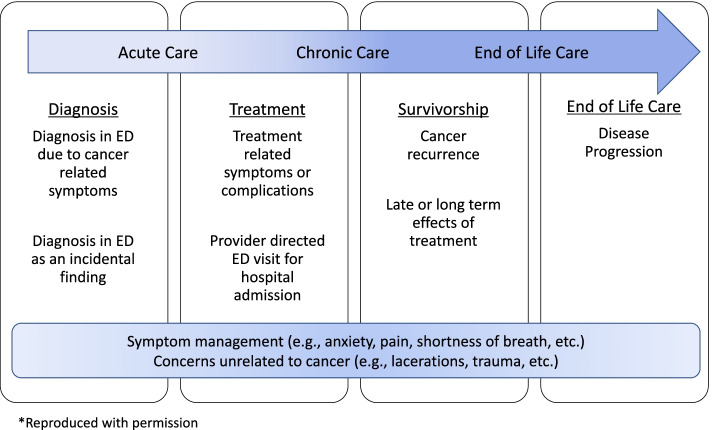
The global prevalence of cancer is rapidly increasing and will increase the acute care needs of patients with cancer, including emergency department (ED) care. Patients with cancer present to the ED across the cancer care continuum from diagnosis through treatment, survivorship, and end-of-life. This article describes the characteristics and determinants of ED visits, as well as challenges in the effort to define preventable ED visits in this population.
The most recent population-based estimates suggest 4% of all ED visits are cancer-related and roughly two thirds of these ED visits result in hospitalization-a 4-fold higher ED hospitalization rate than the general population. Approximately 44% of cancer patients visit the ED within 1 year of diagnosis, and more often have repeat ED visits within a short time frame, though there is substantial variability across cancer types. Similar patterns of cancer-related ED use are observed internationally across a range of different national payment and health system settings. ED use for patients with cancer likely reflects a complex interaction of individual and contextual factors-including provider behavior, health system characteristics, and health policies-that warrants greater attention in the literature.
Given the amount and complexity of cancer care delivered in the emergency setting, future research is recommended to examine specific symptoms associated with cancer-related ED visits, the contextual determinants of ED use, and definitions of preventable ED use specific to patients with cancer.
全球癌症患病率正在迅速上升,这将增加癌症患者的急性护理需求,包括急诊科护理。癌症患者在从诊断到治疗、生存以及临终的整个癌症护理过程中都会前往急诊科就诊。本文描述了急诊科就诊的特征和决定因素,以及在界定该人群中可预防的急诊科就诊方面所面临的挑战。
最新的基于人群的估计表明,所有急诊科就诊中有4%与癌症相关,其中约三分之二的急诊科就诊会导致住院治疗——这一急诊科住院率比普通人群高4倍。约44%的癌症患者在确诊后1年内会前往急诊科就诊,并且在短时间内更常出现再次急诊科就诊的情况,不过不同癌症类型之间存在很大差异。在国际上,在一系列不同的国家支付和卫生系统环境中都观察到了与癌症相关的急诊科就诊的类似模式。癌症患者使用急诊科的情况可能反映了个体因素和背景因素的复杂相互作用,包括医疗服务提供者的行为、卫生系统特征和卫生政策,而这在文献中值得更多关注。
鉴于在急诊环境中提供的癌症护理的数量和复杂性,建议未来的研究检查与癌症相关的急诊科就诊相关的特定症状、使用急诊科的背景决定因素,以及针对癌症患者的可预防的急诊科使用的定义。