Ndevahoma Fransina, Nkambule Bongani B, Dludla Phiwayinkosi V, Mukesi Munyaradzi, Natanael Kandiwapa N, Nyambuya Tawanda M
Department of Health Sciences Faculty of Health and Applied Sciences Namibia University of Science and Technology Windhoek Namibia.
School of Laboratory Medicine and Medical Sciences College of Health Sciences University of KwaZulu-Natal Durban South Africa.
EJHaem. 2021 Jul 6;2(3):357-365. doi: 10.1002/jha2.257. eCollection 2021 Aug.
To investigate the impact of inflammation on iron metabolism, cardiovascular risk and renal function in type 2 diabetes (T2D).
A total of 50 patients with T2D were included in this study. The patients were stratified into two groups based on their levels of C-reactive protein (CRP), namely normal and high levels ( = 25/group). All laboratory tests were measured using standardised methods.
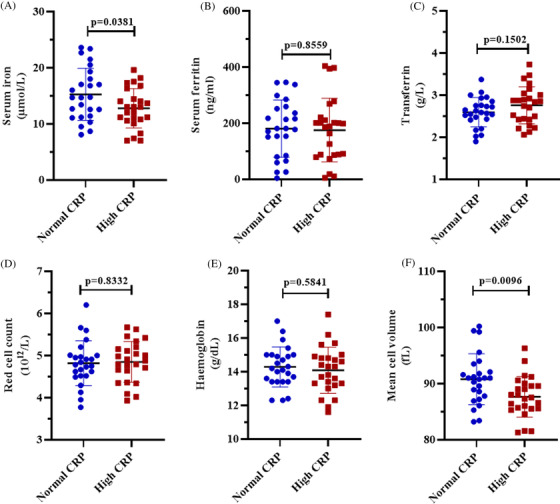
Fasting plasma glucose levels were elevated in patients with high CRP when compared to those with normal levels ( = 0.0413). Total serum iron levels were lower in patients with high CRP levels (12.78 ± 3.50) when compared to those with normal levels (15.26 ± 4.64), = 0.0381. However, ferritin and transferrin levels were comparable between the groups ( > 0.05). The mean cell volume (MCV) in the high CRP group was lower (87.66 ± 3.62) than the normal level group (90.79 ± 4.52), = 0.0096, whilst the lipograms were similar ( > 0.05). The estimated glomerular filtration rate (eGFR) was lower in the high CRP group (98.06 ± 11.64) than the normal level group (104.7 ± 11.11), = 0.046. Notably, CRP levels were negatively associated with serum iron levels ( = -0.38, = 0.0061), MCV ( = -0.41, = 0.0031), potassium ( = -0.37, = 0.0086) and sodium levels ( = -0.28, = 0.0471). Regression analyses showed that only CRP ( = -0.16, standard error [SE]: 0.06, = 0.0125) and sodium ( = 0.51, SE: 0.25, = 0.0434) levels contributed significantly to the prediction of serum iron levels.
Underlying inflammation in T2D is associated with increased incidence of hypertension and reduced levels of serum iron, MCV and renal function. Although there was no apparent clinical anaemia or renal dysfunction in these patients, mitigating inflammation may be effective in circumventing the ultimate development of iron deficiency anaemia and chronic kidney disease in T2D.
研究炎症对2型糖尿病(T2D)患者铁代谢、心血管风险及肾功能的影响。
本研究共纳入50例T2D患者。根据C反应蛋白(CRP)水平将患者分为两组,即正常水平组和高水平组(每组25例)。所有实验室检测均采用标准化方法。
与CRP正常水平患者相比,CRP高水平患者的空腹血糖水平升高(P = 0.0413)。CRP高水平患者的血清总铁水平(12.78 ± 3.50)低于正常水平患者(15.26 ± 4.64),P = 0.0381。然而,两组间铁蛋白和转铁蛋白水平相当(P > 0.05)。CRP高水平组的平均红细胞体积(MCV)(87.66 ± 3.62)低于正常水平组(90.79 ± 4.52),P = 0.0096,而血脂谱相似(P > 0.05)。CRP高水平组的估算肾小球滤过率(eGFR)(98.06 ± 11.64)低于正常水平组(104.7 ± 11.11),P = 0.046。值得注意的是,CRP水平与血清铁水平(P = -0.38,P = 0.0061)、MCV(P = -0.41,P = 0.0031)、钾(P = -0.37,P = 0.0086)和钠水平(P = -0.28,P = 0.0471)呈负相关。回归分析显示,只有CRP水平(P = -0.16,标准误[SE]:0.06,P = 0.0125)和钠水平(P = 0.51,SE:0.25,P = 0.0434)对血清铁水平的预测有显著贡献。
T2D患者潜在的炎症与高血压发病率增加以及血清铁、MCV和肾功能水平降低有关。尽管这些患者没有明显的临床贫血或肾功能障碍,但减轻炎症可能有效避免T2D患者最终发展为缺铁性贫血和慢性肾脏病。