Abrial Erika, Chalancon Benoît, Leaune Edouard, Brunelin Jérôme, Wallon Martine, Moll Frédéric, Barakat Nadine, Hoestlandt Benoit, Fourier Anthony, Simon Louis, Magnin Charline, Hermand Marianne, Poulet Emmanuel
Centre Hospitalier Le Vinatier, Bron, France.
INSERM U1028, CNRS UMR5292 Lyon Neuroscience Research Center, PSYR2 Team, Bron, France.
Front Psychiatry. 2022 Jun 29;13:916640. doi: 10.3389/fpsyt.2022.916640. eCollection 2022.
Suicide is the fourth leading cause of death in youth. Previous suicide attempts are among the strongest predictors of future suicide re-attempt. However, the lack of data and understanding of suicidal re-attempt behaviors in this population makes suicide risk assessment complex and challenging in clinical practice. The primary objective of this study is to determine the rate of suicide re-attempts in youth admitted to the emergency department after a first suicide attempt. The secondary objectives are to explore the clinical, socio-demographic, and biological risk factors that may be associated with re-attempted suicide in adolescents and young adults.
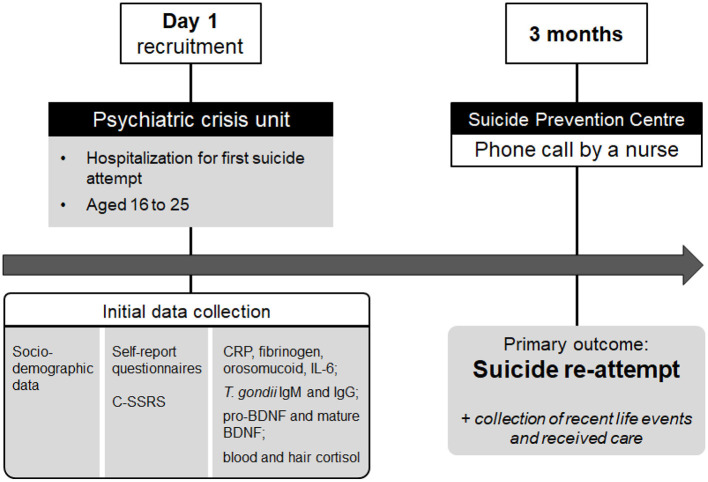
We have developed a single-center prospective and naturalistic study that will follow a cohort of 200 young people aged 16 to 25 years admitted for a first suicide attempt to the emergency department of Lyon, France. The primary outcome measure will be the incidence rate of new suicide attempts during 3 months of follow-up. Secondary outcomes to investigate predictors of suicide attempts will include several socio-demographic, clinical and biological assessments: blood and hair cortisol levels, plasma pro- and mature Brain-Derived Neurotrophic Factor (BDNF) isoforms proportion, previous infection with , and C-Reactive Protein (CRP), orosomucoid, fibrinogen, interleukin (IL)-6 inflammatory markers.
To our knowledge, the present study is the first prospective study specifically designed to assess the risk of re-attempting suicide and to investigate the multidimensional predictive factors associated with re-attempting suicide in youth after a first suicide attempt. The results of this study will provide a unique opportunity to better understand whether youth are an at-risk group for suicide re-attempts, and will help us identify predictive factors of suicide re-attempt risk that could be translated into clinical settings to improve psychiatric care in this population.
ClinicalTrials.gov, identifier: NCT03538197, first registered on 05/29/2018. The first patient was enrolled 05/22/2018.
自杀是青少年死亡的第四大主要原因。既往自杀未遂是未来自杀再次未遂的最强预测因素之一。然而,该人群中关于自杀再次未遂行为的数据匮乏且缺乏了解,这使得临床实践中的自杀风险评估复杂且具有挑战性。本研究的主要目的是确定首次自杀未遂后入住急诊科的青少年自杀再次未遂的发生率。次要目的是探索可能与青少年和青年成人自杀再次未遂相关的临床、社会人口学和生物学风险因素。
我们开展了一项单中心前瞻性自然研究,将对200名年龄在16至25岁之间、因首次自杀未遂入住法国里昂急诊科的年轻人进行随访。主要结局指标将是随访3个月期间新的自杀未遂发生率。用于调查自杀未遂预测因素的次要结局将包括多项社会人口学、临床和生物学评估:血液和头发皮质醇水平、血浆前体和成熟脑源性神经营养因子(BDNF)亚型比例、既往感染情况、C反应蛋白(CRP)、类黏蛋白、纤维蛋白原、白细胞介素(IL)-6炎症标志物。
据我们所知,本研究是第一项专门设计用于评估自杀再次未遂风险以及调查首次自杀未遂后青少年自杀再次未遂相关多维度预测因素的前瞻性研究。本研究结果将提供一个独特的机会,以更好地了解青少年是否为自杀再次未遂的高危人群,并将帮助我们识别自杀再次未遂风险的预测因素,这些因素可转化应用于临床环境,以改善该人群的精神科护理。
ClinicalTrials.gov,标识符:NCT03538197,于2018年5月29日首次注册。首例患者于2018年5月22日入组。