Su Yanbing, Zhang Jianxing, Wang Huanwei, Gu Yangkui, Ouyang Handong, Huang Wan
Sun Yat-sen University Cancer Center, State Key Laboratory of Oncology in South China, Collaborative Innovation Center for Cancer Medicine, Guangzhou, China.
Ann Transl Med. 2022 Jun;10(12):704. doi: 10.21037/atm-22-2756.
In the anesthesia management of percutaneous liver tumor ablation, the requirement of analgesia is very strict. Currently, intravenous anesthesia is commonly used, such as remifentanil combined with sedative drugs. However, the pain relief is not instantaneous after increasing the dosage of remifentanil. Esketamine, a medium- or long-term analgesic drug, does not inhibit respiration to maintain patient comfort during the ablation and reduces the consumption of remifentanil. Therefore, this experiment was designed to investigate the potential of combinational therapy and the most appropriate dose of esketamine.
A total of 120 patients were randomly divided into three groups by SPSS. The regular anesthesia model included dexmedetomidine 0.5 µg/kg, intravenous glucose tolerance test, remifentanil continuous infusion, flurbiprofen 50 mg, i.v., palonosetron 0.225 mg, i.v., and 1% lidocaine for local anesthesia. Group A was the regular control group, only using the regular model; Group B also received with 0.1 mg/kg esketamine, i.v.; and Group C also received 0.2 mg/kg esketamine, i.v.. The whole experiment was double-blind.
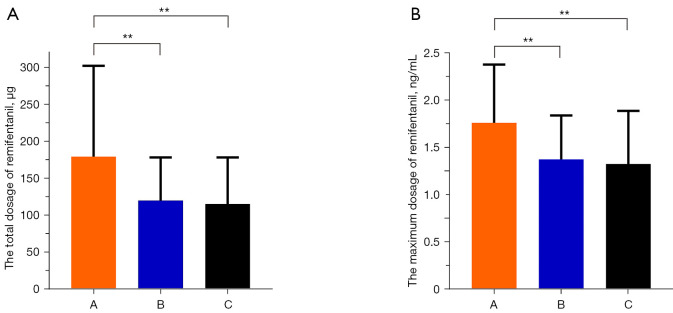
From December 2020 to March 2021, 120 patients were randomized in total, and 108 were included in the analysis: 36, 37, 35 were allocated to Group A, Group B, and Group C, respectively. The total dosage of remifentanil in Group A, Group B, Group C was 179.38±123.37, 120.31±57.96 and 115.91±62.42 µg, respectively. We found the total dosage of remifentanil in Group B and Group C were significantly decreased in comparison to that of Group A (P=0.004, P=0.003, respectively). The maximum dosage of remifentanil in Group A, Group B, and Group C was 1.76±0.62, 1.37±0.47, and 1.33±0.56 ng/mL, respectively. The maximum dosage of remifentanil in Group B and Group C were significantly decreased in comparison to that of Group A (P=0.003, P=0.001, respectively). The incidence of severe pain during the ablation in Group B was significantly lower than that in Group A (3 12, P<0.05).
The use of esketamine can reduce the dosage of opioids for liver tumor ablation and reduce the occurrence of severe pain. We found that 0.1 mg/kg esketamine, i.v. is the most suitable dose for liver tumor ablation.
Chinese Clinical Trial Registry ChiCTR2100049152.
在经皮肝肿瘤消融的麻醉管理中,镇痛要求非常严格。目前,静脉麻醉常用,如瑞芬太尼联合镇静药物。然而,增加瑞芬太尼剂量后疼痛缓解并非即刻起效。艾司氯胺酮是一种中长效镇痛药,在消融过程中不抑制呼吸以维持患者舒适度,并减少瑞芬太尼的用量。因此,本实验旨在研究联合治疗的潜力以及艾司氯胺酮的最合适剂量。
采用SPSS将120例患者随机分为三组。常规麻醉方案包括右美托咪定0.5μg/kg、静脉葡萄糖耐量试验、瑞芬太尼持续输注、氟比洛芬50mg静脉注射、帕洛诺司琼0.225mg静脉注射以及1%利多卡因局部麻醉。A组为常规对照组,仅采用常规方案;B组静脉注射0.1mg/kg艾司氯胺酮;C组静脉注射0.2mg/kg艾司氯胺酮。整个实验为双盲实验。
2020年12月至2021年3月,共随机纳入120例患者,108例纳入分析:分别有36、37、35例被分配至A组、B组和C组。A组、B组、C组瑞芬太尼总用量分别为179.38±123.37、120.31±57.96和115.91±62.42μg。我们发现,与A组相比,B组和C组瑞芬太尼总用量显著降低(分别为P = 0.004,P = 0.003)。A组、B组、C组瑞芬太尼最大用量分别为1.76±0.62、1.37±0.47和1.33±0.56ng/mL。与A组相比,B组和C组瑞芬太尼最大用量显著降低(分别为P = 0.003,P = 0.001)。B组消融过程中重度疼痛发生率显著低于A组(3/12,P < 0.05)。
使用艾司氯胺酮可减少肝肿瘤消融时阿片类药物的用量,并减少重度疼痛的发生。我们发现静脉注射0.1mg/kg艾司氯胺酮是肝肿瘤消融的最合适剂量。
中国临床试验注册中心ChiCTR2100049152 。