Key Laboratory of Neuroregeneration of Jiangsu and Ministry of Education, Co-Innovation Center of Neuroregeneration, National Medical Products Administration (NMPA) Key Laboratory for Research and Evaluation of Tissue Engineering Technology Products, Jiangsu Clinical Medicine Center of Tissue Engineering and Nerve Injury Repair, Nantong University, Nantong, China.
Department of Laboratory Medicine, Department of Endocrinology, Binhai County People's Hospital affiliated to Kangda College of Nanjing Medical University, Yancheng, China.
Front Endocrinol (Lausanne). 2022 Jun 30;13:917113. doi: 10.3389/fendo.2022.917113. eCollection 2022.
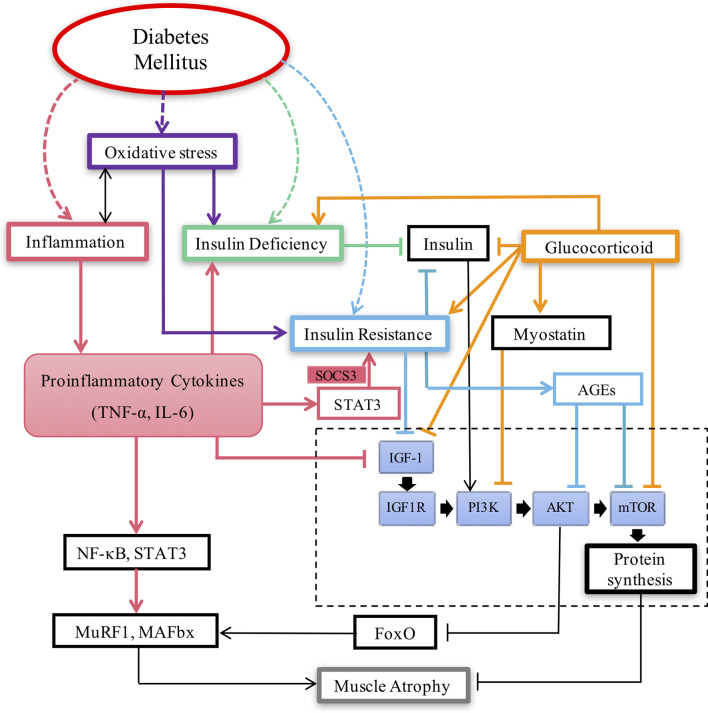
Diabetes mellitus (DM) is a typical chronic disease that can be divided into 2 types, dependent on insulin deficiency or insulin resistance. Incidences of diabetic complications gradually increase as the disease progresses. Studies in diabetes complications have mostly focused on kidney and cardiovascular diseases, as well as neuropathy. However, DM can also cause skeletal muscle atrophy. Diabetic muscular atrophy is an unrecognized diabetic complication that can lead to quadriplegia in severe cases, seriously impacting patients' quality of life. In this review, we first identify the main molecular mechanisms of muscle atrophy from the aspects of protein degradation and synthesis signaling pathways. Then, we discuss the molecular regulatory mechanisms of diabetic muscular atrophy, and outline potential drugs and treatments in terms of insulin resistance, insulin deficiency, inflammation, oxidative stress, glucocorticoids, and other factors. It is worth noting that inflammation and oxidative stress are closely related to insulin resistance and insulin deficiency in diabetic muscular atrophy. Regulating inflammation and oxidative stress may represent another very important way to treat diabetic muscular atrophy, in addition to controlling insulin signaling. Understanding the molecular regulatory mechanism of diabetic muscular atrophy could help to reveal new treatment strategies.
糖尿病(DM)是一种典型的慢性疾病,可以分为 2 种类型,依赖于胰岛素缺乏或胰岛素抵抗。随着疾病的进展,糖尿病并发症的发生率逐渐增加。糖尿病并发症的研究大多集中在肾脏和心血管疾病以及神经病变上。然而,DM 也会导致骨骼肌萎缩。糖尿病性肌肉萎缩是一种未被识别的糖尿病并发症,在严重情况下可导致四肢瘫痪,严重影响患者的生活质量。在这篇综述中,我们首先从蛋白降解和合成信号通路方面确定了肌肉萎缩的主要分子机制。然后,我们讨论了糖尿病性肌肉萎缩的分子调控机制,并概述了针对胰岛素抵抗、胰岛素缺乏、炎症、氧化应激、糖皮质激素和其他因素的潜在药物和治疗方法。值得注意的是,炎症和氧化应激与糖尿病性肌肉萎缩中的胰岛素抵抗和胰岛素缺乏密切相关。调节炎症和氧化应激可能代表治疗糖尿病性肌肉萎缩的另一种非常重要的方法,除了控制胰岛素信号之外。了解糖尿病性肌肉萎缩的分子调控机制有助于揭示新的治疗策略。