Gutman Ilanit, Gutman Ron, Sidney John, Chihab Leila, Mishto Michele, Liepe Juliane, Chiem Anthony, Greenbaum Jason, Yan Zhen, Sette Alessandro, Koşaloğlu-Yalçın Zeynep, Peters Bjoern
Center for Infectious Disease and Vaccine Research, La Jolla Institute for Immunology, La Jolla, California 92037-1387, United States.
Centre for Inflammation Biology and Cancer Immunology (CIBCI) & Peter Gorer Department of Immunobiology, King's College London, London SE1 1UL, U.K.
ACS Omega. 2022 Jun 27;7(27):23771-23781. doi: 10.1021/acsomega.2c02425. eCollection 2022 Jul 12.
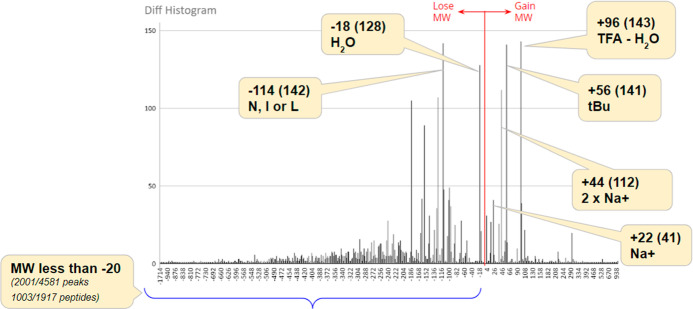
Synthetic peptides are commonly used in biomedical science for many applications in basic and translational research. While peptide synthesis is generally easy and reliable, the chemical nature of some amino acids as well as the many steps and chemical compounds involved can render the synthesis of some peptide sequences difficult. Identification of these problematic sequences and mitigation of issues they may present can be important for the reliable use of peptide reagents in several contexts. Here, we assembled a large dataset of peptides that were synthesized using standard Fmoc chemistry and whose identity was validated using mass spectrometry. We analyzed the mass spectra to identify errors in peptide syntheses and sought to develop a computational tool to predict the likelihood that any given peptide sequence would be synthesized accurately. Our model, named Peptide Synthesis Score (PepSySco), is able to predict the likelihood that a peptide will be successfully synthesized based on its amino acid sequence.
合成肽在生物医学科学中常用于基础研究和转化研究的许多应用。虽然肽合成通常简单可靠,但某些氨基酸的化学性质以及所涉及的许多步骤和化合物可能会使某些肽序列的合成变得困难。识别这些有问题的序列并缓解它们可能出现的问题对于在多种情况下可靠地使用肽试剂可能很重要。在这里,我们收集了一个使用标准Fmoc化学合成的肽的大型数据集,其身份通过质谱法进行了验证。我们分析了质谱以识别肽合成中的错误,并试图开发一种计算工具来预测任何给定肽序列准确合成的可能性。我们的模型名为肽合成评分(PepSySco),能够根据其氨基酸序列预测肽成功合成的可能性。