Battalio Samuel L, Pfammatter Angela F, Kershaw Kiarri N, Hernandez Alexis, Conroy David E, Spring Bonnie
Department of Preventive Medicine, Northwestern University Feinberg School of Medicine, Chicago, IL, United States.
Department of Kinesiology, The Pennsylvania State University (PSU), University Park, PA, United States.
Front Digit Health. 2022 Jun 30;4:821049. doi: 10.3389/fdgth.2022.821049. eCollection 2022.
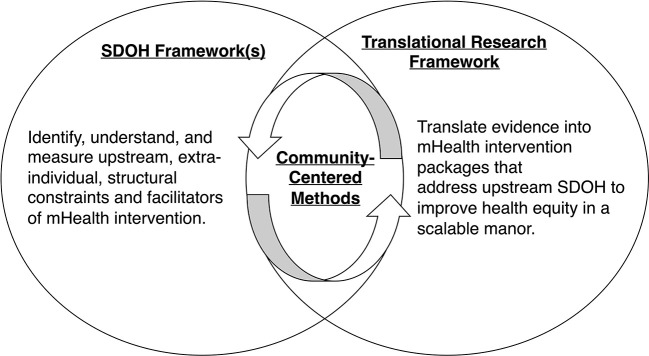
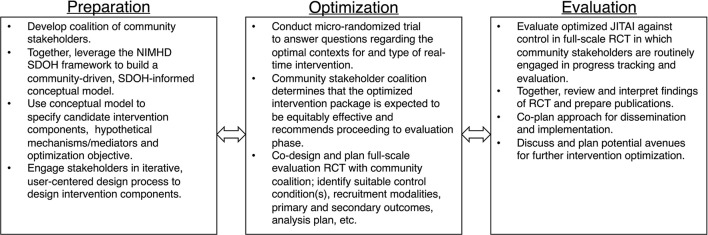
Although US tobacco use trends show overall improvement, social disadvantage continues to drive significant disparities. Traditional tobacco cessation interventions and public policy initiatives have failed to equitably benefit socially-disadvantaged populations. Advancements in mobile digital technologies have created new opportunities to develop resource-efficient mobile health (mHealth) interventions that, relative to traditional approaches, have greater reach while still maintaining comparable or greater efficacy. Their potential for affordability, scalability, and efficiency gives mHealth tobacco cessation interventions potential as tools to help redress tobacco use disparities. We discuss our perspectives on the state of the science surrounding mHealth tobacco cessation interventions for use by socially-disadvantaged populations. In doing so, we outline existing models of health disparities and social determinants of health (SDOH) and discuss potential ways that mHealth interventions might be optimized to offset or address the impact of social determinants of tobacco use. Because smokers from socially-disadvantaged backgrounds face multi-level barriers that can dynamically heighten the risks of tobacco use, we discuss cutting-edge mHealth interventions that adapt dynamically based on context. We also consider complications and pitfalls that could emerge when designing, evaluating, and implementing mHealth tobacco cessation interventions for socially-disadvantaged populations. Altogether, this perspective article provides a conceptual foundation for optimizing mHealth tobacco cessation interventions for the socially-disadvantaged populations in greatest need.
尽管美国的烟草使用趋势总体上有所改善,但社会劣势仍然导致了显著的差异。传统的戒烟干预措施和公共政策举措未能公平地惠及社会弱势群体。移动数字技术的进步创造了新的机会,可开发资源高效的移动健康(mHealth)干预措施,相对于传统方法,这些措施覆盖面更广,同时仍能保持相当或更高的效果。其在可负担性、可扩展性和效率方面的潜力使移动健康戒烟干预措施有潜力成为帮助消除烟草使用差异的工具。我们讨论了围绕针对社会弱势群体的移动健康戒烟干预措施的科学现状的观点。在此过程中,我们概述了现有的健康差异模型和健康的社会决定因素(SDOH),并讨论了优化移动健康干预措施以抵消或解决烟草使用的社会决定因素影响的潜在方法。由于来自社会弱势背景的吸烟者面临多层次的障碍,这些障碍会动态增加烟草使用的风险,我们讨论了基于情境动态适应的前沿移动健康干预措施。我们还考虑了在为社会弱势群体设计、评估和实施移动健康戒烟干预措施时可能出现的并发症和陷阱。总之,这篇观点文章为优化针对最需要帮助的社会弱势群体的移动健康戒烟干预措施提供了概念基础。