Department of Evolution, Ecology and Behavior, University of Illinois, Urbana Champaign, 515 Morrill Hall, 505 S Goodwin Ave, Urbana, IL, 61801.
Evolution. 2022 Sep;76(9):2076-2088. doi: 10.1111/evo.14557. Epub 2022 Jul 25.
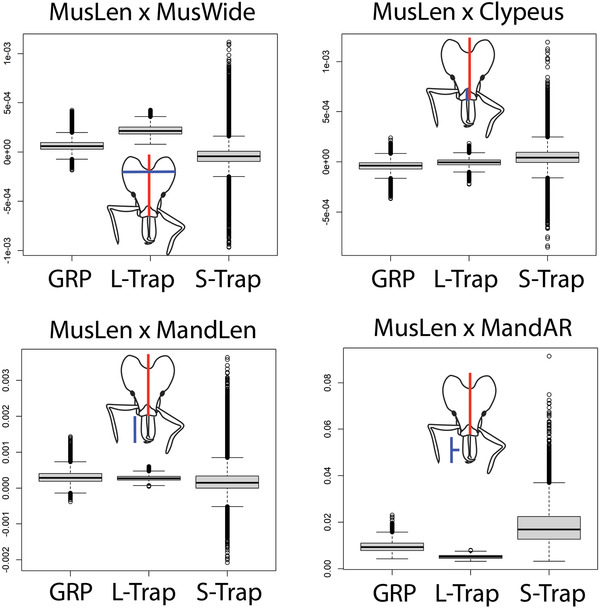
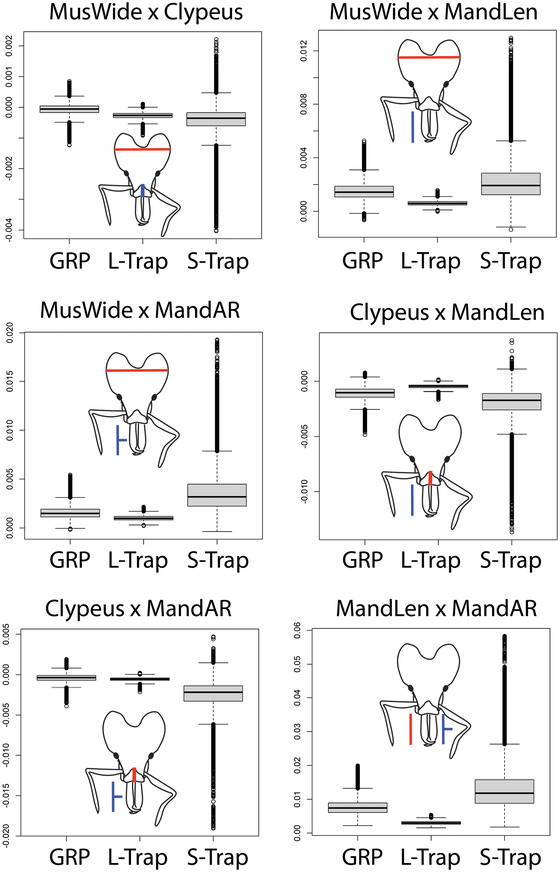
A long-standing question in comparative biology is how the evolution of biomechanical systems influences morphological evolution. The need for functional fidelity implies that the evolution of such systems should be associated with tighter morphological covariation, which may promote or dampen rates of morphological evolution. I examine this question across multiple evolutionary origins of the trap-jaw mechanism in the genus Strumigenys. Trap-jaw ants have latch-mediated, spring-actuated systems that amplify the power output of their mandibles. I use Bayesian estimates of covariation and evolutionary rates to test the hypotheses that the evolution of this high-performance system is associated with tighter morphological covariation in the head and mandibles relative to nontrap-jaw forms and that this leads to shifts in rates of morphological evolution. Contrary to these hypotheses, there is no evidence of a large-scale shift to higher covariation in trap-jaw forms, while different traits show both increased and decreased evolutionary rates between forms. These patterns may be indicative of many-to-one mapping and/or mechanical sensitivity in the trap-jaw LaMSA system. Overall, it appears that the evolution of trap-jaw forms in Strumigenys did not require a correlated increase in morphological covariation, partly explaining the proclivity with which the system has evolved.
长期以来,比较生物学领域一直存在一个问题,即生物力学系统的进化如何影响形态进化。功能保真度的需要意味着这些系统的进化应该与更紧密的形态协同进化相关联,这可能会促进或抑制形态进化的速度。我在 Strumigenys 属的多个陷阱颚机制的进化起源中检验了这个问题。陷阱颚蚂蚁具有由闩锁介导的弹簧驱动系统,可放大其下颚的功率输出。我使用协变和进化率的贝叶斯估计来检验以下假设:与非陷阱颚形式相比,这种高性能系统的进化与头部和下颚的形态协同进化更为紧密,这导致形态进化的速度发生变化。与这些假设相反,没有证据表明陷阱颚形式的协变程度有较大幅度的提高,而不同的特征在形式之间表现出增加和减少的进化率。这些模式可能表明在陷阱颚 LaMSA 系统中存在多对一映射和/或机械敏感性。总体而言,Strumigenys 中陷阱颚形式的进化似乎并不需要形态协同进化的相关性增加,这部分解释了该系统进化的倾向。