West China Biomedical Big Data Center, West China Hospital, Sichuan University, Chengdu, China.
Med-X Center for Informatics, Sichuan University, Chengdu, China.
Am J Clin Nutr. 2022 Sep 2;116(3):730-740. doi: 10.1093/ajcn/nqac148.
Habitual coffee consumption has been associated with multiple health benefits. A comprehensive analysis of disease trajectory and comorbidity networks in relation to coffee consumption is, however, currently lacking.
We aimed to comprehensively examine the health outcomes associated with habitual coffee consumption, through clarifying its disease trajectory and comorbidity networks.
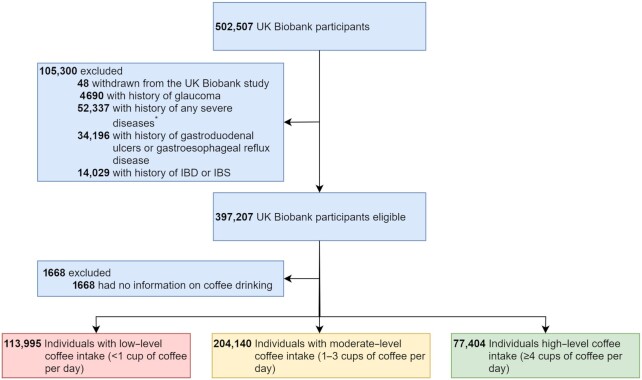
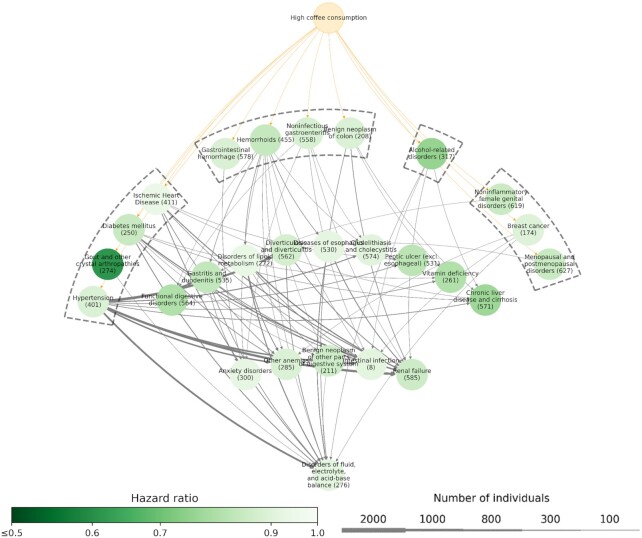
Based on the UK Biobank cohort, we included 395,539 individuals with available information on coffee intake collected at recruitment between 2006 and 2010. These individuals were categorized as having low (<1 cup per day), moderate (1-3 cups), and high (≥4 cups) levels of coffee intake, and were followed through 2020 to ascertain 496 medical conditions. Cox regression was used to assess the associations between high-level coffee intake and the risk of medical conditions with a prevalence ≥0.5% in the study population, after adjusting for multiple confounders, using low-level coffee intake as the reference. Disease-trajectory and comorbidity network analyses were then applied to visualize the temporal and nontemporal relationships between the medical conditions that had an inverse association with high-level coffee intake.
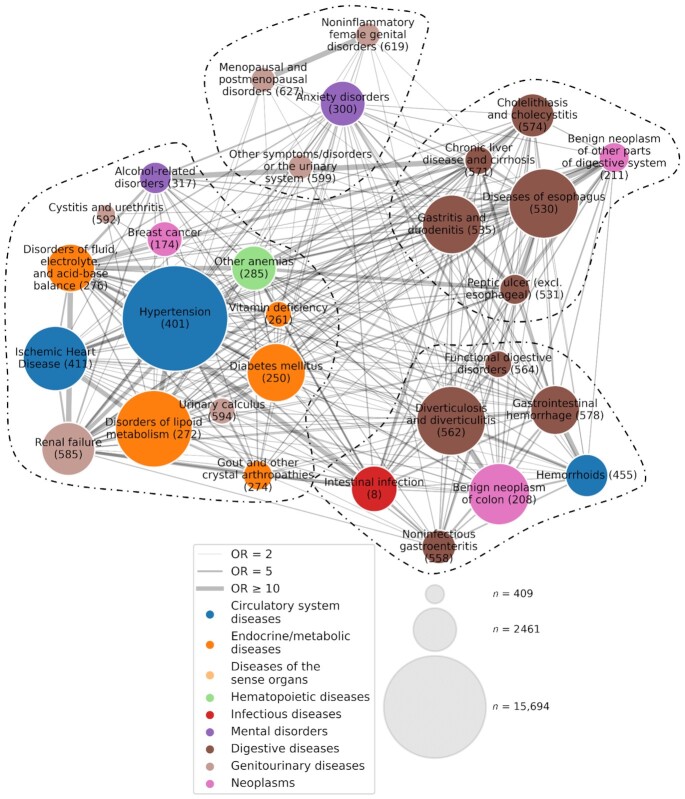
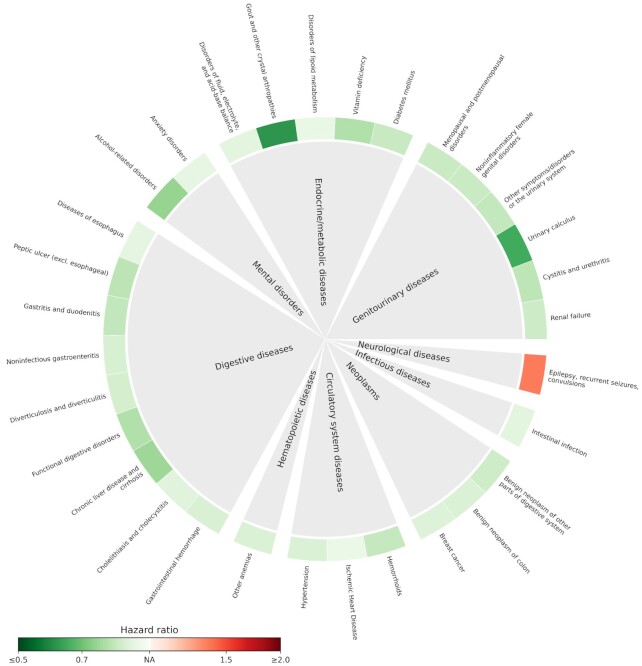
During a median follow-up of 11.8 years, 31 medical conditions were found to be associated with high-level coffee intake, among which 30 showed an inverse association (HRs ranged from 0.61 to 0.94). The inverse associations were more pronounced for women, compared with men. Disease-trajectory and comorbidity network analyses of these 30 conditions identified 4 major clusters of medical conditions, mainly in the cardiometabolic and gastrointestinal systems, among both men and women; 1 cluster of medical conditions following alcohol-related disorders, primarily among men; as well as a cluster of estrogen-related conditions among women.
Habitual coffee consumption was associated with lower risks of many medical conditions, especially those in the cardiometabolic and gastrointestinal systems and those related to alcohol use and estrogen regulation.
习惯性喝咖啡与多种健康益处有关。然而,目前缺乏对与咖啡消费相关的疾病轨迹和合并症网络的全面分析。
我们旨在通过阐明咖啡消费的疾病轨迹和合并症网络,全面研究与习惯性咖啡消费相关的健康结果。
基于英国生物库队列,我们纳入了 395539 名在 2006 年至 2010 年招募期间有咖啡摄入量信息的个体。这些个体被分为低(<1 杯/天)、中(1-3 杯)和高(≥4 杯)咖啡摄入量水平,并随访至 2020 年,以确定 496 种医疗状况。使用 Cox 回归评估高水平咖啡摄入与研究人群中患病率≥0.5%的医疗状况之间的关联,在调整了多个混杂因素后,以低水平咖啡摄入作为参考。然后应用疾病轨迹和合并症网络分析来可视化与高水平咖啡摄入呈负相关的医疗状况之间的时间和非时间关系。
在中位数为 11.8 年的随访期间,发现 31 种医疗状况与高水平咖啡摄入相关,其中 30 种呈负相关(HR 范围为 0.61 至 0.94)。与男性相比,女性的负相关更为明显。对这 30 种疾病的疾病轨迹和合并症网络分析,在男女两性中均确定了 4 个主要的医疗状况集群,主要在心血管代谢和胃肠道系统中;1 个以酒精相关障碍为主的集群,主要在男性中;以及女性中的雌激素相关疾病集群。
习惯性喝咖啡与许多医疗状况的风险降低有关,特别是心血管代谢和胃肠道系统以及与酒精使用和雌激素调节相关的疾病。