
RA 信号通路与 Wnt 信号通路共同调控人诱导多能干细胞(hiPSCs)向窦房结样细胞分化。
RA signaling pathway combined with Wnt signaling pathway regulates human-induced pluripotent stem cells (hiPSCs) differentiation to sinus node-like cells.
机构信息
Department of Cardiology, Renmin Hospital of Wuhan University, 238 Jiefang Road, Wuchang, Wuhan, 430060, Hubei, People's Republic of China.
Cardiovascular Research Institute, Wuhan University, Wuhan, 430060, People's Republic of China.
出版信息
Stem Cell Res Ther. 2022 Jul 18;13(1):324. doi: 10.1186/s13287-022-03006-8.
BACKGROUND
The source of SAN is debated among researchers. Many studies have shown that RA and Wnt signaling are involved in heart development. In this study, we investigated the role of retinoic acid (RA) and Wnt signaling in the induction of sinus node-like cells.
METHODS
The experimental samples were divided into four groups: control group (CHIR = 0), CHIR = 3, RA + CHIR = 0 andRA + CHIR = 3. After 20 days of differentiation, Western blot, RT-qPCR, immunofluorescence and flow cytometry were performed to identify sinus node-like cells. Finally, whole-cell patch clamp technique was used to record pacing funny current and action potential (AP) in four groups.
RESULTS
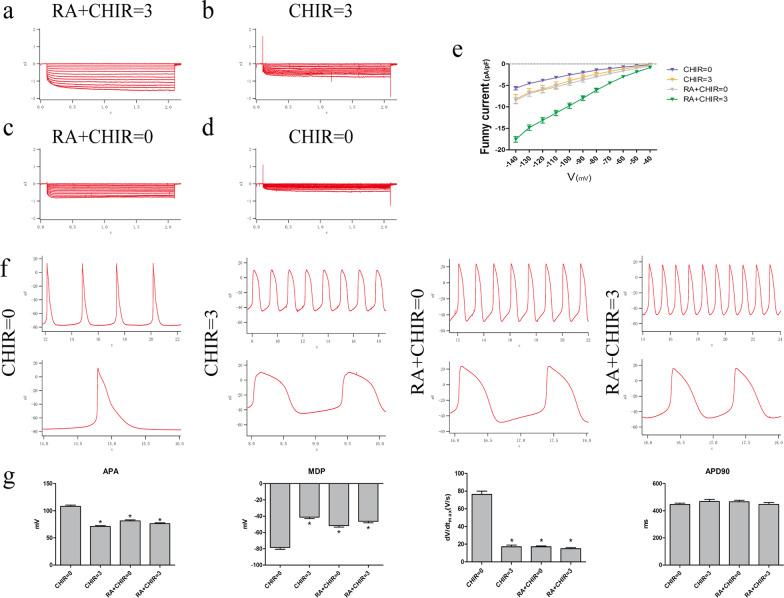
The best intervention method used in our experiment was RA = 0.25 µmol/L D5-D9 + CHIR = 3 µmol/L D5-D7. Results showed that CHIR can increase the expression of ISL-1 and TBX3, while RA mainly elevated Shox2. Immunofluorescence assay and flow cytometry further illustrated that combining RA with CHIR can induce sinus node-like cells (CTNTShox2Nkx2.5). Moreover, CHIR might reduce the frequency of cell beats, but in conjunction with RA could partly compensate for this side effect. Whole cell patch clamps were able to record funny current and the typical sinus node AP in the experimental group, which did not appear in the control group.
CONCLUSIONS
Combining RA with Wnt signaling within a specific period can induce sinus node-like cells.
背景
窦房结(SAN)的起源一直是研究者们争论的焦点。许多研究表明,RA 和 Wnt 信号通路参与了心脏发育。在本研究中,我们研究了维甲酸(RA)和 Wnt 信号通路在诱导窦房结样细胞中的作用。
方法
实验样本分为四组:对照组(CHIR=0)、CHIR=3、RA+CHIR=0 和 RA+CHIR=3。分化 20 天后,通过 Western blot、RT-qPCR、免疫荧光和流式细胞术鉴定窦房结样细胞。最后,采用全细胞膜片钳技术记录四组起搏电流和动作电位(AP)。
结果
实验中最佳干预方法为 RA=0.25μmol/L D5-D9+CHIR=3μmol/L D5-D7。结果表明,CHIR 可增加 ISL-1 和 TBX3 的表达,而 RA 主要提高 Shox2 的表达。免疫荧光和流式细胞术进一步表明,RA 与 CHIR 联合可诱导窦房结样细胞(CTNT+Shox2+Nkx2.5)。此外,CHIR 可能降低细胞跳动的频率,但与 RA 联合使用可部分弥补这种副作用。全细胞膜片钳可记录实验组的起搏电流和典型的窦房结 AP,而对照组则没有。
结论
在特定时间段内联合使用 RA 和 Wnt 信号可诱导窦房结样细胞。




 Zotero 插件