Department of Cardiology, Keio University School of Medicine, Tokyo, Japan.
Department of Cardiology, National Hospital Organization Tokyo Medical Center, Tokyo, Japan.
Europace. 2023 Feb 8;25(1):83-91. doi: 10.1093/europace/euac108.
The usefulness of catheter ablation (CA) for atrial fibrillation (AF) across a broad spectrum of heart failure (HF) patients remains to be established. We assessed the association of CA with both health-related quality of life (QoL) and cardiovascular events among HF patients with reduced and preserved left ventricular ejection fraction (LVEF) in an 'all-comer' outpatient-based AF registry.
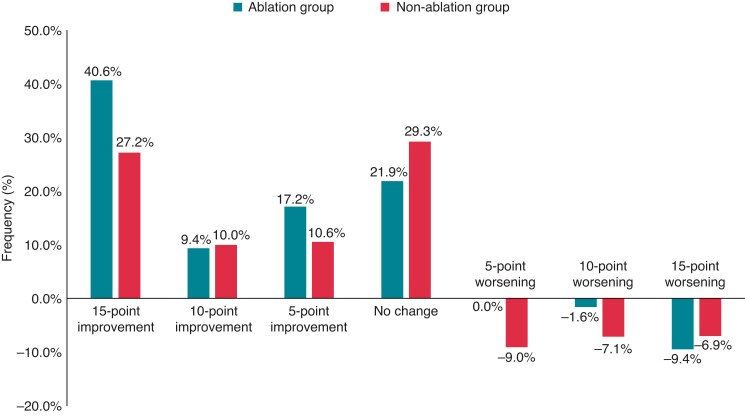
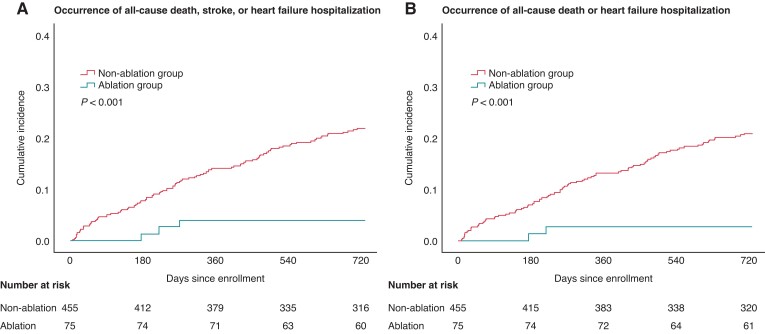
Of 3303 patients with AF consecutively enrolled in a retrospective multicentre registry that mandated the Atrial Fibrillation Effect on QualiTy-of-life (AFEQT) questionnaire at registration and 1-year follow-up, we extracted data from 530 patients complicating clinical HF. The association between CA and both 1-year change in AFEQT Overall Summary (AFEQT-OS) scores and 2-year composite clinical outcomes (including all-cause death, stroke, and HF hospitalization) was assessed by multivariable analyses. The median duration of AF was 108 days (52-218 days), and 83.4% had LVEF >35%. Overall, 75 patients (14.2%) underwent CA for AF within 1-year after registration. At 1-year follow-up, 67.2% in the ablation group showed clinically meaningful improvements of ≥ 5 points in AFEQT-OS score than 47.8% in the non-ablation group {adjusted odds ratio, 2.03 [95% confidence interval (CI): 1.13-3.64], P = 0.017}. Furthermore, the composite endpoint of all-cause death, stroke, and HF hospitalization occurred less frequently in the ablation group than the non-ablation group [adjusted hazard ratio, 0.27 (95% CI: 0.09-0.86), P = 0.027].
Among AF-HF patients, CA was associated with improved QoL and lower risk of cardiovascular events against drug therapy alone, even for patients with mildly reduced and preserved LVEF.
在广泛的心力衰竭(HF)患者人群中,导管消融(CA)治疗心房颤动(AF)的有效性仍有待确定。我们评估了在一个“所有患者”的门诊 AF 注册研究中,CA 对射血分数降低和保留的 HF 患者的健康相关生活质量(QoL)和心血管事件的影响。
在一项回顾性多中心注册研究中,连续纳入了 3303 例 AF 患者,该研究要求在登记和 1 年随访时填写房颤对生活质量的影响(AFEQT)问卷,我们从 530 例合并临床 HF 的患者中提取数据。通过多变量分析评估了 CA 与 1 年 AFEQT 总体综合评分(AFEQT-OS)变化和 2 年复合临床结局(包括全因死亡、卒中和 HF 住院)之间的关系。AF 的中位持续时间为 108 天(52-218 天),83.4%的患者射血分数>35%。总的来说,在登记后 1 年内,75 例(14.2%)患者因 AF 接受 CA。在 1 年随访时,消融组中有 67.2%的患者 AFEQT-OS 评分较基线改善≥5 分,而非消融组为 47.8%(调整后的优势比,2.03[95%可信区间(CI):1.13-3.64],P=0.017)。此外,与非消融组相比,消融组全因死亡、卒中和 HF 住院的复合终点发生率较低[调整后的风险比,0.27(95%CI:0.09-0.86),P=0.027]。
在 AF-HF 患者中,与单纯药物治疗相比,CA 不仅可改善 QoL,还可降低心血管事件风险,甚至对射血分数轻度降低和保留的患者也有效。