Karl Landsteiner University of Health Sciences, Dr. Karl-Dorrek-Straße 30, 3500, Krems, Austria.
Department of Neurology, University Hospital St. Pölten, Dunant-Platz 1, 3100, St. Pölten, Austria.
J Neurol. 2022 Nov;269(11):6129-6138. doi: 10.1007/s00415-022-11271-z. Epub 2022 Jul 19.
Rotational thromboelastometry (ROTEM) records whole blood coagulation in vitro. Data on dynamic changes of clot patterns during intravenous thrombolysis (IVT) in acute ischemic stroke is scarce. We investigated the feasibility of ROTEM as a potential point-of-care assessment tool for IVT.
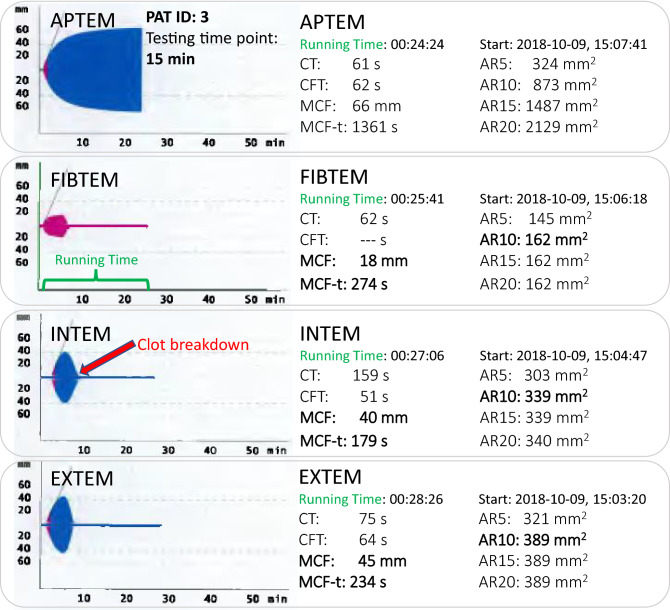
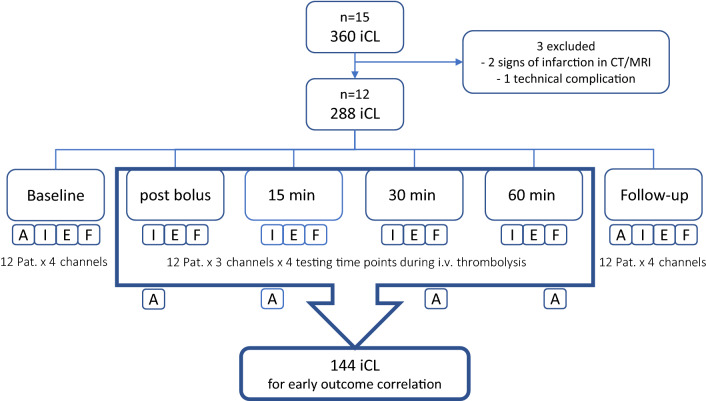
In this prospective pilot study, patients with acute stroke symptoms received IVT. Whole blood coagulation was tracked on the ROTEM analyzer. Blood samples were analyzed before, and then 2, 15, 30 and 60 min after beginning IVT. In vitro clots (iCLs) were described by their maximum clot firmness (MCF), the time needed to reach MCF (MCF-t), as well as the area under the curve (AR10). National Institutes of Health Stroke Scale (NIHSS) was used as early clinical outcome parameter.
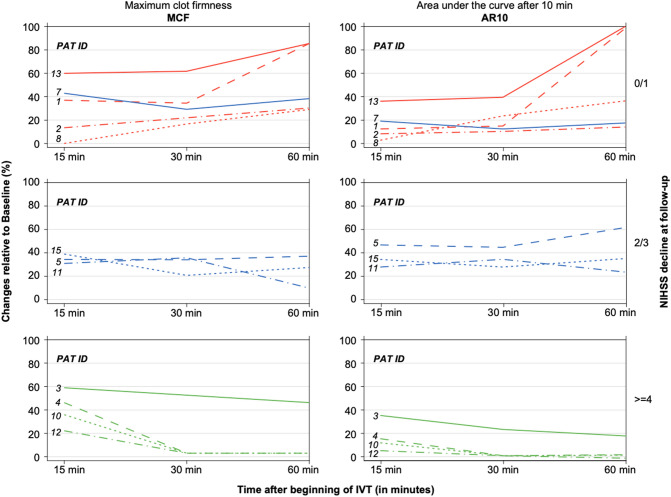
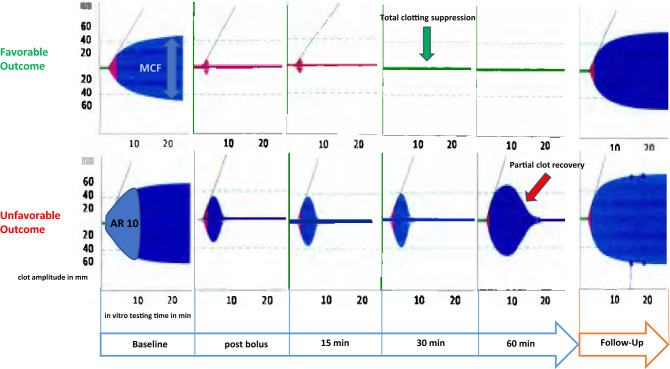
We analyzed 288 iCLs from 12 patients undergoing IVT. In all iCLs, an early fibrinolysis (91% within the first 10 min) was detected during IVT. Three different curve progression patterns were observed: a low-responder pattern with a continuous clot increase, a high-responder pattern with a sustained clot decrease or total clotting suppression and an intermediate-responder pattern with alternating clot characteristics. There was a difference among these groups in early clinical outcome (AR10 and MCF each p = 0.01, MCF-t p = 0.02, Kruskal-Wallis Test).
The fibrinolysis patterns determined using ROTEM allow for the monitoring of IVT in patients with acute ischemic stroke. This pilot study found a correlation between the in vitro fibrinolysis patterns and early clinical outcomes. These findings support a potential for individualization of IVT in the future.
旋转血栓弹性测定仪(ROTEM)记录体外全血凝血。关于急性缺血性脑卒中静脉溶栓(IVT)过程中凝块模式动态变化的数据很少。我们研究了 ROTEM 作为 IVT 即时护理评估工具的可行性。
在这项前瞻性试点研究中,急性脑卒中症状的患者接受 IVT。使用 ROTEM 分析仪跟踪全血凝血。在开始 IVT 之前、之后 2、15、30 和 60 分钟分析血液样本。体外凝块(iCL)通过其最大凝块硬度(MCF)、达到 MCF 所需的时间(MCF-t)以及曲线下面积(AR10)来描述。国立卫生研究院卒中量表(NIHSS)被用作早期临床结局参数。
我们分析了 12 名接受 IVT 的患者的 288 个 iCL。在所有 iCL 中,在 IVT 期间均检测到早期纤维蛋白溶解(91%在 10 分钟内)。观察到三种不同的曲线进展模式:低反应者模式,即持续增加凝块;高反应者模式,即持续减少凝块或完全抑制凝血;以及中间反应者模式,即凝块特征交替。这些组之间在早期临床结局方面存在差异(AR10 和 MCF 均 p=0.01,MCF-t p=0.02,Kruskal-Wallis 检验)。
使用 ROTEM 确定的纤维蛋白溶解模式可监测急性缺血性脑卒中患者的 IVT。这项初步研究发现,体外纤维蛋白溶解模式与早期临床结局之间存在相关性。这些发现支持未来 IVT 个体化的潜力。