Discovery Pharmacology Department, Kamakura Research Division, Chugai Pharmaceutical Co., Ltd., 200 Kajiwara, Kamakura, Kanagawa, 247-8530, Japan.
Translational Research Division, Chugai Pharmaceutical Co., Ltd., 1-1 Nihonbashi-Muromachi 2-Chome, Chuo-ku, Tokyo, 103-8324, Japan.
Sci Rep. 2022 Jul 19;12(1):12312. doi: 10.1038/s41598-022-16564-x.
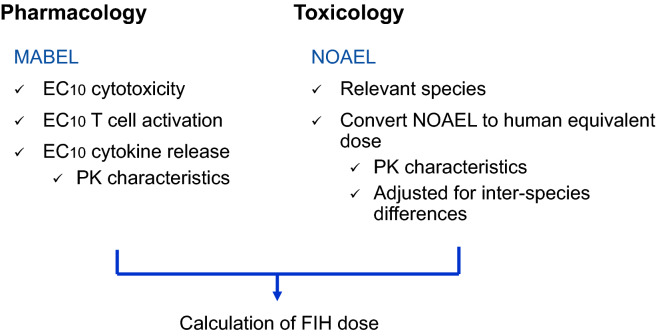
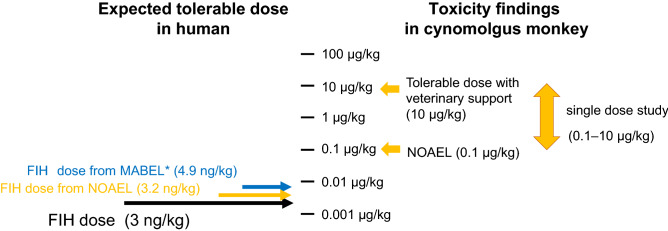
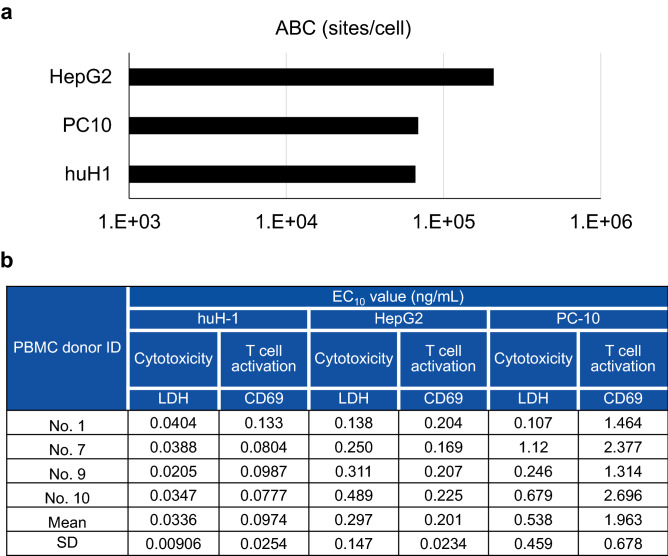
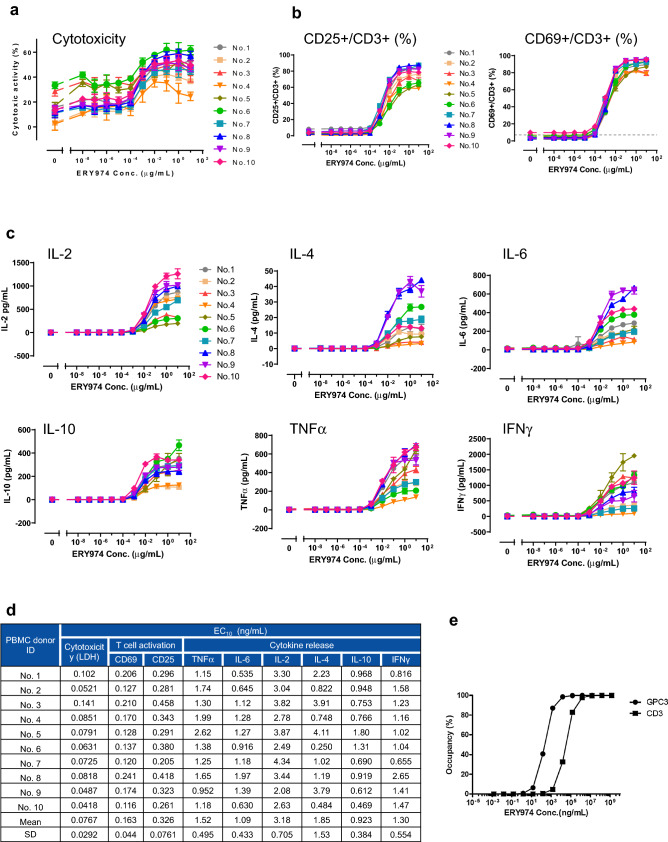
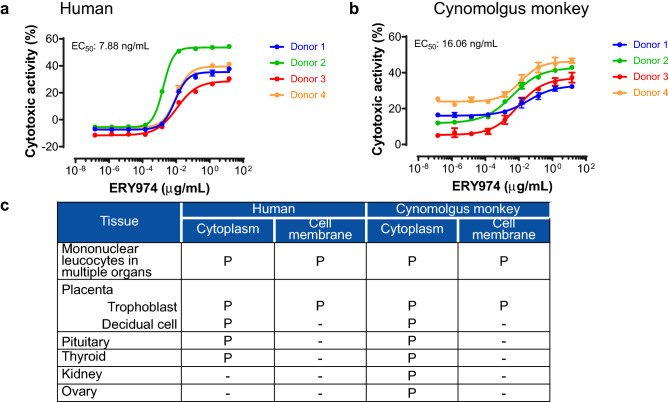
Currently, ERY974, a humanized IgG4 bispecific T cell-redirecting antibody recognizing glypican-3 and CD3, is in phase I clinical trials. After a first-in-human clinical trial of an anti-CD28 agonist monoclonal antibody resulting in severe life-threatening adverse events, the minimal anticipated biological effect level approach has been considered for determining the first-in-human dose of high-risk drugs. Accordingly, we aimed to determine the first-in-human dose of ERY974 using both the minimal anticipated biological effect level and no observed adverse effect level approaches. In the former, we used the 10% effective concentration value from a cytotoxicity assay using the huH-1 cell line with the highest sensitivity to ERY974 to calculate the first-in-human dose of 4.9 ng/kg, at which maximum drug concentration after 4 h of intravenous ERY974 infusion was equal to the 10% effective concentration value. To determine the no observed adverse effect level, we conducted a single-dose study in cynomolgus monkeys that were intravenously infused with ERY974 (0.1, 1, and 10 μg/kg). The lowest dose of 0.1 μg/kg was determined as the no observed adverse effect level, and the first-in-human dose of 3.2 ng/kg was calculated, considering body surface area and species difference. For the phase I clinical trial, we selected 3.0 ng/kg as a starting dose, which was lower than the first-in-human dose calculated from both the no observed adverse effect level and minimal anticipated biological effect level. Combining these two methods to determine the first-in-human dose of strong immune modulators such as T cell-redirecting antibodies would be a suitable approach from safety and efficacy perspectives.Clinical trial registration: JapicCTI-194805/NCT05022927.
目前,一种识别磷脂酰聚糖-3 和 CD3 的人源化 IgG4 双特异性 T 细胞重定向抗体 ERY974 正在进行 I 期临床试验。在一项抗 CD28 激动剂单克隆抗体的首次人体临床试验导致严重危及生命的不良事件后,人们考虑采用最低预期生物学效应水平方法来确定高风险药物的首次人体剂量。因此,我们旨在使用最低预期生物学效应水平和无观察到不良效应水平方法来确定 ERY974 的首次人体剂量。在前一种方法中,我们使用对 ERY974 最敏感的 huH-1 细胞系的细胞毒性测定中的 10%有效浓度值来计算首次人体剂量 4.9ng/kg,在此剂量下,静脉内输注 4 小时后最大药物浓度等于 10%有效浓度值。为了确定无观察到不良效应水平,我们在静脉内输注 ERY974(0.1、1 和 10μg/kg)的食蟹猴中进行了单次剂量研究。确定最低剂量 0.1μg/kg 为无观察到不良效应水平,并考虑到体表面积和种间差异,计算出首次人体剂量 3.2ng/kg。在 I 期临床试验中,我们选择 3.0ng/kg 作为起始剂量,低于从无观察到不良效应水平和最低预期生物学效应水平计算出的首次人体剂量。从安全性和疗效的角度来看,将这两种方法结合起来确定 T 细胞重定向抗体等强免疫调节剂的首次人体剂量是一种合适的方法。临床试验注册:JapicCTI-194805/NCT05022927。