Robinson Myranda B, Shin Peter, Alunday Robert, Cole Chad, Torbey Michel T, Carlson Andrew P
Departments of Neurosurgery and.
Neurology, University of New Mexico School of Medicine, Albuquerque, New Mexico.
J Neurosurg Case Lessons. 2021 Jun 21;1(25):CASE2197. doi: 10.3171/CASE2197.
Severe traumatic brain injury (TBI) requires individualized, physiology-based management to avoid secondary brain injury. Recent improvements in quantitative assessments of metabolism, oxygenation, and subtle examination changes may potentially allow for more targeted, rational approaches beyond simple intracranial pressure (ICP)-based management. The authors present a case in which multimodality monitoring assisted in decision-making for decompressive craniectomy.
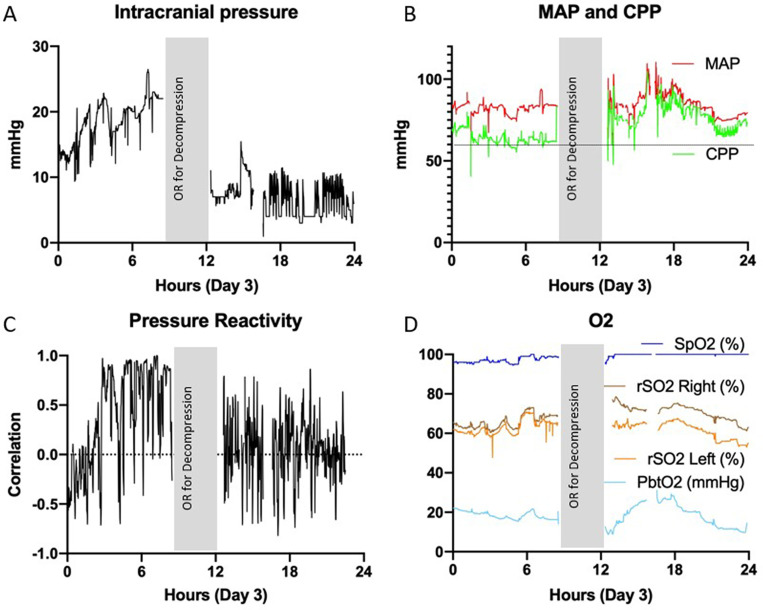
This patient sustained a severe TBI without mass lesion and was monitored with a multimodality approach. Although imaging did not seem grossly worrisome, ICP, pressure reactivity, brain tissue oxygenation, and pupillary response all began worsening, pushing toward decompressive craniectomy. All parameters normalized after decompression, and the patient had a satisfactory clinical outcome.
Given recent conflicting randomized trials on the utility of decompressive craniectomy in severe TBI, precision, physiology-based approaches may offer an improved strategy to determine who is most likely to benefit from aggressive treatment. Trials are underway to test components of these strategies.
重型颅脑损伤(TBI)需要个体化的、基于生理学的管理,以避免继发性脑损伤。近期在代谢、氧合定量评估以及细微检查变化方面的进展,可能使我们能够采用超越基于单纯颅内压(ICP)管理的更具针对性、更合理的方法。作者介绍了一个多模态监测辅助减压性颅骨切除术决策的病例。
该患者遭受了无占位性病变的重型TBI,并采用多模态方法进行监测。尽管影像学检查似乎没有明显令人担忧的情况,但颅内压、压力反应性、脑组织氧合和瞳孔反应均开始恶化,促使考虑进行减压性颅骨切除术。减压后所有参数均恢复正常,患者临床结局良好。
鉴于近期关于减压性颅骨切除术在重型TBI中效用的随机试验结果相互矛盾,基于精确生理学的方法可能提供一种改进策略,以确定谁最有可能从积极治疗中获益。目前正在进行试验以测试这些策略的组成部分。