Soyama Shigeto, Matsuda Ryosuke, Hontsu Shigeto, Ando Satsuki, Tatsumi Saori, Kitamura Tetsuro, Nakagawa Ichiro, Kido Akira, Nakase Hiroyuki
Department of Medical Technology Center, Nara Medical University, Kashihara, Japan.
Department of Neurosurgery, Nara Medical University, Kashihara, Japan.
Surg Neurol Int. 2022 Jul 1;13:280. doi: 10.25259/SNI_500_2022. eCollection 2022.
Prosopagnosia is a rare form of apraxia, in which a person has normal memory and vision, but has impaired cognition of human faces that are manifested through symptoms such as not being able to recognize the face of a familiar person, one has known or not being able to remember the face of a person. Here, we report the case of a patient with transient prosopagnosia associated with brain metastasis from epidermal growth factor receptor (EGFR)-mutated lung adenocarcinoma who was treated with tyrosine kinase inhibitors (TKIs).
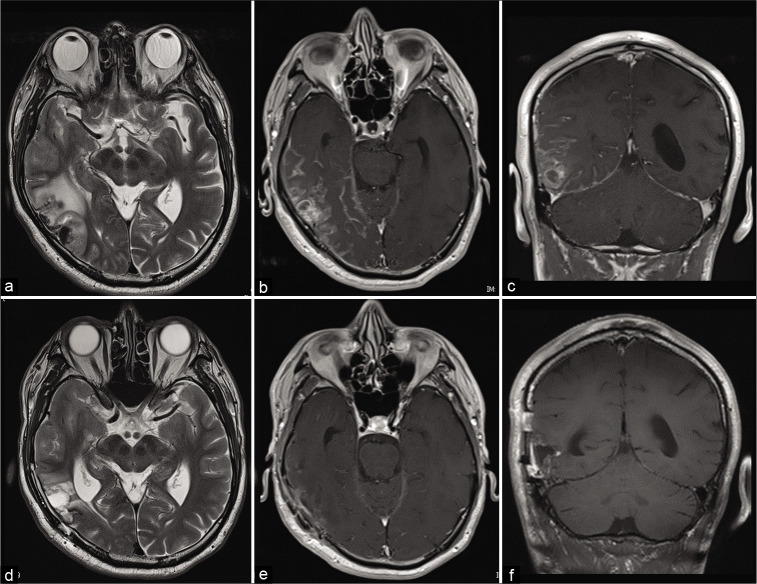
A 52-year-old right-handed man with lung adenocarcinoma was introduced to our department because brain metastasis. On admission, he complained that he could not recognize his wife's face, but he could recall her face based on her voice. MRI revealed a right temporo-occipital enhancing lesion with perifocal edema and dissemination that were indicative of brain metastasis from lung adenocarcinoma. Two weeks after open biopsy, he was started on TKI therapy with osimertinib at a dosage of 80 mg/day. An MRI scan taken 1 month later revealed shrinkage of the metastasis. In addition, he had recovered from transient prosopagnosia and returned to normal life.
In this study, the TKI osimertinib was administered to a patient with brain metastasis of EGFR-mutated lung adenocarcinoma who presented with prosopagnosia, and the patient's lesion shrunk and his symptoms were reversed with this treatment.
面孔失认症是一种罕见的失用症形式,患者记忆力和视力正常,但对面孔的认知受损,表现为无法识别熟人的面孔、记不起某人的面孔等症状。在此,我们报告一例患有短暂性面孔失认症的患者,该患者因表皮生长因子受体(EGFR)突变的肺腺癌脑转移接受酪氨酸激酶抑制剂(TKIs)治疗。
一名52岁右利手男性因肺腺癌脑转移入住我科。入院时,他抱怨无法识别妻子的面孔,但能根据声音回忆起她的面容。磁共振成像(MRI)显示右侧颞枕叶强化病灶伴灶周水肿及播散,提示肺腺癌脑转移。开放活检两周后,他开始接受奥希替尼80毫克/天的TKI治疗。1个月后进行的MRI扫描显示转移灶缩小。此外,他已从短暂性面孔失认症中康复并恢复正常生活。
在本研究中,对一名患有EGFR突变肺腺癌脑转移且伴有面孔失认症的患者给予TKI奥希替尼治疗,该患者的病灶缩小且症状因该治疗而逆转。