Yamada Shuhei, Kijima Noriyuki, Kinoshita Manabu, Shinzaki Shinichiro, Sato Kazuaki, Kido Kansuke, Hirayama Ryuichi, Kagawa Naoki, Takehara Tetsuo, Morii Eiichi, Kishima Haruhiko
Department of Neurosurgery, Graduate School of Medicine, Suita, Osaka, Japan.
Department of Gastroenterology and Hepatology, Graduate School of Medicine, Suita, Osaka, Japan.
Surg Neurol Int. 2022 Jun 23;13:264. doi: 10.25259/SNI_117_2022. eCollection 2022.
Neuroendocrine tumors (NETs) are uncommon neoplasms arising from neuroendocrine cells and are rarely associated with intracranial metastases.
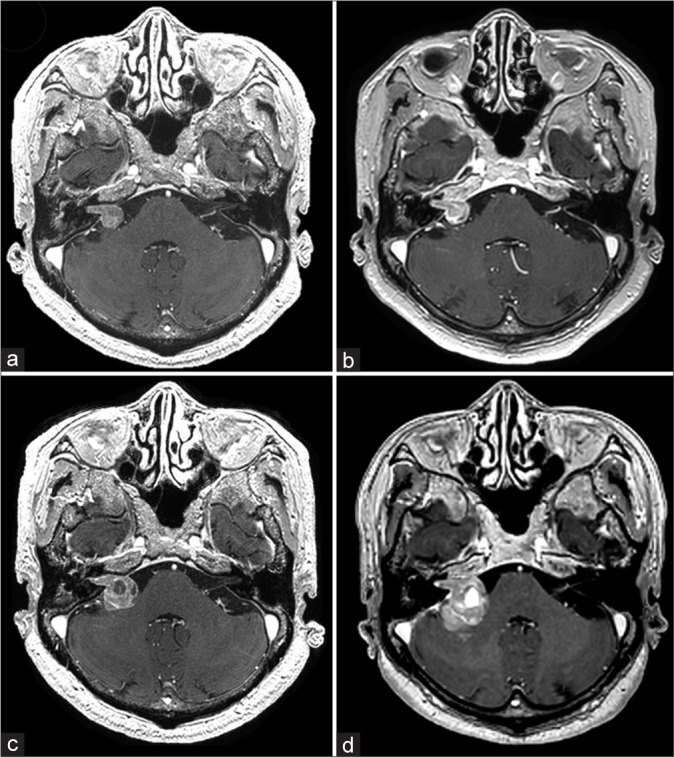
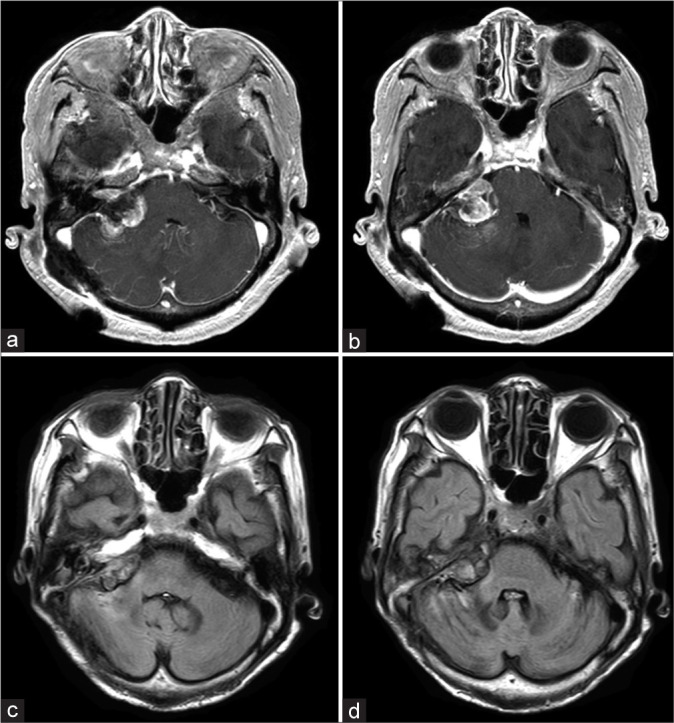
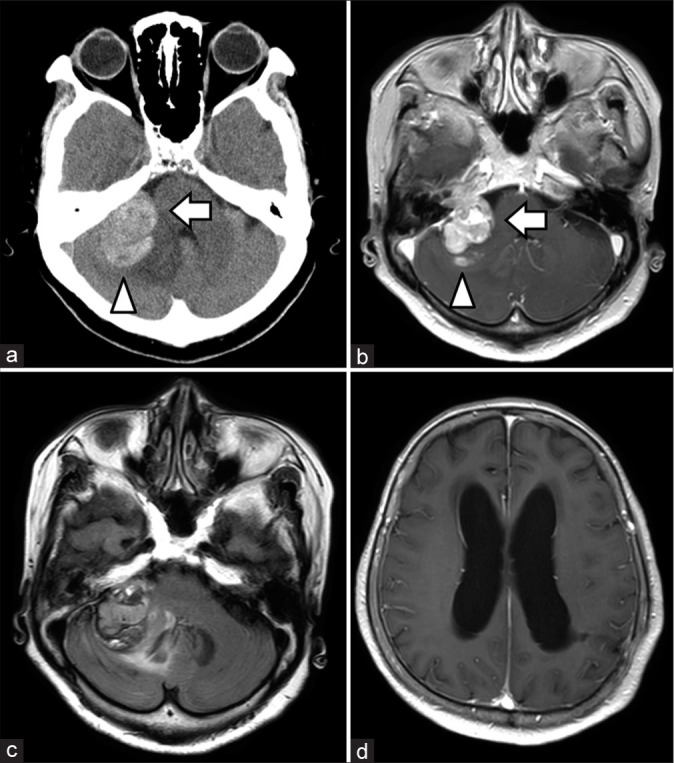
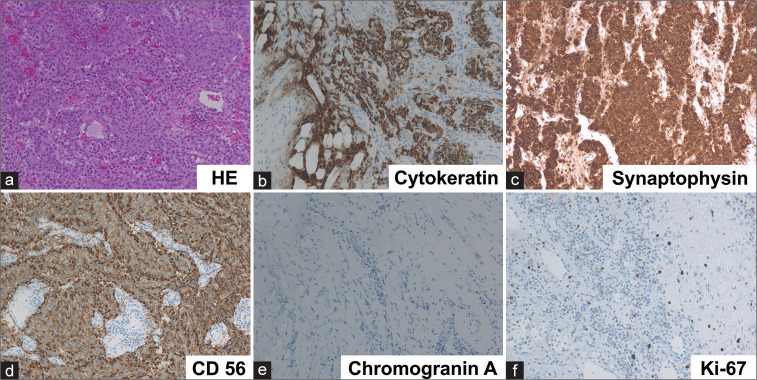
We discuss the case of a 74-year-old woman with a right CPA tumor. She had a history of retroperitoneal NET, but was diagnosed with vestibular schwannoma due to a right-sided hearing loss and a right CPA tumor along the VII and VIII nerves. After a 3-year follow-up, she presented with repetitive vomiting, a 1-month history of gait instability, and a 3-month history of general fatigue. Brain imaging revealed tumor growth and edematous changes in the right cerebellum. She underwent retrosigmoid craniotomy and partial resection. Histopathological examination revealed metastatic NET. She underwent stereotactic radiosurgery for residual lesion and, at 11 months of follow-up, the lesion was confirmed to have shrunk on magnetic resonance imaging (MRI).
This is the first case to report the natural course of cerebellopontine metastasis of a NET. The differential diagnosis of CPA tumors is diverse, and, in our case, we suspected a vestibular schwannoma because of the typical symptoms and imaging features. However, the tumor grew relatively faster than expected and showed intratumoral hemorrhage during the 3-year follow-up. Therefore, in patients with a history of a NET, a careful follow-up is advisable even for lesions highly suspected to be another benign tumor on MRI. Careful follow-up imaging and appropriate treatment strategies were useful to manage the brain metastasis. Although NETs metastasizing to the CPA are extremely rare, this possibility should be considered when patients with NETs have intracranial lesions.
神经内分泌肿瘤(NETs)是起源于神经内分泌细胞的罕见肿瘤,很少发生颅内转移。
我们讨论一名74岁患有右侧桥小脑角(CPA)肿瘤的女性病例。她有腹膜后NET病史,但因右侧听力丧失以及沿第VII和第VIII神经的右侧CPA肿瘤而被诊断为前庭神经鞘瘤。经过3年随访,她出现反复呕吐、1个月的步态不稳病史以及3个月的全身乏力病史。脑部影像学检查显示右侧小脑肿瘤生长及水肿改变。她接受了乙状窦后开颅术及部分切除术。组织病理学检查显示为转移性NET。她接受了立体定向放射外科治疗残余病灶,在随访11个月时,磁共振成像(MRI)证实病灶缩小。
这是首例报告NET小脑桥脑转移自然病程的病例。CPA肿瘤的鉴别诊断多种多样,在我们的病例中,由于典型症状和影像学特征,我们怀疑是前庭神经鞘瘤。然而,在3年随访期间,肿瘤生长速度相对比预期快,并出现瘤内出血。因此,对于有NET病史的患者,即使MRI上高度怀疑为另一种良性肿瘤的病灶,也建议进行仔细随访。仔细的随访影像学检查和适当的治疗策略有助于处理脑转移。尽管转移至CPA的NET极其罕见,但当NET患者出现颅内病变时,应考虑这种可能性。