Van Der Veken Jorn, Harding Marguerite, Hatami Saba, Agzarian Marc, Vrodos Nick
Neurosurgery Department and.
South Australia Medical Imaging, Flinders Medical Centre, Bedford Park, South Australia, Australia; and.
J Neurosurg Case Lessons. 2021 Sep 13;2(11):CASE21341. doi: 10.3171/CASE21341.
Chiari Type I malformation (CM1) is a disorder recognized by caudal displacement of the cerebellar tonsils through the foramen magnum and into the cervical canal. Syringomyelia is frequently found in patients with CM1, but the pathophysiology of syringomyelia remains an enigma. As a general consensus, symptomatic patients should be treated and asymptomatic patients without a syrinx should not be treated. Mildly symptomatic patients or asymptomatic patients with a syrinx, on the other hand, pose a more challenging dilemma, as the natural evolution is uncertain. For many surgeons, the presence of a syrinx is an indication to offer surgery even if the patient is asymptomatic or mildly symptomatic.
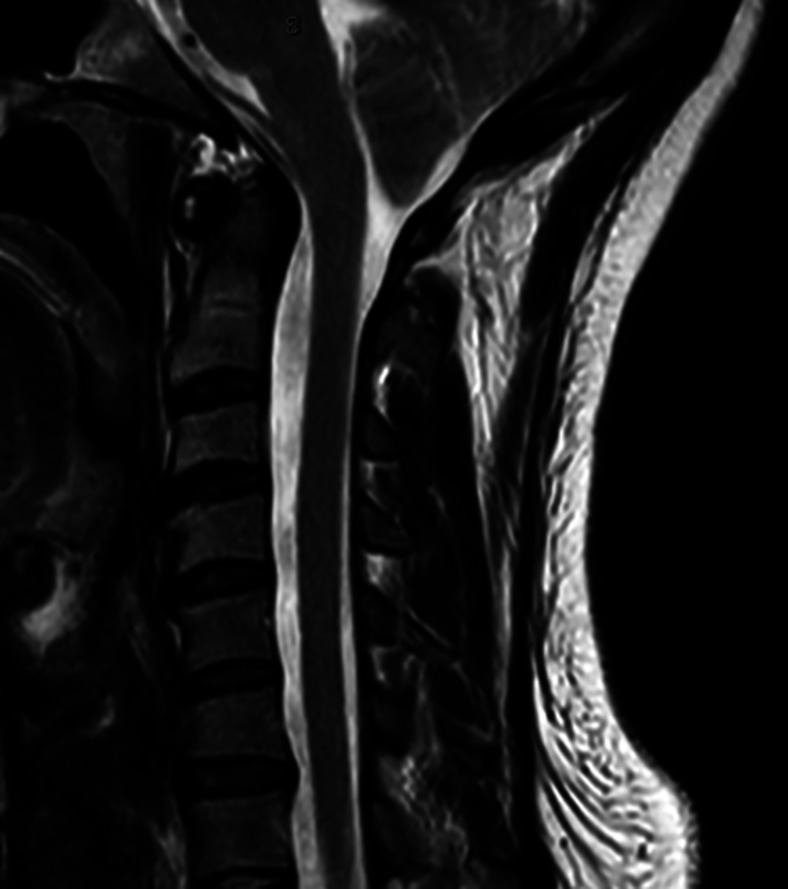
The authors describe an illustrative case of a 31-year-old female with an incidental finding of a CM1 malformation and cervical syrinx in 2013. Conservative management was advocated as the patient was asymptomatic. Monitoring of the syrinx over a course of 8 years showed resolution, followed by reappearance and finally a complete resolution in 2021. A review of the literature and the possible pathophysiology is discussed.
The unusual course of this patient highlights the importance of guiding treatment by clinical symptoms, not radiological findings. Furthermore it reflects the complexity of the pathophysiology and the uncertain natural history of syringomyelia.
Chiari I型畸形(CM1)是一种因小脑扁桃体经枕骨大孔向尾侧移位并进入颈椎管而被识别的疾病。脊髓空洞症在CM1患者中很常见,但其病理生理学仍然是个谜。普遍的共识是,有症状的患者应接受治疗,而没有脊髓空洞症的无症状患者不应接受治疗。另一方面,症状轻微的患者或有脊髓空洞症的无症状患者则带来了更具挑战性的困境,因为其自然演变情况尚不确定。对于许多外科医生来说,即使患者无症状或症状轻微,脊髓空洞症的存在也是进行手术的一个指征。
作者描述了一个具有代表性的病例,一名31岁女性在2013年偶然发现患有CM1畸形和颈椎脊髓空洞症。由于患者无症状,故主张采取保守治疗。在8年的时间里对脊髓空洞症进行监测,结果显示其先消失,随后再次出现,最终在2021年完全消失。本文还讨论了对相关文献的回顾以及可能的病理生理学机制。
该患者的异常病程突出了以临床症状而非影像学检查结果来指导治疗的重要性。此外,它还反映了脊髓空洞症病理生理学的复杂性以及其自然病史的不确定性。