
脑线粒体功能障碍:一种可能的机制,将早年焦虑与晚年阿尔茨海默病联系起来。
Brain Mitochondrial Dysfunction: A Possible Mechanism Links Early Life Anxiety to Alzheimer's Disease in Later Life.
作者信息
Wang Qixue, Lu Mengna, Zhu Xinyu, Gu Xinyi, Zhang Ting, Xia Chenyi, Yang Li, Xu Ying, Zhou Mingmei
机构信息
1Institute for Interdisciplinary Medicine Sciences, Shanghai University of Traditional Chinese Medicine, Shanghai, China.
4Shanghai Frontiers Science Center of TCM Chemical Biology, Institute of Interdisciplinary Integrative Medicine Research, Shanghai University of Traditional Chinese Medicine, Shanghai, China.
出版信息
Aging Dis. 2022 Jul 11;13(4):1127-1145. doi: 10.14336/AD.2022.0221.
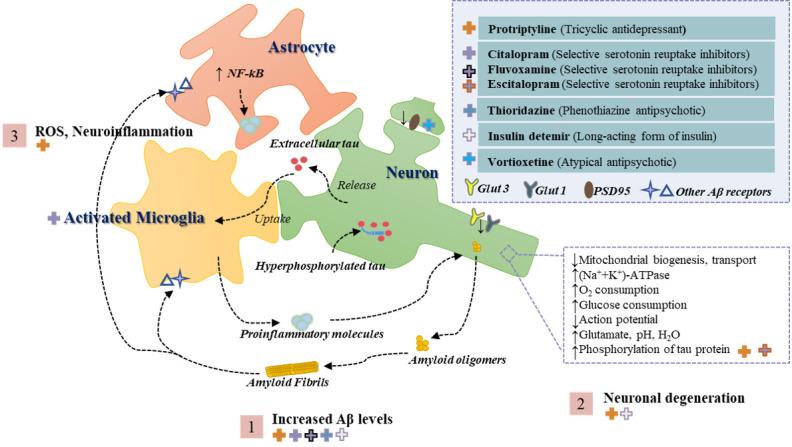
Alzheimer's disease (AD) is usually manifested in patients with dementia, accompanied by anxiety and other mental symptoms. Emerging evidence from humans indicates that people who suffer from anxiety in their early life are more likely to develop AD in later life. Mitochondria, the prominent organelles of energy production in the brain, have crucial physiological significance for the brain, requiring considerable energy to maintain its normal physiological activities. Net reactive oxygen species (ROS) was produced by mitochondrial impairment, in which oxidative stress is also included, and the production of ROS is mostly more than that of removal. In this paper, we propose that as a critical process in brain pathology, mitochondrial dysfunction caused by anxiety triggering oxidative stress might be a possible mechanism that links early life anxiety to AD in later life. Several pivotal physiological roles of mitochondria are reviewed, including functions regulating glucose homeostasis, which may disrupt in oxidative stress. Increased levels of oxidative stress are constantly shown in anxiety disorder patients, and antioxidant drugs have promise in treating anxiety. In the early stages of AD, mitochondrial dysfunction is concentrated around senile plaques, a landmark lesion composed of aggregated Aβ and Tau protein. In turn, the accumulated Aβ and Tau disrupts mitochondrial activity, and the tricky physiological processes of mitochondria might be significant to the course of AD. In the end, we conclude that mitochondria might present as one of the novel therapeutic targets to block oxidative stress in patients with anxiety disorders to prevent AD in the early stage.
阿尔茨海默病(AD)通常在患有痴呆症的患者中表现出来,伴有焦虑和其他精神症状。来自人类的新证据表明,早年患有焦虑症的人在晚年更有可能患上AD。线粒体是大脑中产生能量的主要细胞器,对大脑具有至关重要的生理意义,维持其正常生理活动需要相当多的能量。线粒体损伤会产生净活性氧(ROS),其中也包括氧化应激,并且ROS的产生大多超过其清除。在本文中,我们提出,作为脑病理学中的一个关键过程,由焦虑引发氧化应激导致的线粒体功能障碍可能是将早年焦虑与晚年AD联系起来的一种可能机制。本文回顾了线粒体的几个关键生理作用,包括调节葡萄糖稳态的功能,而这一功能在氧化应激中可能会受到破坏。焦虑症患者体内的氧化应激水平持续升高,抗氧化药物在治疗焦虑方面具有前景。在AD的早期阶段,线粒体功能障碍集中在老年斑周围,老年斑是由聚集的Aβ和Tau蛋白组成的标志性病变。反过来,积累的Aβ和Tau会破坏线粒体活性,而线粒体复杂的生理过程可能对AD的病程具有重要意义。最后,我们得出结论,线粒体可能作为一种新的治疗靶点,用于阻断焦虑症患者的氧化应激,以在早期预防AD。
 Zotero 插件