Department of Internal Medicine, Hanyang University, College of Medicine, 222, Wangsimni-ro, Seongdong-gu, Seoul, Republic of Korea.
Department of Statistics and Actuarial Science, Soongsil University, 369, Sangdo-Ro, Dongjak-Gu, Seoul, Republic of Korea.
Alzheimers Res Ther. 2021 Jan 5;13(1):9. doi: 10.1186/s13195-020-00758-4.
Insulin resistance is suggested to have negative effects on cognition; however, results from large population studies are lacking. In this study, the potential relationships between the triglyceride glucose (TyG) index, a simple surrogate marker of insulin resistance, and dementia were evaluated using a large-scale population dataset.
This was a retrospective, observational, cohort study using data from the National Health Information Database from 2009 to 2015 and included 5,586,048 participants 40 years age or older. The TyG index was used as a measure of insulin resistance, and participants were divided into quartiles based on TyG index. The incidence of dementia was assessed using hazard ratios (HRs) estimated with Cox proportional hazard modeling.
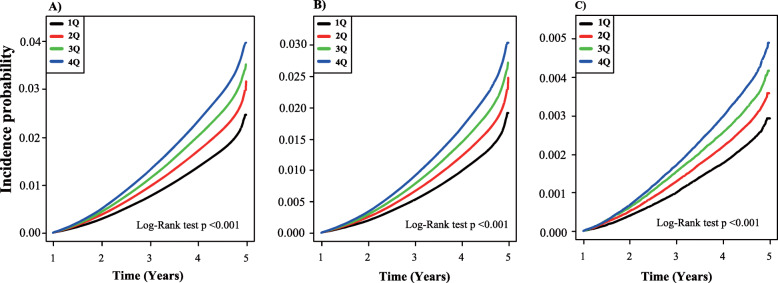
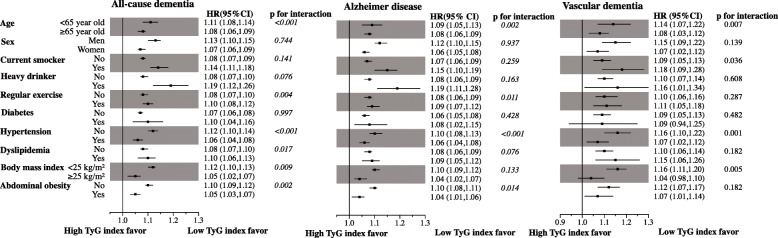
During a median follow-up of 7.21 years, dementia was diagnosed in 142,714 (2.55%) participants. Alzheimer's disease (AD) and vascular dementia (VD) were diagnosed in 74.3% and 12.5% of the participants. Multivariate-adjusted HRs for patients in the TyG index 4th quartile were higher for dementia (HRs = 1.14; 95% confidence interval [CI] 1.12-1.16), AD (HRs = 1.12; 95% CI 1.09-1.14), and VD (HRs = 1.18; 95% CI 1.12-1.23) compared with the 1st quartile of TyG index; however, this had a small effect size (Cohen's d = 0.10, 0.08, and 0.13, respectively). These effects were independent of age, sex, smoking status, physical activity, body mass index, systolic blood pressure, and total cholesterol.
In this large population study, TyG index was associated with an increased risk of dementia, including AD and VD, that was independent of traditional cardiovascular risk factors, although the effect size of the TyG index was small.
胰岛素抵抗被认为对认知有负面影响,但缺乏来自大型人群研究的结果。在这项研究中,使用大型人群数据集评估了甘油三酯-葡萄糖(TyG)指数作为胰岛素抵抗的简单替代标志物与痴呆之间的潜在关系。
这是一项回顾性、观察性队列研究,使用了 2009 年至 2015 年国家健康信息数据库的数据,共纳入 5586048 名 40 岁或以上的参与者。TyG 指数被用作胰岛素抵抗的衡量标准,参与者根据 TyG 指数分为四组。使用 Cox 比例风险模型估计的风险比(HR)评估痴呆的发病率。
在中位随访 7.21 年期间,142714 名(2.55%)参与者被诊断为痴呆。在参与者中,阿尔茨海默病(AD)和血管性痴呆(VD)的诊断率分别为 74.3%和 12.5%。多变量调整后的第 4 四分位 TyG 指数患者的痴呆(HR=1.14;95%置信区间[CI]1.12-1.16)、AD(HR=1.12;95%CI 1.09-1.14)和 VD(HR=1.18;95%CI 1.12-1.23)的 HRs 更高,而第 1 四分位 TyG 指数的 HRs 则较低;然而,这种关联的效应大小较小(Cohen's d 分别为 0.10、0.08 和 0.13)。这些效应独立于年龄、性别、吸烟状况、身体活动、体重指数、收缩压和总胆固醇。
在这项大型人群研究中,TyG 指数与痴呆风险增加相关,包括 AD 和 VD,且独立于传统心血管危险因素,尽管 TyG 指数的效应大小较小。