• 文献检索
  • 文档翻译
  • 深度研究
  • 学术资讯
  • Suppr Zotero 插件Zotero 插件
  • 邀请有礼
  • 套餐&价格
  • 历史记录
应用&插件
Suppr Zotero 插件Zotero 插件浏览器插件Mac 客户端Windows 客户端微信小程序
定价
高级版会员购买积分包购买API积分包
服务
文献检索文档翻译深度研究API 文档MCP 服务
关于我们
关于 Suppr公司介绍联系我们用户协议隐私条款
关注我们

Suppr 超能文献

核心技术专利:CN118964589B侵权必究
粤ICP备2023148730 号-1Suppr @ 2026

文献检索

告别复杂PubMed语法,用中文像聊天一样搜索,搜遍4000万医学文献。AI智能推荐,让科研检索更轻松。

立即免费搜索

文件翻译

保留排版,准确专业,支持PDF/Word/PPT等文件格式,支持 12+语言互译。

免费翻译文档

深度研究

AI帮你快速写综述,25分钟生成高质量综述,智能提取关键信息,辅助科研写作。

立即免费体验

休克复苏——肾血流灌注评估的必要性与优先性

Shock Resuscitation - the Necessity and Priority of Renal Blood Perfusion Assessment.

作者信息

Liu Lixia, Chao Yangong, Wang Xiaoting

机构信息

1Department of Critical Care Medicine, the Fourth Hospital of Hebei Medical University, Shijiazhuang 05001, China.

2Department of Critical Care Medicine, the First Affiliated Hospital of Tsinghua University, Beijing 100016, China.

出版信息

Aging Dis. 2022 Jul 11;13(4):1056-1062. doi: 10.14336/AD.2022.0105.

DOI:10.14336/AD.2022.0105
PMID:35855346
原文链接:https://pmc.ncbi.nlm.nih.gov/articles/PMC9286909/
Abstract

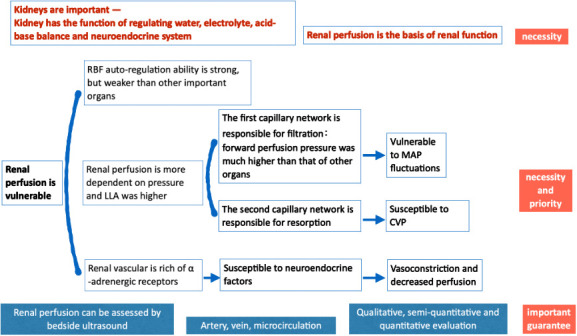
Improving organ perfusion is the aim of shock resuscitation; therefore, improving organ blood perfusion is a direct indicator for shock resuscitation. During shock, different organs have different capacities for blood flow autoregulation. The kidney is an important organ with excellent ability to autoregulate the blood flow and with vulnerability to poor organ perfusion, which places kidney perfusion in a position of necessity and priority relative to that of other organs in shock. Critical-care ultrasonography provides the best evaluation of renal perfusion.

摘要

改善器官灌注是休克复苏的目标;因此,改善器官血液灌注是休克复苏的直接指标。在休克期间,不同器官的血流自动调节能力不同。肾脏是一个重要器官,具有出色的血流自动调节能力,且易受器官灌注不良的影响,这使得肾脏灌注在休克时相对于其他器官而言处于必要且优先的地位。重症超声检查能对肾脏灌注进行最佳评估。
https://cdn.ncbi.nlm.nih.gov/pmc/blobs/3894/9286909/3bf5e035e4c3/AD-13-4-1056-g1.jpg

相似文献

1
Shock Resuscitation - the Necessity and Priority of Renal Blood Perfusion Assessment.休克复苏——肾血流灌注评估的必要性与优先性
Aging Dis. 2022 Jul 11;13(4):1056-1062. doi: 10.14336/AD.2022.0105.
2
Personalizing blood pressure management in septic shock.脓毒性休克中血压管理的个性化
Ann Intensive Care. 2015 Dec;5(1):41. doi: 10.1186/s13613-015-0085-5. Epub 2015 Nov 16.
3
A novel method of peritoneal resuscitation improves organ perfusion after hemorrhagic shock.一种新型的腹膜复苏方法可改善失血性休克后的器官灌注。
Am J Surg. 2003 Nov;186(5):443-8. doi: 10.1016/j.amjsurg.2003.07.006.
4
Effects of different types of fluid resuscitation for hemorrhagic shock on splanchnic organ microcirculation and renal reactive oxygen species formation.不同类型液体复苏对失血性休克患者内脏器官微循环及肾脏活性氧生成的影响
Crit Care. 2015 Dec 11;19:434. doi: 10.1186/s13054-015-1135-y.
5
Effect of a Resuscitation Strategy Targeting Peripheral Perfusion Status vs Serum Lactate Levels on 28-Day Mortality Among Patients With Septic Shock: The ANDROMEDA-SHOCK Randomized Clinical Trial.以外周灌注状态为目标的复苏策略与血清乳酸水平对感染性休克患者 28 天死亡率的影响:ANDROMEDA-SHOCK 随机临床试验。
JAMA. 2019 Feb 19;321(7):654-664. doi: 10.1001/jama.2019.0071.
6
Regional perfusion monitoring in shock.休克的区域性灌注监测。
Curr Opin Crit Care. 2020 Jun;26(3):281-288. doi: 10.1097/MCC.0000000000000716.
7
Fluid resuscitation from severe hemorrhagic shock using diaspirin cross-linked hemoglobin fails to improve pancreatic and renal perfusion.使用双阿司匹林交联血红蛋白对严重失血性休克进行液体复苏未能改善胰腺和肾脏灌注。
Acta Anaesthesiol Scand. 2004 Nov;48(10):1328-37. doi: 10.1111/j.1399-6576.2004.00475.x.
8
Autoregulation of renal blood flow in the puppy.幼犬肾血流的自身调节
Am J Physiol. 1975 Oct;229(4):983-8. doi: 10.1152/ajplegacy.1975.229.4.983.
9
From a pressure-guided to a perfusion-centered resuscitation strategy in septic shock: Critical literature review and illustrative case.从压力指导到灌注为中心的复苏策略在感染性休克中的应用:关键文献回顾和案例说明。
J Crit Care. 2020 Apr;56:294-304. doi: 10.1016/j.jcrc.2019.11.008. Epub 2020 Jan 8.
10
Small-volume resuscitation using hypertonic saline improves organ perfusion in burned rats.使用高渗盐水进行小容量复苏可改善烧伤大鼠的器官灌注。
Anesth Analg. 1996 Oct;83(4):782-8. doi: 10.1097/00000539-199610000-00022.

引用本文的文献

1
Relationship between intraoperative blood pressure variability and postoperative acute kidney injury in pediatric cardiac surgery.小儿心脏手术中血压变异性与术后急性肾损伤的关系
Pediatr Nephrol. 2025 Jun;40(6):2071-2081. doi: 10.1007/s00467-025-06659-8. Epub 2025 Jan 27.
2
Hypoxic Conditioning: A Potential Perioperative Strategy to Reduce Abdominal Aortic Occlusion-Related Injury in Mouse Proximal and Distal Organs.缺氧预处理:一种减少小鼠近远端器官腹主动脉阻断相关损伤的潜在围手术期策略。
Aging Dis. 2024 Jan 24;15(6):2863-2879. doi: 10.14336/AD.2024.0121.
3
Renal hemodynamic evaluation protocol based on the pathophysiological mechanism of acute kidney injury: Critical Care UltraSound Guided-ABCDE.

本文引用的文献

1
Cerebral autoregulation in the operating room and intensive care unit after cardiac surgery.心脏手术后手术室和重症监护病房的脑自动调节。
Br J Anaesth. 2021 May;126(5):967-974. doi: 10.1016/j.bja.2020.12.043. Epub 2021 Mar 23.
2
Acute kidney injury from sepsis: current concepts, epidemiology, pathophysiology, prevention and treatment.脓毒症导致的急性肾损伤:当前概念、流行病学、病理生理学、预防和治疗。
Kidney Int. 2019 Nov;96(5):1083-1099. doi: 10.1016/j.kint.2019.05.026. Epub 2019 Jun 7.
3
Determinants of Doppler-based renal resistive index in patients with septic shock: impact of hemodynamic parameters, acute kidney injury and predisposing factors.
基于急性肾损伤病理生理机制的肾脏血液动力学评估方案:重症超声引导的 ABCDE。
Ren Fail. 2023;45(2):2284842. doi: 10.1080/0886022X.2023.2284842. Epub 2023 Nov 23.
4
Incidence and risk factors of acute kidney injury in patients with malignant tumors: a systematic review and meta-analysis.恶性肿瘤患者急性肾损伤的发生率及危险因素:系统评价和荟萃分析。
BMC Cancer. 2023 Nov 17;23(1):1123. doi: 10.1186/s12885-023-11561-3.
5
Intrarenal Doppler approaches in hemodynamics: A major application in critical care.肾内多普勒血流动力学研究方法:重症监护中的一项主要应用。
Front Physiol. 2022 Oct 12;13:951307. doi: 10.3389/fphys.2022.951307. eCollection 2022.
感染性休克患者基于多普勒的肾阻力指数的决定因素:血流动力学参数、急性肾损伤及易感因素的影响
Ann Intensive Care. 2019 Apr 24;9(1):51. doi: 10.1186/s13613-019-0525-8.
4
Cerebral Autoregulation-Guided Optimal Blood Pressure in Sepsis-Associated Encephalopathy: A Case Series.脓毒症相关性脑病中脑自动调节引导下的最佳血压:病例系列
J Intensive Care Med. 2020 Dec;35(12):1453-1464. doi: 10.1177/0885066619828293. Epub 2019 Feb 13.
5
Heterogeneity and Variability in Pressure Autoregulation of Organ Blood Flow: Lessons Learned Over 100+ Years.器官血流压力自动调节的异质性和可变性:100 多年来的经验教训。
Crit Care Med. 2019 Mar;47(3):436-448. doi: 10.1097/CCM.0000000000003569.
6
Renal Resistive Index: Response to Shock and its Determinants in Critically Ill Patients.肾脏阻力指数:危重症患者休克反应及其决定因素。
Shock. 2019 Jul;52(1):43-51. doi: 10.1097/SHK.0000000000001246.
7
[Technical specification for clinical application of critical ultrasonography].[危急超声检查临床应用技术规范]
Zhonghua Nei Ke Za Zhi. 2018 Jun 1;57(6):397-417. doi: 10.3760/cma.j.issn.0578-1426.2018.06.004.
8
Dynamic Contrast-Enhanced Ultrasound Identifies Microcirculatory Alterations in Sepsis-Induced Acute Kidney Injury.动态对比增强超声可识别脓毒症相关性急性肾损伤中的微循环改变。
Crit Care Med. 2018 Aug;46(8):1284-1292. doi: 10.1097/CCM.0000000000003209.
9
Early Evidence of Sepsis-Associated Hyperperfusion-A Study of Cerebral Blood Flow Measured With MRI Arterial Spin Labeling in Critically Ill Septic Patients and Control Subjects.早期脓毒症相关性高灌注的证据——一项使用 MRI 动脉自旋标记测量危重脓毒症患者和对照受试者脑血流的研究。
Crit Care Med. 2018 Jul;46(7):e663-e669. doi: 10.1097/CCM.0000000000003147.
10
Renal autoregulation and blood pressure management in circulatory shock.循环休克中的肾自身调节和血压管理。
Crit Care. 2018 Mar 22;22(1):81. doi: 10.1186/s13054-018-1962-8.