He Zhiyuan, Liu Lingyu, de Zwart Felix J, Xue Xiaolian, Ehlers Andreas W, Yan KaKing, Demeshko Serhiy, van der Vlugt Jarl Ivar, de Bruin Bas, Krogman Jeremy
School of Physical Science and Technology, ShanghaiTech University, Shanghai 201210, China.
van't Hoff Institute for Molecular Sciences, University of Amsterdam, Science Park 904, 1098 XH Amsterdam, The Netherlands.
Inorg Chem. 2022 Aug 1;61(30):11725-11733. doi: 10.1021/acs.inorgchem.2c01369. Epub 2022 Jul 20.
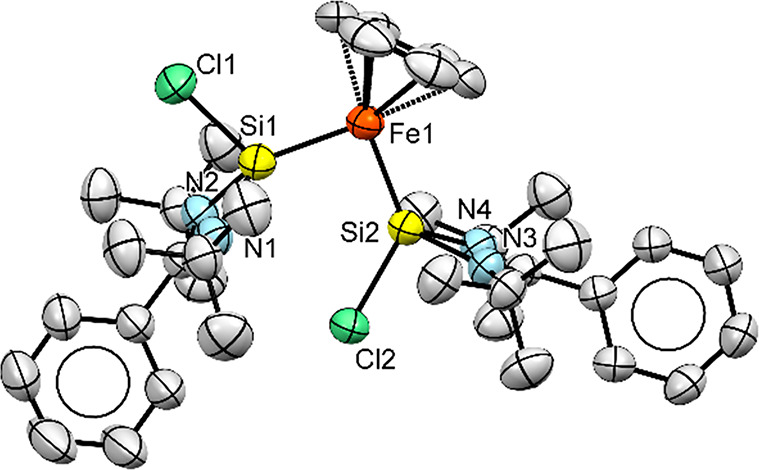
In this paper, we report the synthesis of a unique silicon(I)-based metalla-disilirane and report on its reactivity toward TMS-azide and benzophenone. Metal complexes containing disilylenes ((bis)silylenes with a Si-Si bond) are known, but direct ligation of the Si(I) centers to transition metals always generated dinuclear species. To overcome this problem, we targeted the formation of a mononuclear iron(0)-silicon(I)-based disilylene complex via templated synthesis, starting with ligation of two Si(II) centers to iron(II), followed by a two-step reduction. The DFT structure of the resulting η-disilylene-iron complex reveals metal-to-silicon π-back donation and a delocalized three-center-two-electron (3c-2e) aromatic system. The Si(I)-Si(I) bond displays unusual but well-defined reactivity. With TMS-azide, both the initial azide adduct and the follow-up four-membered nitrene complex could be isolated. Reaction with benzophenone led to selective 1,4-addition into the Si-Si bond. This work reveals that selective reactions of Si(I)-Si(I) bonds are made possible by metal ligation.
在本文中,我们报道了一种独特的硅(I)基金属二硅烯的合成,并报道了其与三甲基硅基叠氮化物和二苯甲酮的反应活性。含有二硅烯(具有Si-Si键的(双)硅烯)的金属配合物是已知的,但Si(I)中心与过渡金属的直接连接总是生成双核物种。为了克服这个问题,我们通过模板合成目标形成单核铁(0)-硅(I)基二硅烯配合物,首先将两个Si(II)中心与铁(II)连接,然后进行两步还原。所得η-二硅烯-铁配合物的DFT结构揭示了金属到硅的π-反馈以及离域的三中心两电子(3c-2e)芳香体系。Si(I)-Si(I)键表现出不同寻常但明确的反应活性。与三甲基硅基叠氮化物反应时,可以分离出初始叠氮化物加合物和后续的四元氮烯配合物。与二苯甲酮反应导致选择性地1,4-加成到Si-Si键中。这项工作表明,通过金属连接可以实现Si(I)-Si(I)键的选择性反应。