Department of Developmental Biology, Erasmus MC, Rotterdam, The Netherlands.
Oncode Institute, Erasmus MC, Rotterdam, The Netherlands.
PLoS Genet. 2022 Jul 20;18(7):e1010046. doi: 10.1371/journal.pgen.1010046. eCollection 2022 Jul.
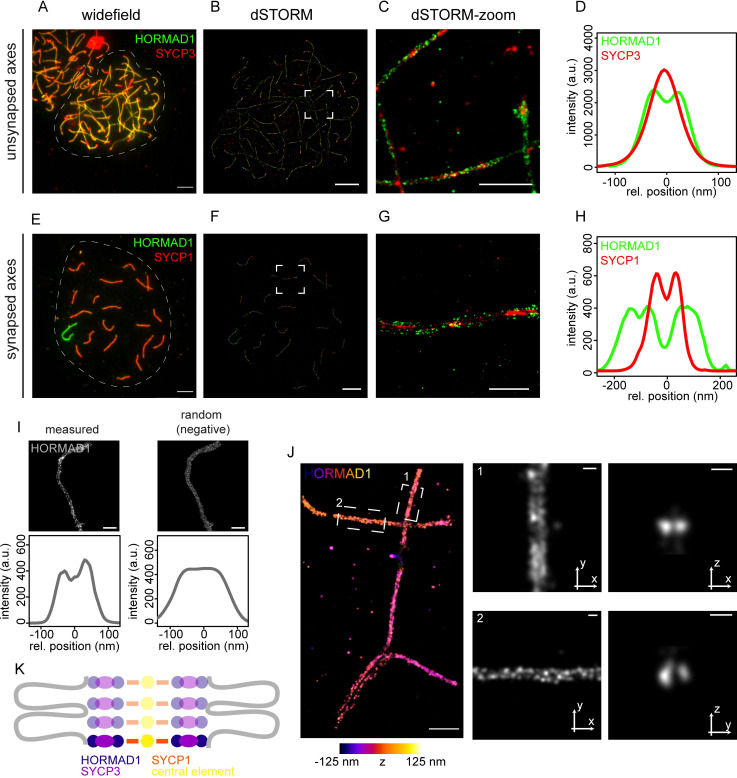
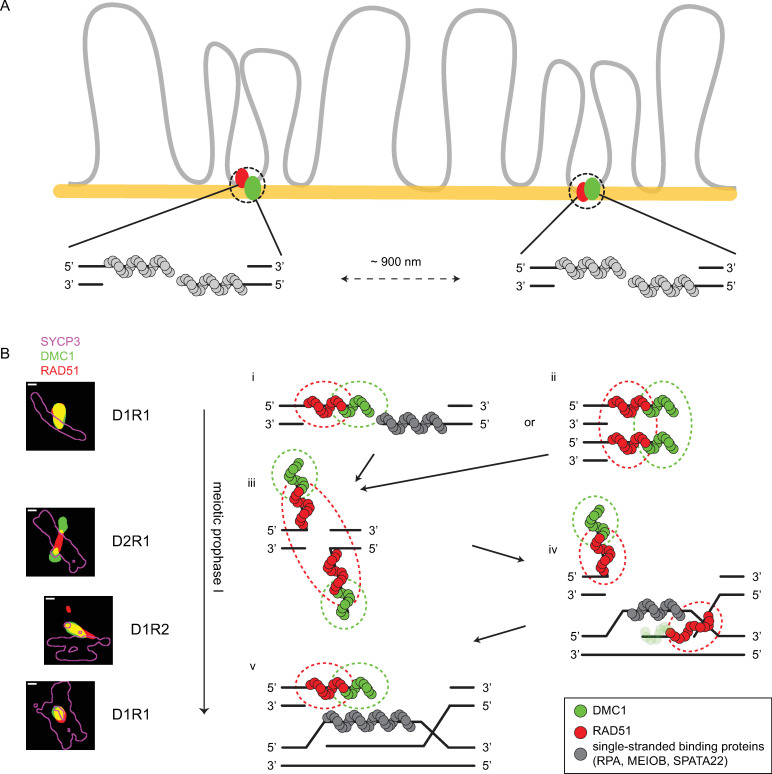
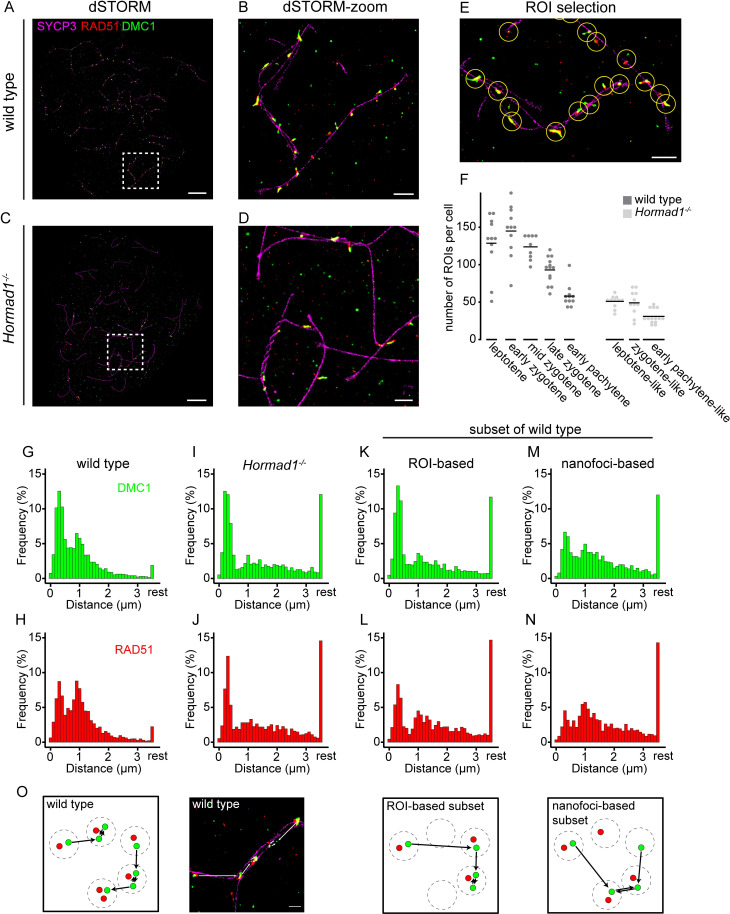
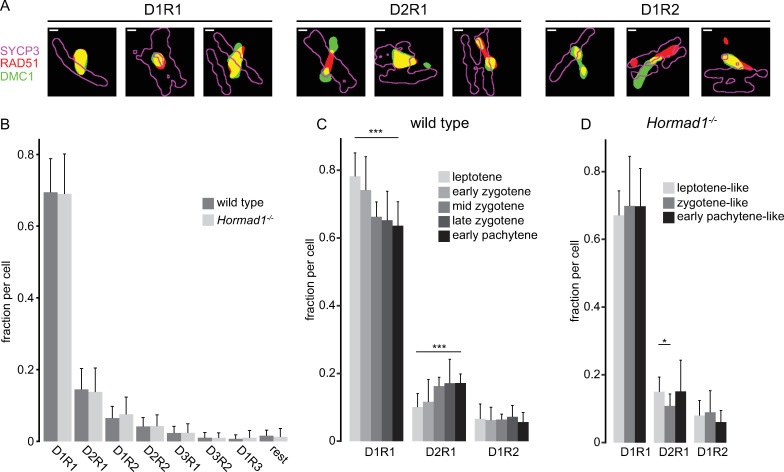
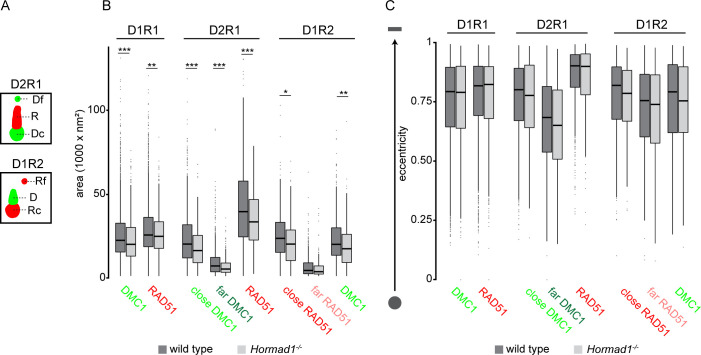
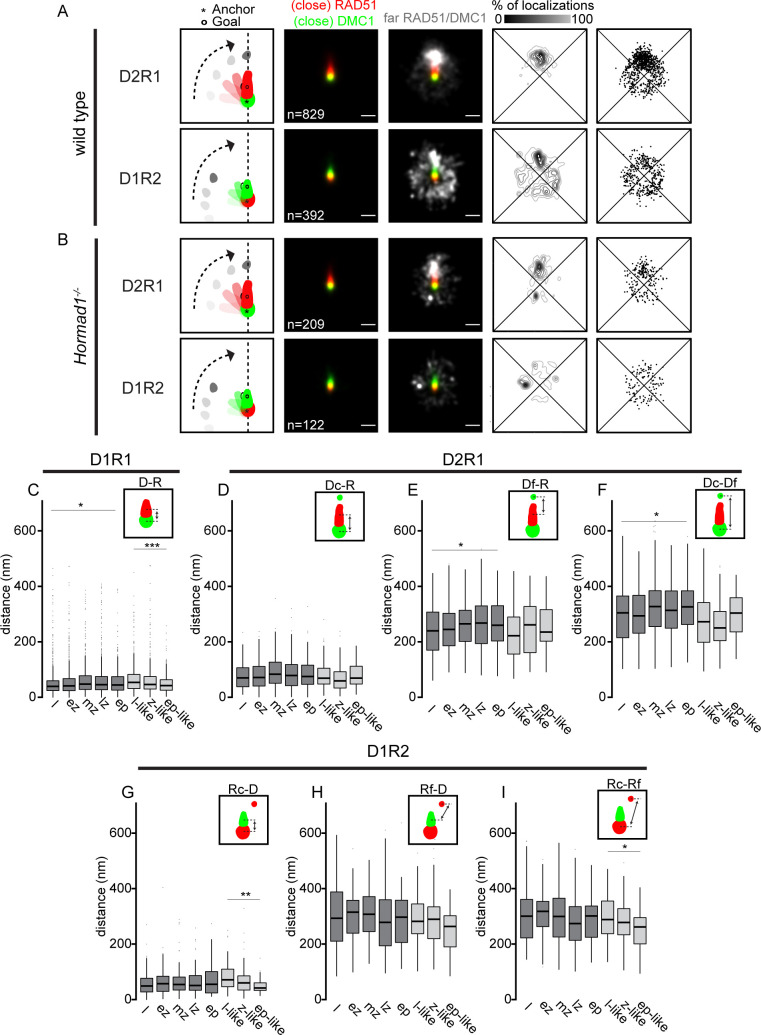
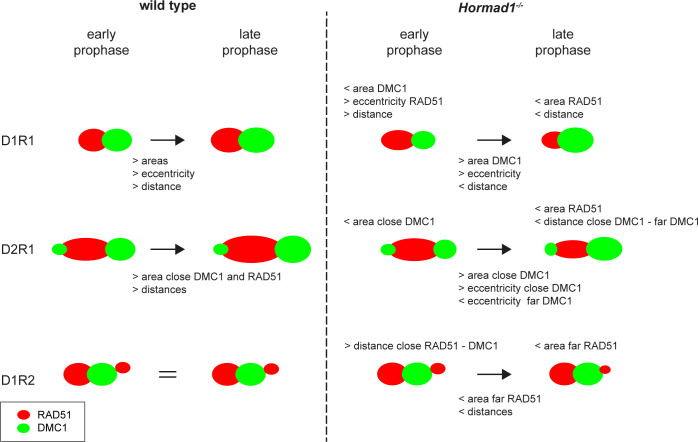
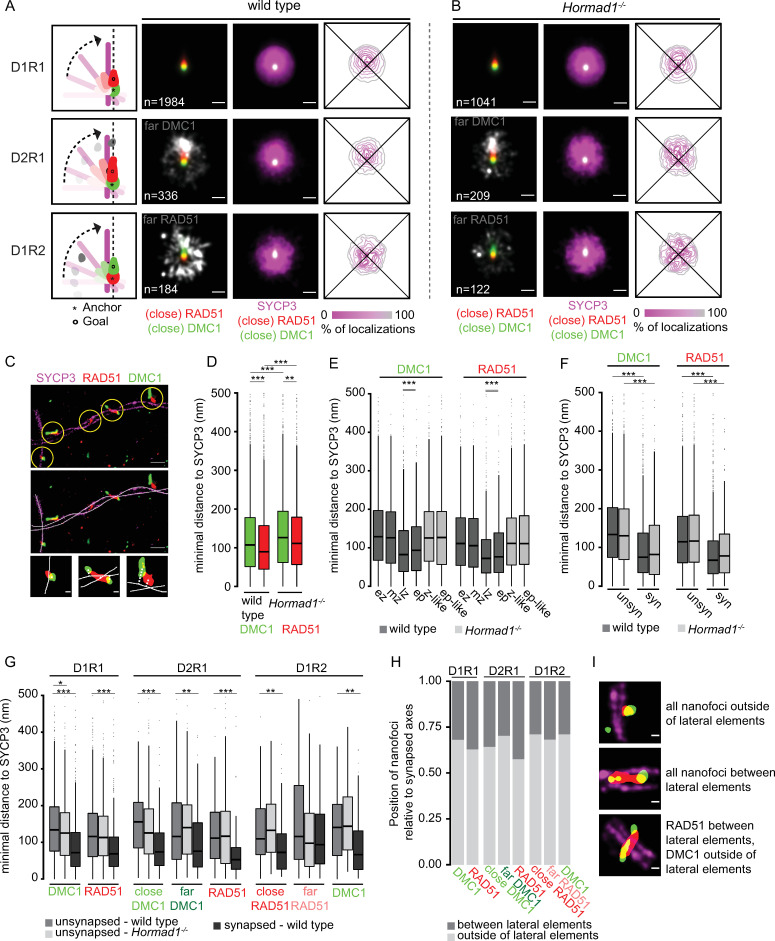
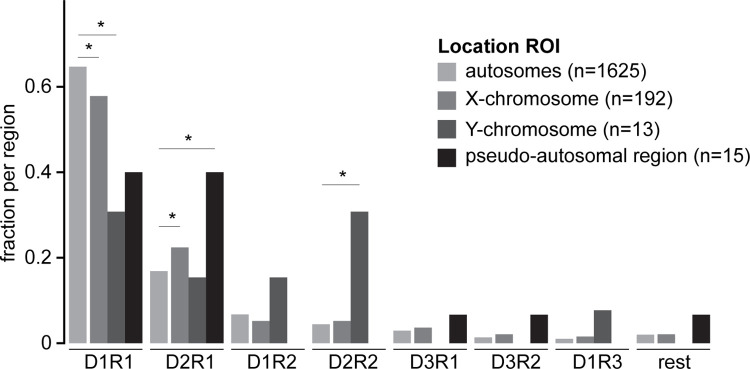
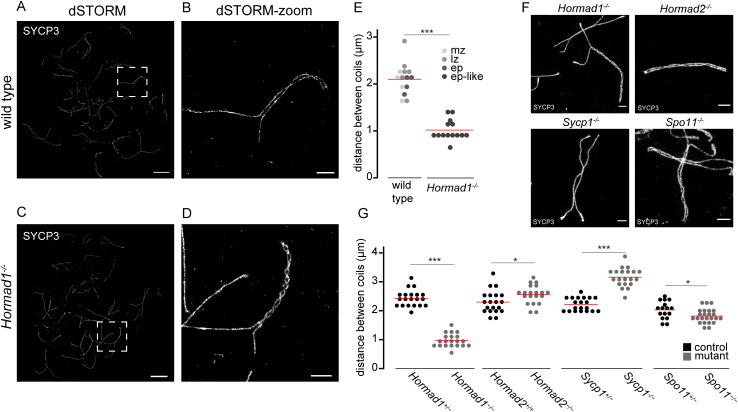
Recombinases RAD51 and its meiosis-specific paralog DMC1 accumulate on single-stranded DNA (ssDNA) of programmed DNA double strand breaks (DSBs) in meiosis. Here we used three-color dSTORM microscopy, and a mouse model with severe defects in meiotic DSB formation and synapsis (Hormad1-/-) to obtain more insight in the recombinase accumulation patterns in relation to repair progression. First, we used the known reduction in meiotic DSB frequency in Hormad1-/- spermatocytes to be able to conclude that the RAD51/DMC1 nanofoci that preferentially localize at distances of ~300 nm form within a single DSB site, whereas a second preferred distance of ~900 nm, observed only in wild type, represents inter-DSB distance. Next, we asked whether the proposed role of HORMAD1 in repair inhibition affects the RAD51/DMC1 accumulation patterns. We observed that the two most frequent recombinase configurations (1 DMC1 and 1 RAD51 nanofocus (D1R1), and D2R1) display coupled frequency dynamics over time in wild type, but were constant in the Hormad1-/- model, indicating that the lifetime of these intermediates was altered. Recombinase nanofoci were also smaller in Hormad1-/- spermatocytes, consistent with changes in ssDNA length or protein accumulation. Furthermore, we established that upon synapsis, recombinase nanofoci localized closer to the synaptonemal complex (SYCP3), in both wild type and Hormad1-/- spermatocytes. Finally, the data also revealed a hitherto unknown function of HORMAD1 in inhibiting coil formation in the synaptonemal complex. SPO11 plays a similar but weaker role in coiling and SYCP1 had the opposite effect. Using this large super-resolution dataset, we propose models with the D1R1 configuration representing one DSB end containing recombinases, and the other end bound by other ssDNA binding proteins, or both ends loaded by the two recombinases, but in below-resolution proximity. This may then often evolve into D2R1, then D1R2, and finally back to D1R1, when DNA synthesis has commenced.
重组酶 RAD51 及其减数分裂特异性同源物 DMC1 在前减数分裂期 DNA 双链断裂 (DSB) 的单链 DNA (ssDNA) 上积累。在这里,我们使用三色 dSTORM 显微镜和一种减数分裂 DSB 形成和联会严重缺陷的小鼠模型 (Hormad1-/-) 来深入了解重组酶在修复进展中的积累模式。首先,我们利用 Hormad1-/-精母细胞减数分裂 DSB 频率的已知降低,能够得出结论,即优先定位于 ~300nm 距离的 RAD51/DMC1 纳米焦点形成于单个 DSB 位点内,而第二个优先距离 ~900nm,仅在野生型中观察到,代表两个 DSB 之间的距离。接下来,我们询问了 HORMAD1 在修复抑制中的拟议作用是否会影响 RAD51/DMC1 的积累模式。我们观察到,在野生型中,两种最常见的重组酶构象 (1 DMC1 和 1 RAD51 纳米焦点 (D1R1) 和 D2R1) 在时间上显示出耦合的频率动力学,但在 Hormad1-/-模型中保持不变,这表明这些中间体的寿命发生了改变。重组酶纳米焦点在 Hormad1-/-精母细胞中也更小,这与 ssDNA 长度或蛋白质积累的变化一致。此外,我们还确定,在联会期间,重组酶纳米焦点在野生型和 Hormad1-/-精母细胞中更靠近联会复合体 (SYCP3) 定位。最后,数据还揭示了 HORMAD1 在抑制联会复合体中螺旋形成方面的一个以前未知的功能。SPO11 发挥类似但较弱的作用,而 SYCP1 则有相反的作用。使用这个大型超分辨率数据集,我们提出了模型,其中 D1R1 构象代表含有重组酶的一个 DSB 末端,而另一个末端被其他 ssDNA 结合蛋白结合,或者两个末端都由两个重组酶加载,但在低于分辨率的接近度。这可能然后经常演变成 D2R1,然后是 D1R2,最后是 D1R1,当 DNA 合成开始时。