Molecular Biology Program, Memorial Sloan Kettering Cancer Center, New York, New York 10065, USA.
Department of Radiation Genetics, Graduate School of Medicine, Kyoto University, Kyoto 606-8501, Japan.
Genes Dev. 2020 Jun 1;34(11-12):806-818. doi: 10.1101/gad.336032.119. Epub 2020 Apr 30.
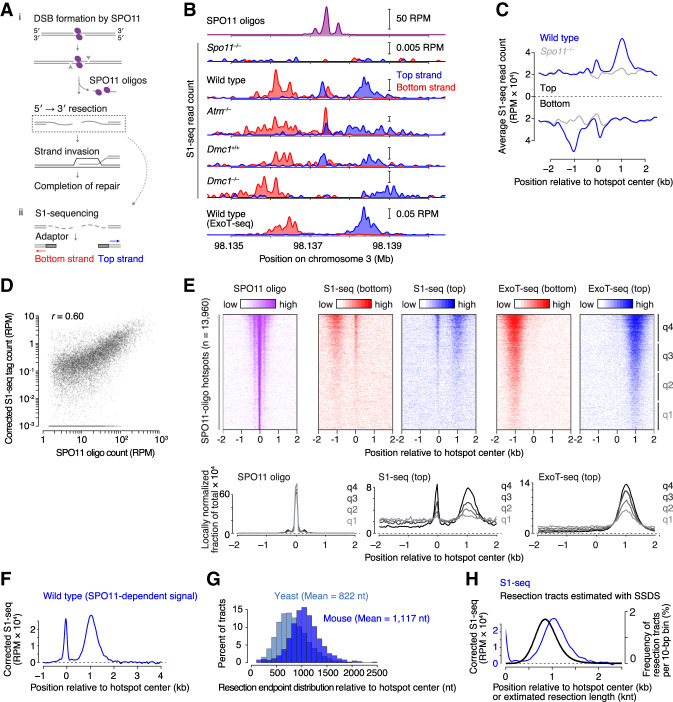
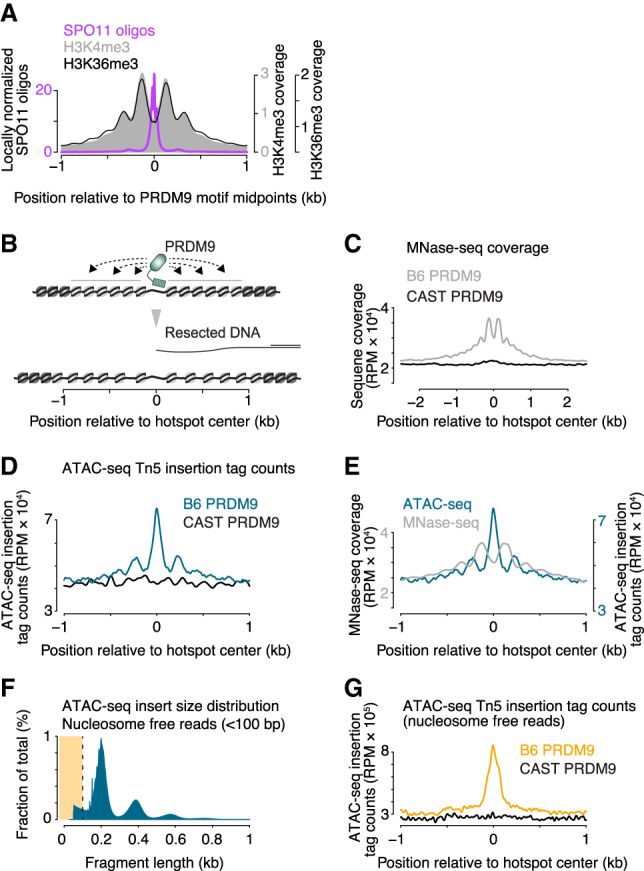
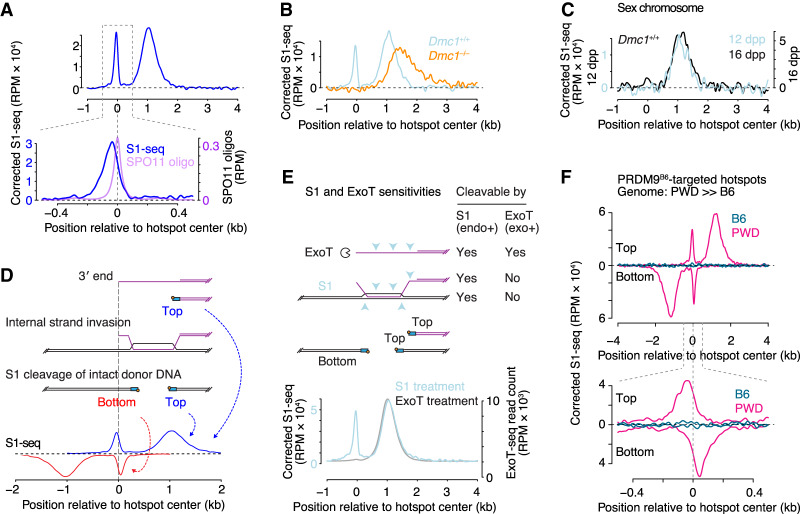
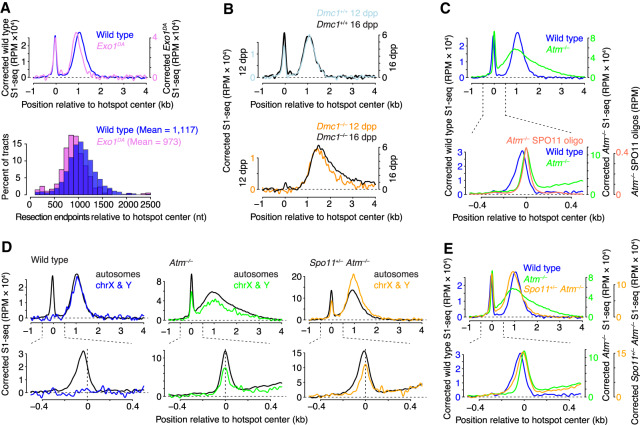
Exonucleolytic resection, critical to repair double-strand breaks (DSBs) by recombination, is not well understood, particularly in mammalian meiosis. Here, we define structures of resected DSBs in mouse spermatocytes genome-wide at nucleotide resolution. Resection tracts averaged 1100 nt, but with substantial fine-scale heterogeneity at individual hot spots. Surprisingly, EXO1 is not the major 5' → 3' exonuclease, but the DSB-responsive kinase ATM proved a key regulator of both initiation and extension of resection. In wild type, apparent intermolecular recombination intermediates clustered near to but offset from DSB positions, consistent with joint molecules with incompletely invaded 3' ends. Finally, we provide evidence for PRDM9-dependent chromatin remodeling leading to increased accessibility at recombination sites. Our findings give insight into the mechanisms of DSB processing and repair in meiotic chromatin.
外切核酸酶切除在通过重组修复双链断裂(DSBs)方面至关重要,但在哺乳动物减数分裂中,其机制尚不清楚。在这里,我们在核苷酸分辨率上全基因组范围内定义了小鼠精母细胞中切除的 DSB 结构。切除片段平均为 1100 个核苷酸,但在单个热点处存在大量精细的异质性。令人惊讶的是,EXO1 不是主要的 5'→3' 外切核酸酶,而是 DSB 反应性激酶 ATM 被证明是启动和延伸切除的关键调节剂。在野生型中,明显的分子间重组中间体聚集在 DSB 位置附近,但有偏移,这与 3' 端未完全入侵的连接分子一致。最后,我们提供了证据表明 PRDM9 依赖性染色质重塑导致重组位点的可及性增加。我们的发现深入了解了减数分裂染色质中 DSB 加工和修复的机制。