Institute for Stroke and Dementia Research (ISD), University Hospital, LMU Munich, Germany.
Department of Neurology, Donders Institute for Brain, Cognition and Behaviour, Radboud University Medical Center, Nijmegen, The Netherlands.
Brain. 2023 Feb 13;146(2):678-689. doi: 10.1093/brain/awac265.
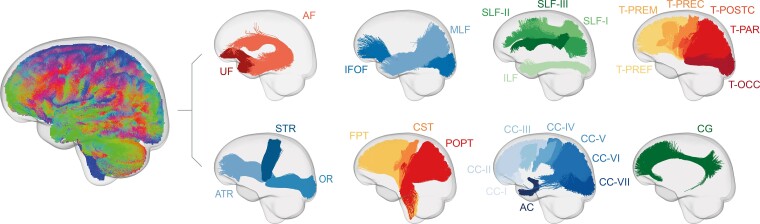
Alzheimer's disease and cerebral small vessel disease are the two leading causes of cognitive decline and dementia and coexist in most memory clinic patients. White matter damage as assessed by diffusion MRI is a key feature in both Alzheimer's and cerebral small vessel disease. However, disease-specific biomarkers of white matter alterations are missing. Recent advances in diffusion MRI operating on the fixel level (fibre population within a voxel) promise to advance our understanding of disease-related white matter alterations. Fixel-based analysis allows derivation of measures of both white matter microstructure, measured by fibre density, and macrostructure, measured by fibre-bundle cross-section. Here, we evaluated the capacity of these state-of-the-art fixel metrics to disentangle the effects of cerebral small vessel disease and Alzheimer's disease on white matter integrity. We included three independent samples (total n = 387) covering genetically defined cerebral small vessel disease and age-matched controls, the full spectrum of biomarker-confirmed Alzheimer's disease including amyloid- and tau-PET negative controls and a validation sample with presumed mixed pathology. In this cross-sectional analysis, we performed group comparisons between patients and controls and assessed associations between fixel metrics within main white matter tracts and imaging hallmarks of cerebral small vessel disease (white matter hyperintensity volume, lacune and cerebral microbleed count) and Alzheimer's disease (amyloid- and tau-PET), age and a measure of neurodegeneration (brain volume). Our results showed that (i) fibre density was reduced in genetically defined cerebral small vessel disease and strongly associated with cerebral small vessel disease imaging hallmarks; (ii) fibre-bundle cross-section was mainly associated with brain volume; and (iii) both fibre density and fibre-bundle cross-section were reduced in the presence of amyloid, but not further exacerbated by abnormal tau deposition. Fixel metrics were only weakly associated with amyloid- and tau-PET. Taken together, our results in three independent samples suggest that fibre density captures the effect of cerebral small vessel disease, while fibre-bundle cross-section is largely determined by neurodegeneration. The ability of fixel-based imaging markers to capture distinct effects on white matter integrity can propel future applications in the context of precision medicine.
阿尔茨海默病和脑小血管病是导致认知能力下降和痴呆的两个主要原因,在大多数记忆诊所患者中同时存在。扩散 MRI 评估的白质损伤是阿尔茨海默病和脑小血管病的一个关键特征。然而,缺乏针对白质改变的特定疾病生物标志物。在固定体水平(体素内的纤维群体)上操作的扩散 MRI 的最新进展有望提高我们对与疾病相关的白质改变的理解。基于固定体的分析允许得出纤维密度测量的白质微观结构和纤维束横截面测量的白质宏观结构的度量。在这里,我们评估了这些最先进的固定体指标区分脑小血管病和阿尔茨海默病对白质完整性影响的能力。我们纳入了三个独立的样本(总 n = 387),包括遗传定义的脑小血管病和年龄匹配的对照组、包括淀粉样蛋白和 tau-PET 阴性对照的阿尔茨海默病的全谱生物标志物证实以及具有假定混合病理学的验证样本。在这项横断面分析中,我们在患者和对照组之间进行了组间比较,并评估了主要白质束内固定体指标与脑小血管病(脑白质高信号体积、腔隙和脑微出血计数)和阿尔茨海默病(淀粉样蛋白和 tau-PET)、年龄和神经退行性变的测量值(脑体积)之间的关联。我们的结果表明:(i)在遗传定义的脑小血管病中,纤维密度降低,与脑小血管病的影像学标志物强烈相关;(ii)纤维束横截面主要与脑体积相关;(iii)在存在淀粉样蛋白的情况下,纤维密度和纤维束横截面均降低,但异常 tau 沉积并未进一步加剧。固定体指标与淀粉样蛋白和 tau-PET 仅弱相关。总之,我们在三个独立样本中的结果表明,纤维密度捕获了脑小血管病的影响,而纤维束横截面主要由神经退行性变决定。基于固定体的成像标志物捕获对白质完整性的不同影响的能力可以推动精准医学背景下的未来应用。