Department of Foods Nutrition & Dietetics Research, Madras Diabetes Research Foundation, Chennai, Tamil Nadu, India.
Department of Diabetology, Madras Diabetes Research Foundation, Chennai, Tamil Nadu, India.
Indian J Med Res. 2022 Jan;155(1):56-65. doi: 10.4103/ijmr.IJMR_1935_19.
BACKGROUND & OBJECTIVES: Consumption of high glycaemic index (GI) food is associated with a high risk for diabetes. There is a felt need to understand the GI of common Indian traditional foods using standard GI protocols. The present study was aimed to analyse the carbohydrate profile of common traditional Indian food preparation and to determine their GI using standardized protocols.
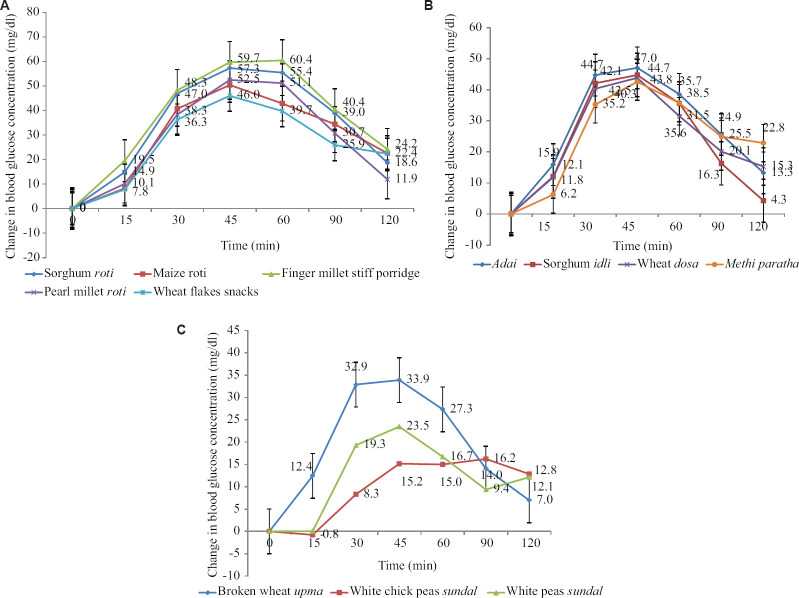
Twelve food preparations made of millets, wheat, maize and pulses were evaluated for nutrient composition including detailed carbohydrate profiling and tested for GI in healthy volunteers using standard methodology. Capillary blood glucose responses for the test foods containing 50 g available carbohydrates were recorded and compared to the reference food (50 g glucose). GI was calculated from the incremental area under the curve (IUAC) for the test and reference foods.
Available carbohydrate content of the food preparations ranged between 13.6 and 49.4 g per cent. Maize roti showed the highest total dietary fibre (7.5 g%). White chick pea 'sundal' showed highest resistant starch content (3.95 g%). Amongst the 12 test foods, five fell in the high GI category (finger millet balls, sorghum, pearl millet and maize roti), four in the medium GI category (sorghum idli, wheat dosa, methi roti and adai) and three in the low GI category (broken wheat upma, white peas sundal and white chick peas sundal).
INTERPRETATION & CONCLUSIONS: Merely being a whole grain-based food does not qualify for a lower GI. The method of processing, food structural integrity and preparation could influence the GI. The type and quality of fibre are important than the quantity of fibre alone. Judicious planning of accompaniments using low GI legumes may favourably modify the glycaemic response to high GI foods in a meal.
食用高血糖指数(GI)食物与糖尿病风险增加有关。人们迫切需要使用标准 GI 方案了解常见印度传统食物的 GI。本研究旨在分析常见传统印度食品制备的碳水化合物特征,并使用标准化方案确定其 GI。
对 12 种由小米、小麦、玉米和豆类制成的食品进行了评估,以分析其营养成分,包括详细的碳水化合物分析,并使用标准方法在健康志愿者中测试其 GI。记录测试食品中 50 克可利用碳水化合物的毛细血管血糖反应,并与参考食品(50 克葡萄糖)进行比较。GI 是通过测试和参考食品的增量曲线下面积(IUAC)计算得出的。
食品制备的可利用碳水化合物含量在 13.6%至 49.4%之间。玉米饼的总膳食纤维含量最高(7.5 克)。白豆“sundal”的抗性淀粉含量最高(3.95 克)。在 12 种测试食品中,有 5 种属于高 GI 类别(小米球、高粱、珍珠小米和玉米饼),4 种属于中 GI 类别(高粱蒸糕、小麦 dosa、methi roti 和 adai),3 种属于低 GI 类别(碎麦 upma、白豌豆 sundal 和白豆 sundal)。
仅仅是全谷物食品并不一定具有较低的 GI。加工方法、食品结构完整性和制备方法都可能影响 GI。纤维的类型和质量比纤维的数量更重要。明智地选择低 GI 豆类作为配菜,可以有利地改变膳食中高 GI 食物的血糖反应。