Baba Toru, Takeda Atsushi, Murakami Aya, Koga Tadashi, Isomura Tatsuya, Mori Etsuro
Department of Neurology, National Hospital Organization Sendai-Nishitaga Hospital, Sendai, Japan.
Department of Behavioral Neurology and Cognitive Neuroscience, Tohoku University Graduate School of Medicine, Sendai, Japan.
EClinicalMedicine. 2022 Jul 14;51:101571. doi: 10.1016/j.eclinm.2022.101571. eCollection 2022 Sep.
Dementia greatly contributes to poor prognosis in patients with Parkinson's disease (PD). We previously reported that severe olfactory dysfunction may be a good predictor of Parkinson's disease dementia (PDD). In this trial, we investigated whether early administration of donepezil to patients with severe hyposmia can reduce the development of PDD.
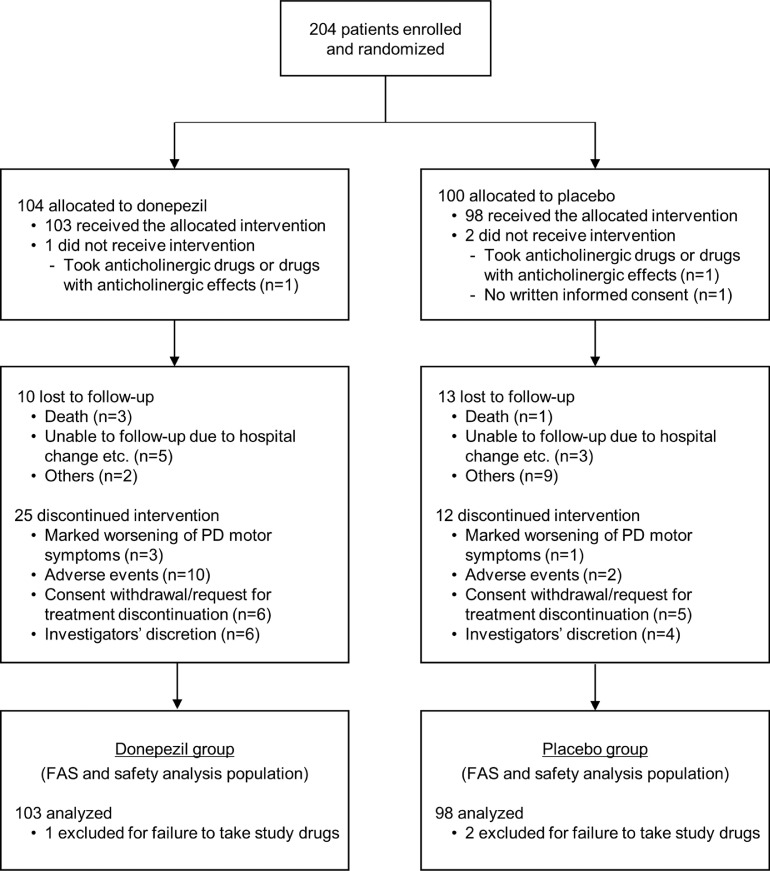
This was a multi-centre, randomized, double-blind, parallel group, placebo-controlled trial in patients with non-demented PD with severe hyposmia (The Donepezil Application for Severe Hyposmic Parkinson's Disease [DASH-PD] study). A total of 201 patients were randomly allocated to receive donepezil or placebo in addition to standard therapy for PD. Patients were followed up every 6 months until the onset of PDD or for a maximum of 4 years. The primary endpoint was the onset of dementia. The secondary endpoint was cognitive impairment measured by Addenbrooke's Cognitive Examination-Revised (ACE-R) and the Clinical Dementia Rating (CDR).(UMIN000009958: February 2013 to May 2019).
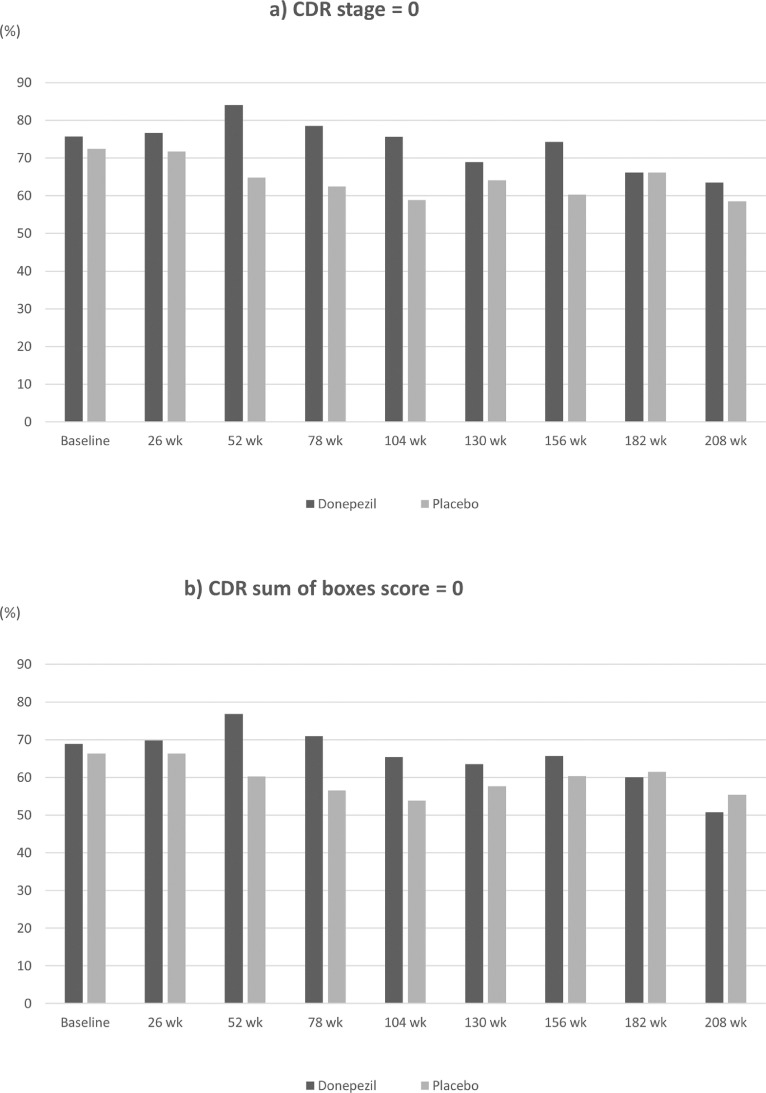
A total of 201 hyposmic patients with PD were randomly assigned to a treatment: 103 to donepezil and 98 to placebo. Overall, 141 (70%) patients completed the 4-year intervention. During follow-up, 7 of 103 (6.8%) patients in the donepezil group and 12 of 98 (12.2%) patients in the placebo group developed PDD; however, the hazard ratio of PDD incidence was not statistically significant (hazard ratio (HR), 0.609; 95% confidence interval, 0.240 to 1.547; = 0.2969). At week 208, the patients in the donepezil group had better scores on the ACE-R ( < 0.005) and the CDR ( < 0.005) than those taking placebo.
Administration of donepezil to PD patients with severe olfactory dysfunction for 4 years did not change the incidence of dementia but had a beneficial effect on neuropsychological function, with good tolerability.
The Ministry of Health Labour and Welfare and the Japan Agency for Medical Research and Development provided funding for this study.
痴呆在很大程度上导致帕金森病(PD)患者预后不良。我们之前报道过,严重嗅觉功能障碍可能是帕金森病痴呆(PDD)的一个良好预测指标。在本试验中,我们研究了对严重嗅觉减退的患者早期给予多奈哌齐是否能减少PDD的发生。
这是一项针对非痴呆型严重嗅觉减退的帕金森病患者的多中心、随机、双盲、平行组、安慰剂对照试验(多奈哌齐用于严重嗅觉减退帕金森病[DASH-PD]研究)。共有201例患者被随机分配接受多奈哌齐或安慰剂,同时接受帕金森病的标准治疗。每6个月对患者进行随访,直至发生PDD或最长随访4年。主要终点是痴呆的发生。次要终点是通过修订的Addenbrooke认知检查(ACE-R)和临床痴呆评定量表(CDR)测量的认知障碍。(UMIN000009958:2013年2月至2019年5月)。
共有201例嗅觉减退的帕金森病患者被随机分配接受治疗:103例接受多奈哌齐治疗,98例接受安慰剂治疗。总体而言,141例(70%)患者完成了4年的干预。在随访期间(4年),多奈哌齐组103例患者中有7例(6.8%)发生PDD,安慰剂组98例患者中有12例(12.2%)发生PDD;然而,PDD发病率的风险比无统计学意义(风险比[HR],0.609;95%置信区间,0.240至1.547;P = 0.2969)。在第208周时,多奈哌齐组患者在ACE-R(P < 0.005)和CDR(P < 0.005)上的得分优于服用安慰剂的患者。
对严重嗅觉功能障碍的帕金森病患者给予多奈哌齐治疗4年,并未改变痴呆的发病率,但对神经心理功能有有益影响,且耐受性良好。
日本厚生劳动省和日本医疗研究与开发机构为本研究提供了资金。