
倾斜范式下急性心血管血液动力学和自主反应的重力剂量反应曲线。
Gravitational Dose-Response Curves for Acute Cardiovascular Hemodynamics and Autonomic Responses in a Tilt Paradigm.
机构信息
Department of Aerospace Engineering Texas A&M University College Station TX.
Department of Health and Kinesiology Texas A&M University College Station TX.
出版信息
J Am Heart Assoc. 2022 Jul 19;11(14):e024175. doi: 10.1161/JAHA.121.024175. Epub 2022 Jul 5.
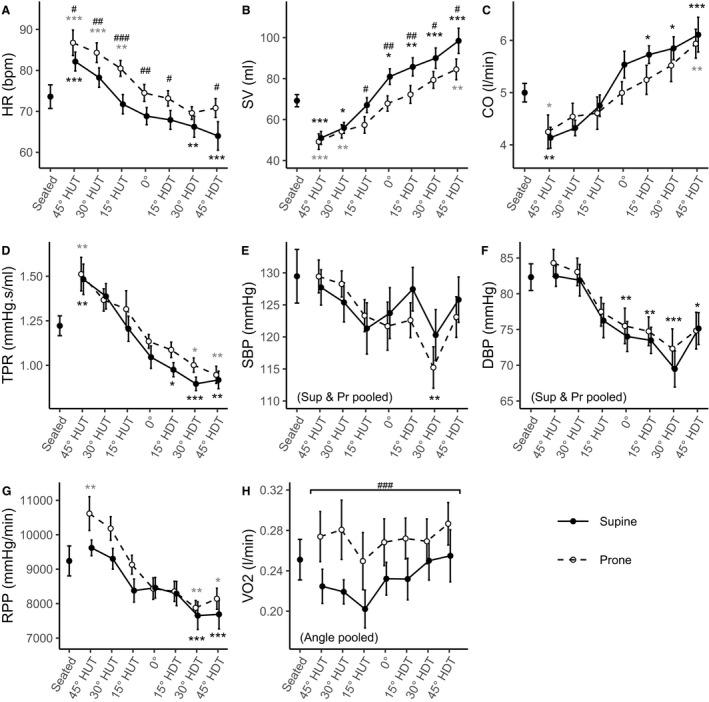
Background The cardiovascular system is strongly dependent on the gravitational environment. Gravitational changes cause mechanical fluid shifts and, in turn, autonomic effectors influence systemic circulation and cardiac control. We implemented a tilt paradigm to (1) investigate the acute hemodynamic response across a range of directions of the gravitational vector, and (2) to generate specific dose-response relationships of this gravitational dependency. Methods and Results Twelve male subjects were tilted from 45° head-up tilt to 45° head-down tilt in 15° increments, in both supine and prone postures. We measured the steady-state hemodynamic response in a range of variables including heart rate, stroke volume, cardiac output, oxygen consumption, total peripheral resistance, blood pressure, and autonomic indices derived from heart rate variability analysis. There is a strong gravitational dependence in almost all variables considered, with the exception of oxygen consumption, whereas systolic blood pressure remained controlled to within ≈3% across the tilt range. Hemodynamic responses are primarily driven by differential loading on the baroreflex receptors, combined with differences in venous return to the heart. Thorax compression in the prone position leads to reduced venous return and increased sympathetic nervous activity, raising heart rate, and systemic vascular resistance while lowering cardiac output and stroke volume. Conclusions Gravitational dose-response curves generated from these data provide a comprehensive baseline from which to assess the efficacy of potential spaceflight countermeasures. Results also assist clinical management of terrestrial surgery in prone posture or head-down tilt positions.
背景
心血管系统强烈依赖于重力环境。重力变化会导致机械流体转移,进而自主效应器会影响全身循环和心脏控制。我们实施了倾斜范式,(1)研究了在重力矢量的多个方向上的急性血液动力学反应,以及(2)生成了这种重力依赖性的特定剂量反应关系。
方法和结果
12 名男性受试者从 45°头高位倾斜到 45°头低位,以 15°的增量倾斜,分别处于仰卧位和俯卧位。我们测量了一系列变量的稳态血液动力学反应,包括心率、每搏量、心输出量、耗氧量、总外周阻力、血压和源自心率变异性分析的自主神经指数。除了耗氧量外,几乎所有考虑的变量都存在强烈的重力依赖性,而收缩压在整个倾斜范围内保持在 ≈3%以内。血液动力学反应主要由压力感受器的差异加载以及心脏静脉回流的差异驱动。俯卧位时胸部受压会导致静脉回流减少和交感神经活性增加,导致心率升高和全身血管阻力增加,同时降低心输出量和每搏量。
结论
从这些数据生成的重力剂量反应曲线为评估潜在太空飞行对策的效果提供了全面的基线。结果还协助了在俯卧位或头低位进行陆地手术的临床管理。



 Zotero 插件