Department of Otorhinolaryngology, Medical University of Innsbruck, Innsbruck, Austria.
Department of Otorhinolaryngology, Head and Neck Surgery, University Hospital of Erlangen, Erlangen, Germany.
Clin Drug Investig. 2022 Sep;42(9):705-720. doi: 10.1007/s40261-022-01184-0. Epub 2022 Jul 21.
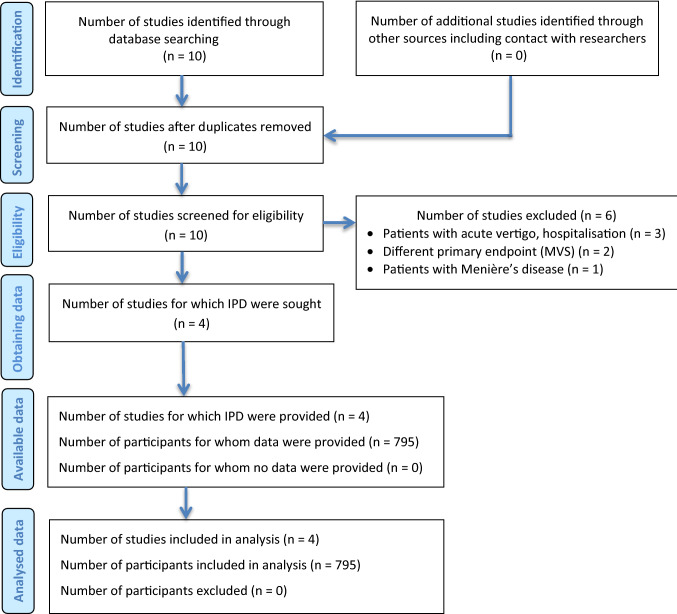
The source data of four individual randomised, double-blind, reference- and/or placebo-controlled clinical trials with virtually identical study design were pooled for the present meta-analysis. The main objective was to further evaluate the efficacy and safety of the fixed combination of cinnarizine 20 mg and dimenhydrinate 40 mg in comparison to various other antivertigo treatments in patients suffering from central and/or peripheral vestibular vertigo.
Adult male and female outpatients were subjected to a 4-week treatment with the fixed combination of cinnarizine 20 mg and dimenhydrinate 40 mg, cinnarizine (20 mg, 50 mg), dimenhydrinate (40 mg, 100 mg), betahistine dimesylate (12 mg), betahistine dihydrochloride (16 mg) and placebo, respectively. The primary efficacy endpoint was the reduction of a validated mean vertigo score (MVS), a composite score of 12 individual vertigo symptoms, the intensities of which were each evaluated by the patients on a 5-point visual analogue scale. For analysis of primary and further secondary efficacy endpoints, baseline-adjusted analysis of covariance (ANCOVA) was used to calculate adjusted least squares means (LSM) with associated two-sided 95% confidence intervals (CIs) for the difference in MVS reductions between treatment groups. Moreover, various sensitivity analyses, responder and subgroup analyses as well as descriptive analyses with respect to safety/tolerability of the treatments were conducted.
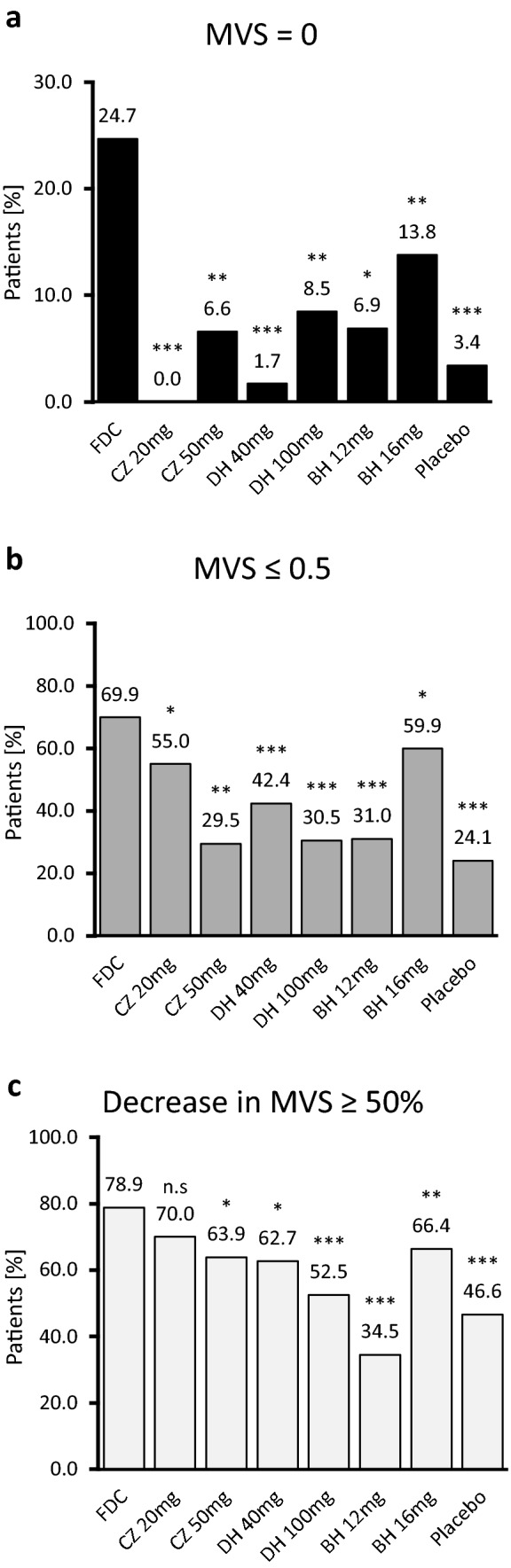
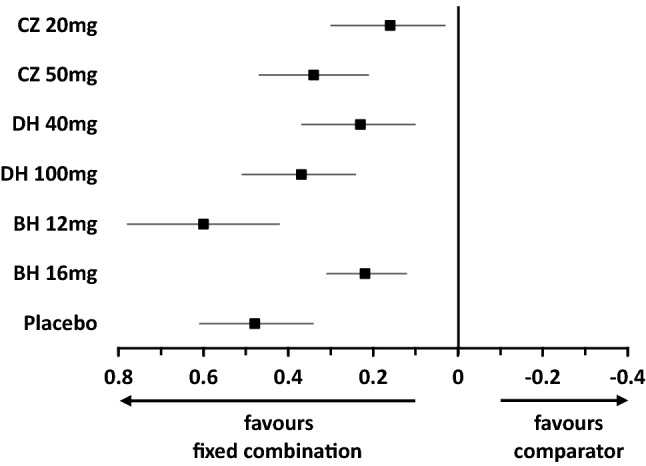
Of 795 randomised patients, 779 belonged to the intent-to treat (ITT) and 723 to the per-protocol (PP) population. The main efficacy analysis was based on the ITT population (mean age 52.1 years, 61% female). The mean decrease of the MVS from baseline to Week 4 in the cinnarizine/dimenhydrinate group (-1.10) proved to be significantly larger than in any of the comparator groups. LSM differences for comparators versus the fixed combination ranged between 0.16 (95% confidence interval (CI) 0.03; 0.30, p = 0.017) for cinnarizine 20 mg and 0.60 (95% CI 0.42; 0.78; p < 0.001) for betahistine dimesylate 12 mg in favour of the fixed combination. Furthermore, after 4 weeks of treatment, 74 patients (24.7%) in the cinnarizine/dimenhydrinate group were completely symptom free (MVS = 0), a significantly greater proportion than in any of the comparator groups. Sensitivity analyses showed that baseline characteristics such as age, sex, duration of vertigo and antivertigo pretreatment had only a very minor and clinically non-relevant impact on the efficacy results regarding the primary efficacy outcome. Subgroup analyses with respect to age groups (< 65 years/≥ 65 years) and sex showed no significant differences in efficacy within any of the treatment groups. All treatments were well tolerated. A total of 55 patients (6.9%) reported 75 non-serious adverse events (AEs), and 19 patients (2.4%) discontinued the study prematurely because of AEs. Nearly 95% of the patients (cinnarizine/dimenhydrinate group: 97.9%) rated the tolerability of the study medications as either "good" or "very good".
The findings of the present meta-analysis indicate that the fixed combination of cinnarizine and dimenhydrinate is a safe and potentially superior treatment option for patients suffering from central and/or peripheral vestibular vertigo, as compared to current standard treatments such as cinnarizine, dimenhydrinate or betahistine given alone in monotherapy.
四项个体随机、双盲、参照和/或安慰剂对照临床试验的原始数据,采用几乎相同的研究设计进行了汇总,用于本次荟萃分析。主要目的是进一步评估盐酸桂利嗪 20mg 和茶苯海明 40mg 固定复方制剂与其他各种抗眩晕治疗在中枢性和/或周围性前庭眩晕患者中的疗效和安全性。
成年男女门诊患者接受盐酸桂利嗪 20mg 和茶苯海明 40mg 固定复方制剂、盐酸桂利嗪(20mg、50mg)、茶苯海明(40mg、100mg)、倍他司汀甲磺酸(12mg)、倍他司汀二盐酸盐(16mg)和安慰剂治疗 4 周。主要疗效终点是降低经验证的平均眩晕评分(MVS),这是 12 个个体眩晕症状的综合评分,患者分别用 5 分视觉模拟量表评估其强度。为了分析主要和次要疗效终点,采用基线调整的协方差分析(ANCOVA),计算治疗组之间 MVS 降低差异的调整最小二乘均值(LSM),并伴有双侧 95%置信区间(CI)。此外,还进行了各种敏感性分析、应答者和亚组分析以及安全性/耐受性的描述性分析。
795 名随机患者中,779 名属于意向治疗(ITT)人群,723 名属于方案人群(平均年龄 52.1 岁,61%为女性)。Cinnarizine/dimenhydrinate 组从基线到第 4 周的 MVS 平均下降(-1.10)明显大于任何对照药物组。比较药物与固定复方制剂的 LSM 差异为 0.16(95%CI 0.03;0.30,p = 0.017),对于盐酸桂利嗪 20mg,0.60(95%CI 0.42;0.78;p < 0.001),对于倍他司汀甲磺酸 12mg,均有利于固定复方制剂。此外,治疗 4 周后,Cinnarizine/dimenhydrinate 组 74 例患者(24.7%)完全无症状(MVS = 0),显著高于任何对照药物组。敏感性分析显示,基线特征如年龄、性别、眩晕持续时间和抗眩晕预处理对主要疗效结果的疗效仅有非常小的、临床无关的影响。年龄组(<65 岁/≥65 岁)和性别亚组分析显示,任何治疗组的疗效均无显著差异。所有治疗均耐受良好。共有 55 例患者(6.9%)报告了 75 例非严重不良事件(AE),19 例患者(2.4%)因 AE 提前退出研究。近 95%的患者(盐酸桂利嗪/茶苯海明组:97.9%)认为研究药物的耐受性为“好”或“非常好”。
本次荟萃分析的结果表明,与当前的标准治疗方法(如单独使用盐酸桂利嗪、茶苯海明或倍他司汀)相比,盐酸桂利嗪和茶苯海明的固定复方制剂是一种安全且可能更优的治疗选择,适用于患有中枢性和/或周围性前庭眩晕的患者。