• 文献检索
  • 文档翻译
  • 深度研究
  • 学术资讯
  • Suppr Zotero 插件Zotero 插件
  • 邀请有礼
  • 套餐&价格
  • 历史记录
应用&插件
Suppr Zotero 插件Zotero 插件浏览器插件Mac 客户端Windows 客户端微信小程序
定价
高级版会员购买积分包购买API积分包
服务
文献检索文档翻译深度研究API 文档MCP 服务
关于我们
关于 Suppr公司介绍联系我们用户协议隐私条款
关注我们

Suppr 超能文献

核心技术专利:CN118964589B侵权必究
粤ICP备2023148730 号-1Suppr @ 2026

文献检索

告别复杂PubMed语法,用中文像聊天一样搜索,搜遍4000万医学文献。AI智能推荐,让科研检索更轻松。

立即免费搜索

文件翻译

保留排版,准确专业,支持PDF/Word/PPT等文件格式,支持 12+语言互译。

免费翻译文档

深度研究

AI帮你快速写综述,25分钟生成高质量综述,智能提取关键信息,辅助科研写作。

立即免费体验

帕克太阳探测器对近日太阳日球电流片中磁重联产生的太阳风高能质子束的观测。

Parker Solar Probe Observations of Solar Wind Energetic Proton Beams Produced by Magnetic Reconnection in the Near-Sun Heliospheric Current Sheet.

作者信息

Phan T D, Verniero J L, Larson D, Lavraud B, Drake J F, Øieroset M, Eastwood J P, Bale S D, Livi R, Halekas J S, Whittlesey P L, Rahmati A, Stansby D, Pulupa M, MacDowall R J, Szabo P A, Koval A, Desai M, Fuselier S A, Velli M, Hesse M, Pyakurel P S, Maheshwari K, Kasper J C, Stevens J M, Case A W, Raouafi N E

机构信息

SSL University of California Berkeley CA USA.

NASA Goddard Space Flight Center Greenbelt MD USA.

出版信息

Geophys Res Lett. 2022 May 16;49(9):e2021GL096986. doi: 10.1029/2021GL096986. Epub 2022 May 4.

DOI:10.1029/2021GL096986
PMID:35864893
原文链接:https://pmc.ncbi.nlm.nih.gov/articles/PMC9286436/
Abstract

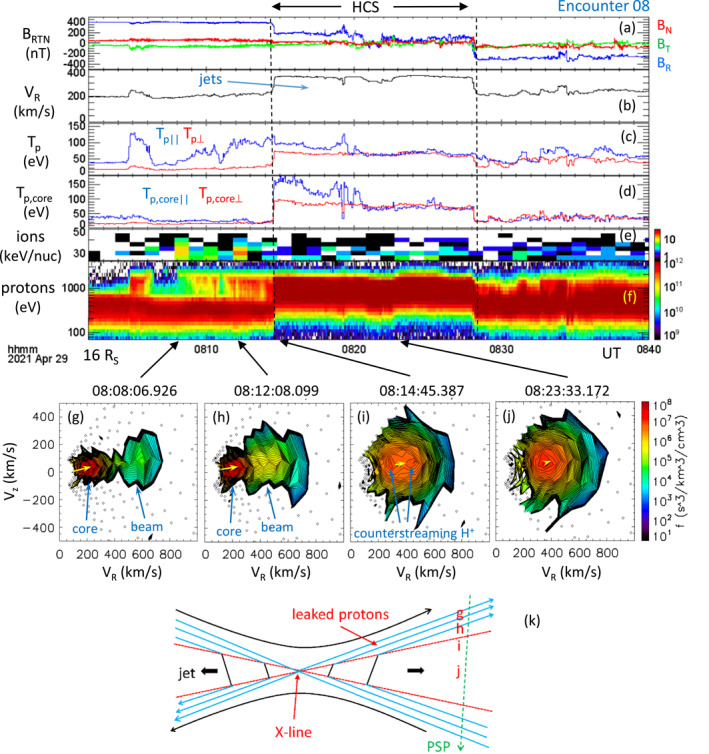
We report observations of reconnection exhausts in the Heliospheric Current Sheet (HCS) during Parker Solar Probe Encounters 08 and 07, at 16 and 20 , respectively. Heliospheric current sheet (HCS) reconnection accelerated protons to almost twice the solar wind speed and increased the proton core energy by a factor of ∼3, due to the Alfvén speed being comparable to the solar wind flow speed at these near-Sun distances. Furthermore, protons were energized to super-thermal energies. During E08, energized protons were found to have leaked out of the exhaust along separatrix field lines, appearing as field-aligned energetic proton beams in a broad region outside the HCS. Concurrent dropouts of strahl electrons, indicating disconnection from the Sun, provide further evidence for the HCS being the source of the beams. Around the HCS in E07, there were also proton beams but without electron strahl dropouts, indicating that their origin was not the local HCS reconnection exhaust.

摘要

我们报告了在帕克太阳探测器第08次和第07次相遇期间,分别在16和20时对日球电流片(HCS)中重联耗尽区的观测结果。由于在这些近日距离处阿尔文速度与太阳风流速相当,日球电流片(HCS)重联将质子加速到几乎两倍于太阳风速度,并使质子核心能量增加了约3倍。此外,质子被加速到超热能量。在E08期间,发现被加速的质子沿着分离线磁力线从耗尽区泄漏出来,在HCS外的广阔区域表现为场向高能质子束。同时出现的日冕电子束缺失,表明与太阳断开连接,这为HCS是这些束流的来源提供了进一步证据。在E07的HCS周围也有质子束,但没有日冕电子束缺失,这表明它们的起源不是当地的HCS重联耗尽区。

https://cdn.ncbi.nlm.nih.gov/pmc/blobs/9baf/9286436/838cd01ff218/GRL-49-0-g002.jpg
https://cdn.ncbi.nlm.nih.gov/pmc/blobs/9baf/9286436/39edf1fe97b5/GRL-49-0-g003.jpg
https://cdn.ncbi.nlm.nih.gov/pmc/blobs/9baf/9286436/a28d72afd138/GRL-49-0-g004.jpg
https://cdn.ncbi.nlm.nih.gov/pmc/blobs/9baf/9286436/673945958c5f/GRL-49-0-g001.jpg
https://cdn.ncbi.nlm.nih.gov/pmc/blobs/9baf/9286436/838cd01ff218/GRL-49-0-g002.jpg
https://cdn.ncbi.nlm.nih.gov/pmc/blobs/9baf/9286436/39edf1fe97b5/GRL-49-0-g003.jpg
https://cdn.ncbi.nlm.nih.gov/pmc/blobs/9baf/9286436/a28d72afd138/GRL-49-0-g004.jpg
https://cdn.ncbi.nlm.nih.gov/pmc/blobs/9baf/9286436/673945958c5f/GRL-49-0-g001.jpg
https://cdn.ncbi.nlm.nih.gov/pmc/blobs/9baf/9286436/838cd01ff218/GRL-49-0-g002.jpg

相似文献

1
Parker Solar Probe Observations of Solar Wind Energetic Proton Beams Produced by Magnetic Reconnection in the Near-Sun Heliospheric Current Sheet.帕克太阳探测器对近日太阳日球电流片中磁重联产生的太阳风高能质子束的观测。
Geophys Res Lett. 2022 May 16;49(9):e2021GL096986. doi: 10.1029/2021GL096986. Epub 2022 May 4.
2
Probing the energetic particle environment near the Sun.探测太阳附近的高能粒子环境。
Nature. 2019 Dec;576(7786):223-227. doi: 10.1038/s41586-019-1811-1. Epub 2019 Dec 4.
3
Interchange reconnection as the source of the fast solar wind within coronal holes.日冕洞高速太阳风中的交换重联源。
Nature. 2023 Jun;618(7964):252-256. doi: 10.1038/s41586-023-05955-3. Epub 2023 Jun 7.
4
(STEREO) Observations of Stream Interaction Regions in 2007 - 2016: Relationship with Heliospheric Current Sheets, Solar Cycle Variations, and Dual Observations.(STEREO)2007 - 2016年流相互作用区域的观测:与日球电流片、太阳周期变化及双视角观测的关系
Sol Phys. 2019 Mar;294(3). doi: 10.1007/s11207-019-1416-8. Epub 2019 Mar 6.
5
Parker Solar Probe Enters the Magnetically Dominated Solar Corona.帕克太阳探测器进入磁主导的日冕。
Phys Rev Lett. 2021 Dec 17;127(25):255101. doi: 10.1103/PhysRevLett.127.255101.
6
Direct evidence for kinetic effects associated with solar wind reconnection.与太阳风重联相关的动力学效应的直接证据。
Sci Rep. 2015 Jan 28;5:8080. doi: 10.1038/srep08080.
7
Highly structured slow solar wind emerging from an equatorial coronal hole.高速结构太阳风源自赤道日冕洞。
Nature. 2019 Dec;576(7786):237-242. doi: 10.1038/s41586-019-1818-7. Epub 2019 Dec 4.
8
ARTEMIS observations of the solar wind proton scattering function from lunar crustal magnetic anomalies.阿耳忒弥斯对来自月球地壳磁异常的太阳风质子散射函数的观测。
J Geophys Res Planets. 2017 Apr;122(4):771-783. doi: 10.1002/2017je005313. Epub 2017 Apr 10.
9
Searching for a Solar Source of Magnetic-Field Switchbacks in Parker Solar Probe's First Encounter.在帕克太阳探测器首次遭遇中寻找磁场折返的太阳来源。
Sol Phys. 2022;297(7):90. doi: 10.1007/s11207-022-02022-4. Epub 2022 Jul 15.
10
Reflected Protons in the Lunar Wake and Their Effects on Wake Potentials.月球尾迹中的反射质子及其对尾迹电势的影响。
J Geophys Res Space Phys. 2020 Jul;125(7). doi: 10.1029/2020ja028154. Epub 2020 Jun 7.

本文引用的文献

1
Guide Field Reconnection: Exhaust Structure and Heating.引导场重联:排气结构与加热
Geophys Res Lett. 2018 May 28;45(10):4569-4577. doi: 10.1029/2018GL077670. Epub 2018 May 19.
2
A New Inner Heliosphere Proton Parameter Dataset from the Mission.来自该任务的一个新的日球层内部质子参数数据集。
Sol Phys. 2018;293(11):155. doi: 10.1007/s11207-018-1377-3. Epub 2018 Nov 26.
3
The FIELDS Instrument Suite for Solar Probe Plus: Measuring the Coronal Plasma and Magnetic Field, Plasma Waves and Turbulence, and Radio Signatures of Solar Transients.
“帕克”太阳探测器的FIELDS仪器套件:测量日冕等离子体和磁场、等离子体波与湍流以及太阳瞬变的射电信号特征
Space Sci Rev. 2016 Dec;204(1-4):49-82. doi: 10.1007/s11214-016-0244-5. Epub 2016 Mar 31.
4
A magnetic reconnection X-line extending more than 390 Earth radii in the solar wind.一条在太阳风中延伸超过390个地球半径的磁重联X线。
Nature. 2006 Jan 12;439(7073):175-8. doi: 10.1038/nature04393.