Department of Astrophysical Sciences, Princeton University, Princeton, NJ, USA.
Goddard Space Flight Center, Greenbelt, MD, USA.
Nature. 2019 Dec;576(7786):223-227. doi: 10.1038/s41586-019-1811-1. Epub 2019 Dec 4.
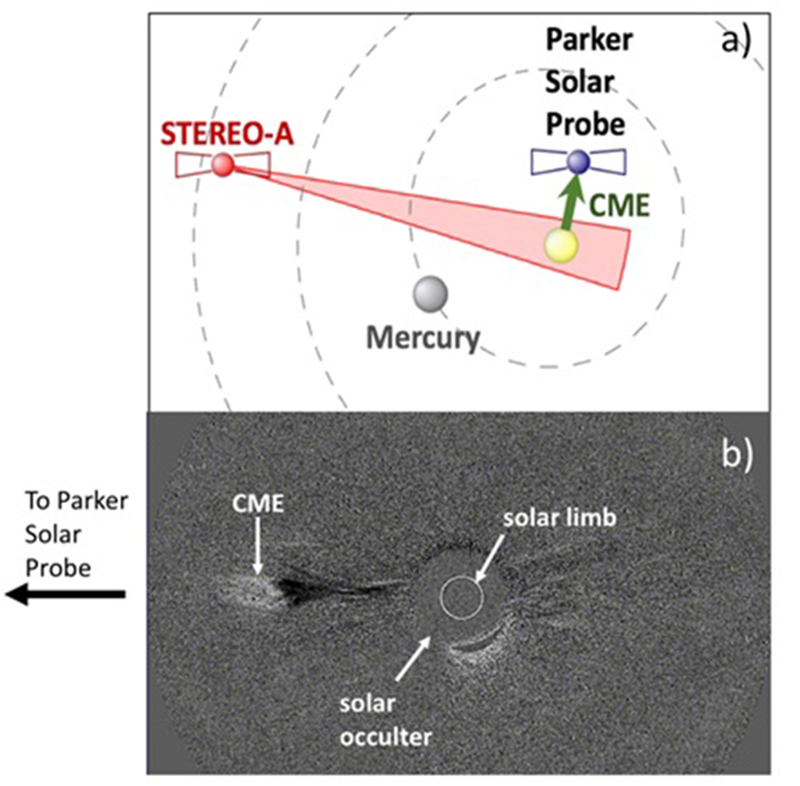
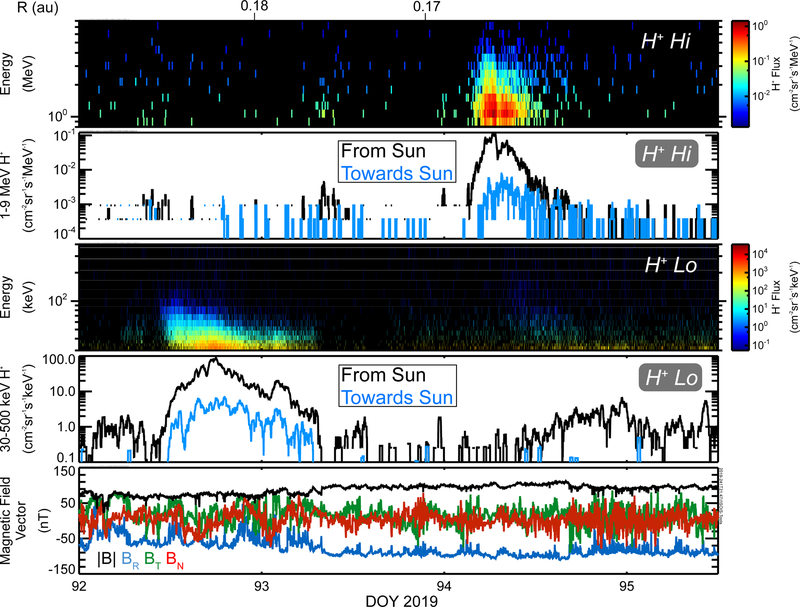
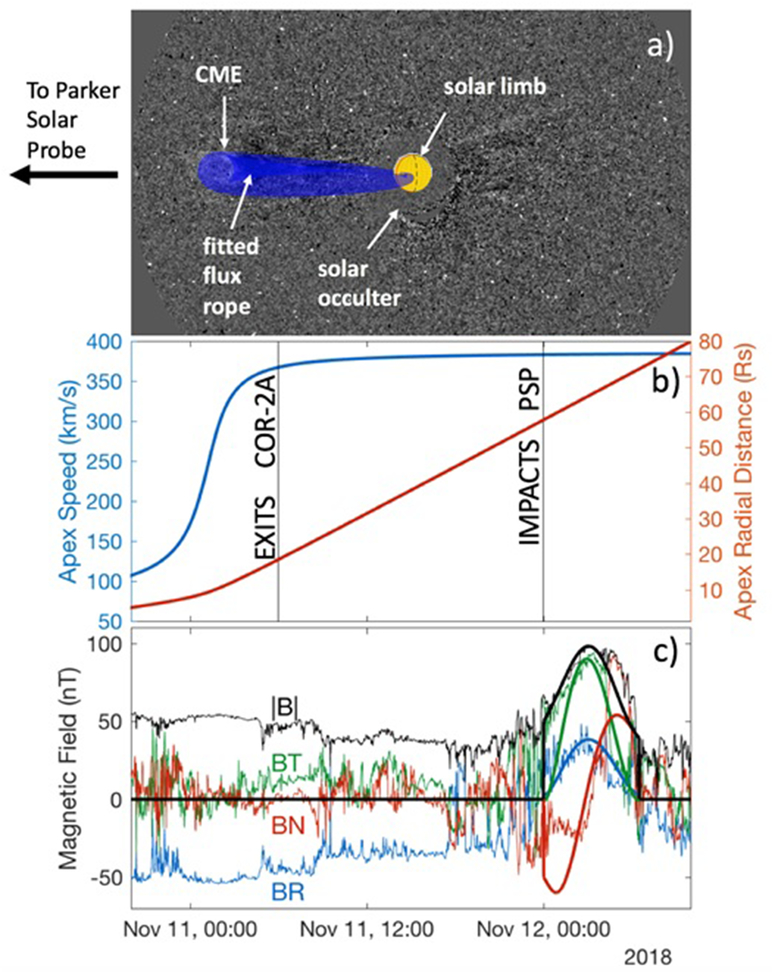
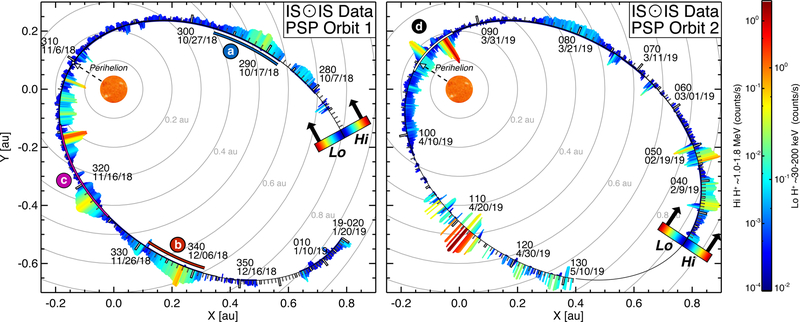
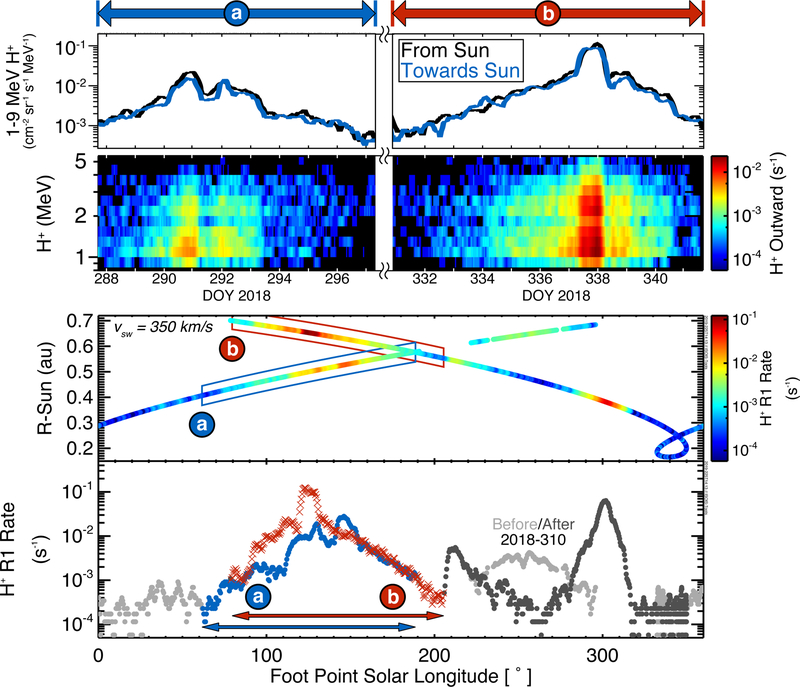
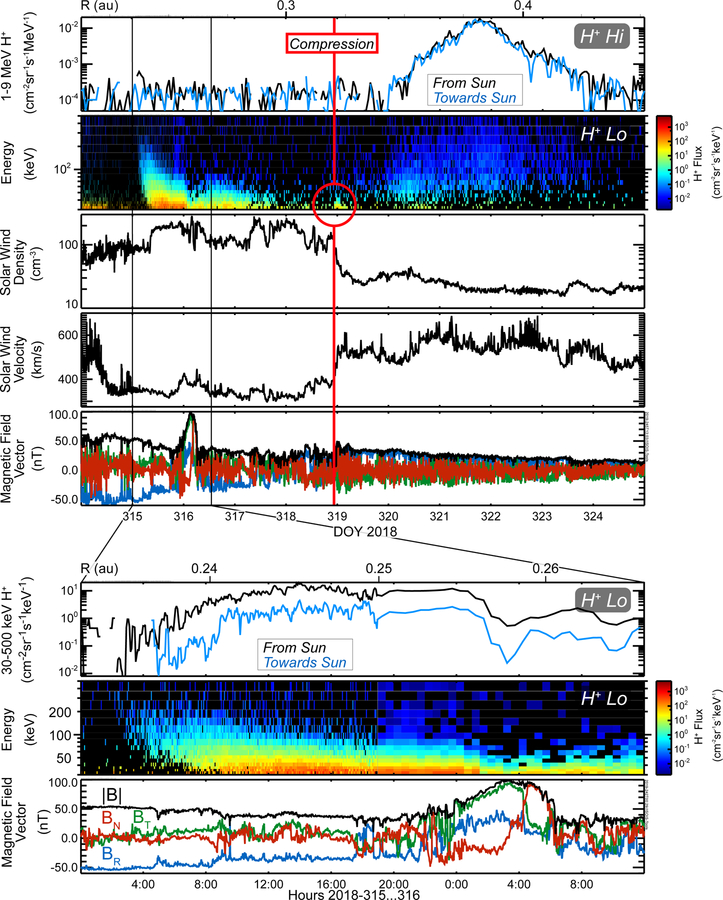
NASA's Parker Solar Probe mission recently plunged through the inner heliosphere of the Sun to its perihelia, about 24 million kilometres from the Sun. Previous studies farther from the Sun (performed mostly at a distance of 1 astronomical unit) indicate that solar energetic particles are accelerated from a few kiloelectronvolts up to near-relativistic energies via at least two processes: 'impulsive' events, which are usually associated with magnetic reconnection in solar flares and are typically enriched in electrons, helium-3 and heavier ions, and 'gradual' events, which are typically associated with large coronal-mass-ejection-driven shocks and compressions moving through the corona and inner solar wind and are the dominant source of protons with energies between 1 and 10 megaelectronvolts. However, some events show aspects of both processes and the electron-proton ratio is not bimodally distributed, as would be expected if there were only two possible processes. These processes have been very difficult to resolve from prior observations, owing to the various transport effects that affect the energetic particle population en route to more distant spacecraft. Here we report observations of the near-Sun energetic particle radiation environment over the first two orbits of the probe. We find a variety of energetic particle events accelerated both locally and remotely including by corotating interaction regions, impulsive events driven by acceleration near the Sun, and an event related to a coronal mass ejection. We provide direct observations of the energetic particle radiation environment in the region just above the corona of the Sun and directly explore the physics of particle acceleration and transport.
美国国家航空航天局(NASA)的帕克太阳探测器任务最近穿过了太阳的内日球层,到达近日点,距离太阳约 2400 万公里。此前在更远的太阳位置(主要在 1 个天文单位的距离处)进行的研究表明,太阳高能粒子通过至少两种过程从几千电子伏特加速到近相对论能量:“脉冲”事件,通常与太阳耀斑中的磁重联有关,通常富含电子、氦-3 和重离子,以及“渐变”事件,通常与大日冕物质抛射驱动的激波和压缩有关,这些激波和压缩穿过日冕和内太阳风运动,是能量在 1 到 10 兆电子伏特之间的质子的主要来源。然而,一些事件表现出两种过程的特征,而且电子-质子比不是双峰分布,如果只有两种可能的过程,这是预期的。由于影响高能粒子种群向更远的航天器传输的各种输运效应,这些过程在之前的观测中很难得到解决。在这里,我们报告了探测器前两个轨道上近太阳高能粒子辐射环境的观测结果。我们发现了各种加速的高能粒子事件,包括在本地和远程加速的事件,其中包括由日心相互作用区、太阳附近加速驱动的脉冲事件和与日冕物质抛射有关的事件。我们提供了在太阳日冕上方区域高能粒子辐射环境的直接观测,并直接探索了粒子加速和输运的物理过程。