Rau Domenico, Attene Giovanna, Rodriguez Monica, Baghino Limbo, Pisanu Anna Barbara, Sanna Davide, Acquadro Alberto, Portis Ezio, Comino Cinzia
Dipartimento di Agraria, Sezione di Agronomia, Coltivazioni Erbacee e Genetica (SACEG), Università degli Studi di Sassari, Sassari, Italy.
Agenzia AGRIS Sardegna (Servizio Ricerca sui Sistemi Colturali Erbacei, Settore Innovazione dei Modelli Gestionali e Studio Della Biodiversità Nelle Colture Intensive), Oristano, Italy.
Front Plant Sci. 2022 Jul 5;13:898740. doi: 10.3389/fpls.2022.898740. eCollection 2022.
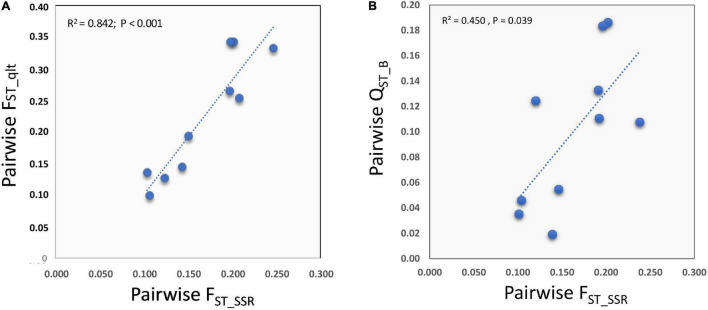
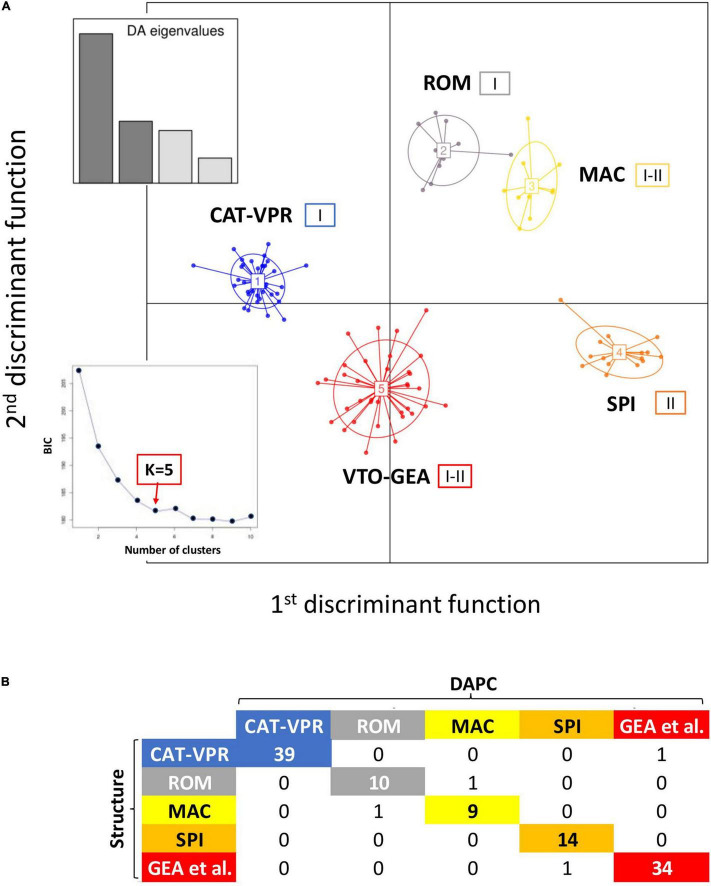
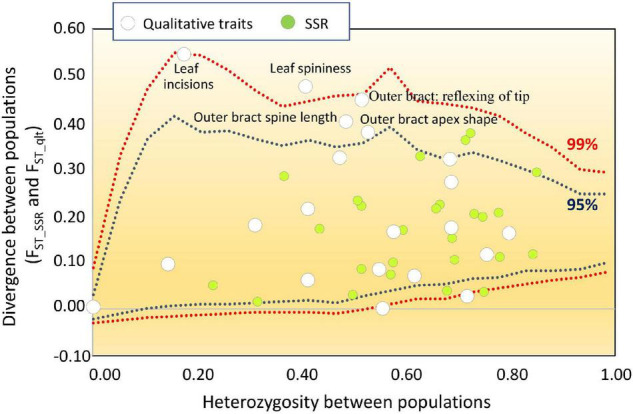
The knowledge of the organization of the domesticated gene pool of crop species is an essential requirement to understand crop evolution, to rationalize conservation programs, and to support practical decisions in plant breeding. Here, we integrate simple sequence repeat (SSR) analysis and phenotypic characterization to investigate a globe artichoke collection that comprises most of the varieties cultivated worldwide. We show that the cultivated gene pool of globe artichoke includes five distinct genetic groups associated with the major phenotypic typologies: Catanesi (which based on our analysis corresponds to Violetti di Provenza), Spinosi, Violetti di Toscana, Romaneschi, and Macau. We observed that 17 and 11% of the molecular and phenotypic variance, respectively, is between these groups, while within groups, strong linkage disequilibrium and heterozygote excess are evident. The divergence between groups for quantitative traits correlates with the average broad-sense heritability within the groups. The phenotypic divergence between groups for both qualitative and quantitative traits is strongly and positively correlated with SSR divergence (F) between groups. All this implies a low population size and strong bottleneck effects, and indicates a long history of clonal propagation and selection during the evolution of the domesticated gene pool of globe artichoke. Moreover, the comparison between molecular and phenotypic population structures suggests that harvest time, plant architecture (i.e., plant height, stem length), leaf spininess, head morphology (i.e., head shape, bract shape, spininess) together with the number of heads per plant were the main targets of selection during the evolution of the cultivated germplasm. We emphasize our findings in light of the potential exploitation of this collection for association mapping studies.
了解作物物种驯化基因库的组织情况是理解作物进化、合理化保护计划以及支持植物育种实际决策的必要条件。在此,我们整合简单序列重复(SSR)分析和表型特征来研究一个包含全球大部分栽培品种的球茎甘蓝种质资源库。我们发现,球茎甘蓝的栽培基因库包括与主要表型类型相关的五个不同遗传组:卡塔内西(根据我们的分析,它对应于普罗旺斯紫罗兰)、多刺型、托斯卡纳紫罗兰、罗马花椰菜和澳门品种。我们观察到,这些组间分子方差和表型方差分别为17%和11%,而在组内,强连锁不平衡和杂合子过剩现象明显。组间数量性状的差异与组内平均广义遗传力相关。组间定性和数量性状的表型差异与组间SSR差异(F)呈强正相关。所有这些都意味着种群规模较小和强烈的瓶颈效应,并表明在球茎甘蓝驯化基因库的进化过程中存在长期的克隆繁殖和选择历史。此外,分子和表型种群结构的比较表明,收获时间、植株结构(即株高、茎长)、叶片多刺性、花球形态(即花球形状、苞片形状、多刺性)以及单株花球数量是栽培种质进化过程中的主要选择目标。鉴于该种质资源库在关联作图研究中的潜在利用价值,我们强调了我们的研究结果。