Xie Fei, Li Xiandong, Xu Yue, Cheng Dongliang, Xia Xianru, Lv Xi, Yuan Guolin, Peng Chunyan
Department of Laboratory Medicine, Taihe Hospital, Hubei University of Medicine, Shiyan, China.
Department of Outpatient, Taihe Hospital, Hubei University of Medicine, Shiyan, China.
Front Cardiovasc Med. 2022 Jul 5;9:895916. doi: 10.3389/fcvm.2022.895916. eCollection 2022.
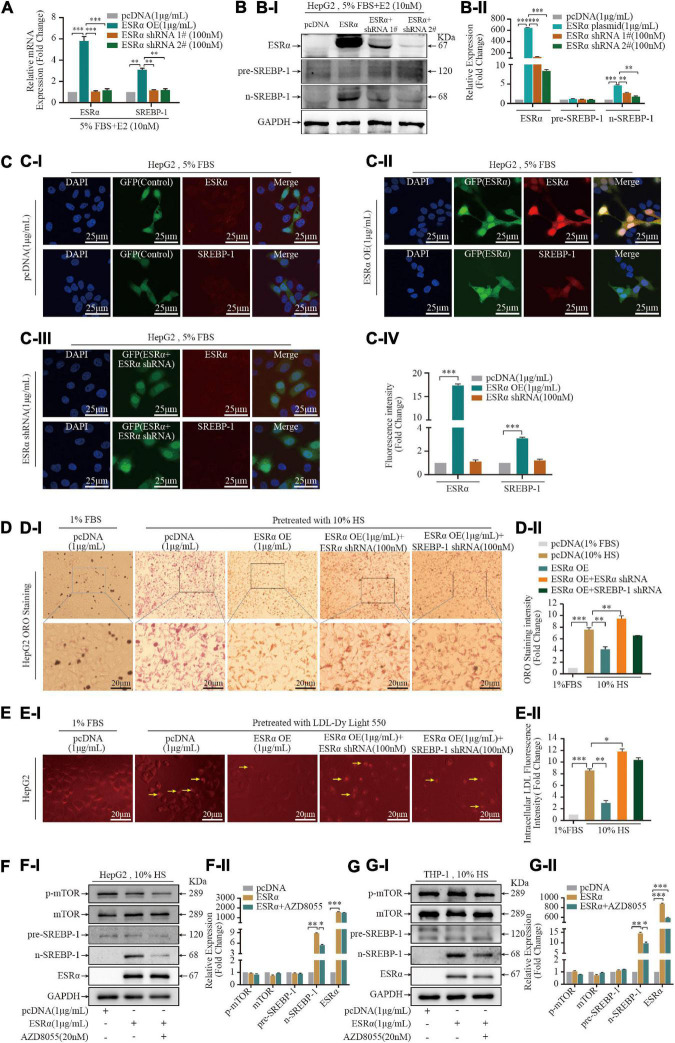
Menopause is associated with dyslipidemia and an increased risk of cardiovascular disease, the underlying mechanism of dyslipidemia is attributed to an insufficiency of estrogen. In this study, we find that estrogen mediates an atherosclerotic-protective action estrogen receptor alpha/SREBP-1 signaling. Increased lipid accumulation and low-density lipoprotein (LDL)-uptake in HepG2 cells and THP-1 macrophages were induced by treatment of mixed hyperlipidemic serum from postmenopausal women; 17β-estradiol [estrogen (E2)] (10 nM) administration significantly improved hyperlipidemic profiles, relieved fatty-liver damage and attenuated the plaque area in the heart chamber of high-fat diet (HFD)-fed ovariectomized (OVX) Apo mice. Expression of sterol regulatory element-binding protein (SREBP)-1 mRNA of circulating leukocytes in postmenopausal women was strongly correlated to the serum E2 level. Exploration of data from the Gene Expression Profiling Interactive Analysis (GEPIA) database revealed that expression of SREBP-1 protein correlated to expression of estrogen receptor (ESR)α protein in the liver, blood and in normal tissue. Genetic overexpression/inhibition of ESRα resulted in increased/decreased SREBP-1 expression as well as attenuated/deteriorated lipid deposition . An inhibitor of the protein kinase B/mammalian target of rapamycin (AKT/mTOR) pathway, AZD8055, abolished ESRα-induced SREBP-1 expression in HepG2 cells. Moreover, E2 and statin co-treatment significantly reduced lipid accumulation and hindered the progression of atherosclerosis and fatty-liver damage in OVX Apo mice. Collectively, our results suggest that estrogen could exerted its atherosclerotic-protective action ESRα/SREBP-1 signaling. E2 might enhance the cellular sensitivity of statins and could be used as a novel therapeutic strategy against atherosclerotic disorders in postmenopausal women.
更年期与血脂异常及心血管疾病风险增加相关,血脂异常的潜在机制归因于雌激素不足。在本研究中,我们发现雌激素通过雌激素受体α/固醇调节元件结合蛋白-1(SREBP-1)信号介导抗动脉粥样硬化作用。绝经后女性混合高脂血症血清处理诱导了HepG2细胞和THP-1巨噬细胞中脂质蓄积增加及低密度脂蛋白(LDL)摄取增加;给予17β-雌二醇[雌激素(E2)](10 nM)可显著改善高脂血症情况,减轻脂肪肝损伤并减小高脂饮食(HFD)喂养的去卵巢(OVX)Apo小鼠心腔中的斑块面积。绝经后女性循环白细胞中固醇调节元件结合蛋白(SREBP)-1 mRNA的表达与血清E2水平密切相关。对基因表达谱交互式分析(GEPIA)数据库数据的探索显示,SREBP-1蛋白的表达与肝脏、血液及正常组织中雌激素受体(ESR)α蛋白的表达相关。ESRα的基因过表达/抑制导致SREBP-1表达增加/减少以及脂质沉积减轻/恶化。蛋白激酶B/雷帕霉素哺乳动物靶标(AKT/mTOR)通路抑制剂AZD8055消除了ESRα诱导的HepG2细胞中SREBP-1的表达。此外,E2与他汀类药物联合治疗显著减少了脂质蓄积,并阻碍了OVX Apo小鼠动脉粥样硬化和脂肪肝损伤的进展。总体而言,我们的结果表明雌激素可通过ESRα/SREBP-1信号发挥其抗动脉粥样硬化作用。E2可能增强细胞对他汀类药物的敏感性,并可作为绝经后女性抗动脉粥样硬化疾病的一种新治疗策略。