Chen Lu, Lu Xisuo, Wang Xin, Hu Zhen, Zhang Linfeng, Zheng Congyi, Chen Zuo, Cao Xue, Tian Yixin, Wang Zengwu
Department of Nephrology, First Medical Center of Chinese PLA General Hospital, State Key Laboratory of Kidney Diseases, National Clinical Research Center for Kidney Diseases, Beijing Key Laboratory of Medical Devices and Integrated Traditional Chinese and Western Drug Development for Severe Kidney Diseases,Beijing Key Laboratory of Digital Intelligent TCM for the Preventionand Treatment of Pan-vascular Diseases, Key Disciplines of National Administration of Traditional Chinese Medicine(zyyzdxk-2023310), Beijing, China.
Department of Information, Beijing Friendship Hospital, Capital Medical University, Beijing, China.
J Glob Health. 2025 May 16;15:04154. doi: 10.7189/jogh.15.04154.
The association between age of menarche, age of menopause, reproductive lifespan and risk of stroke in Chinese women remains unclear and requires further clarification.
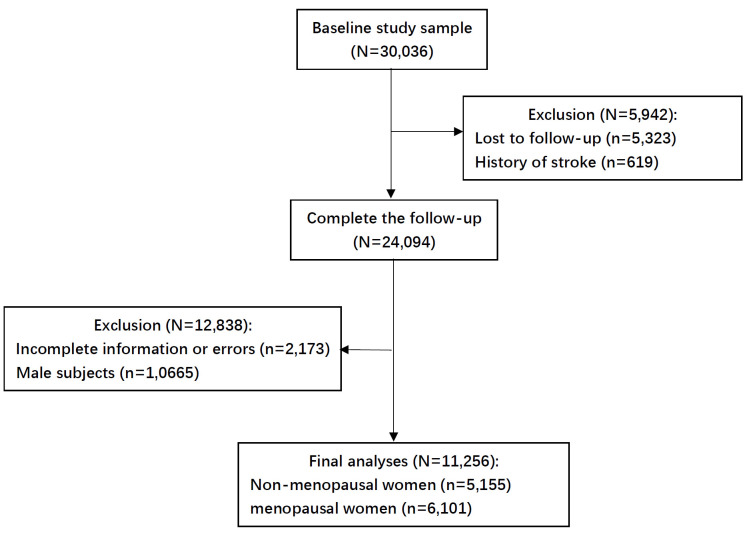
A stratified multi-stage random sampling method was used to select participants at baseline in 2012-2015. The participants' basic information was collected through a standardised questionnaire by professional investigator and examined by trained medical personnel. Follow-up was conducted in 2018-2020 to collect the stroke events. The Cox proportional hazards models were used to evaluate hazard ratios between reproductive factors and stroke risk.
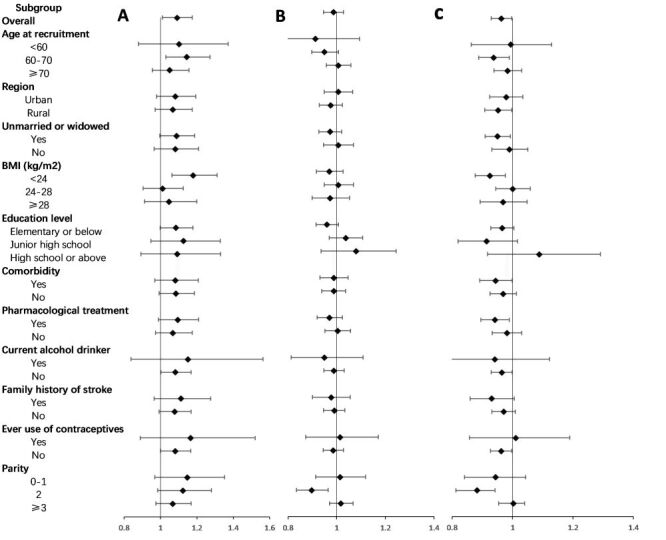
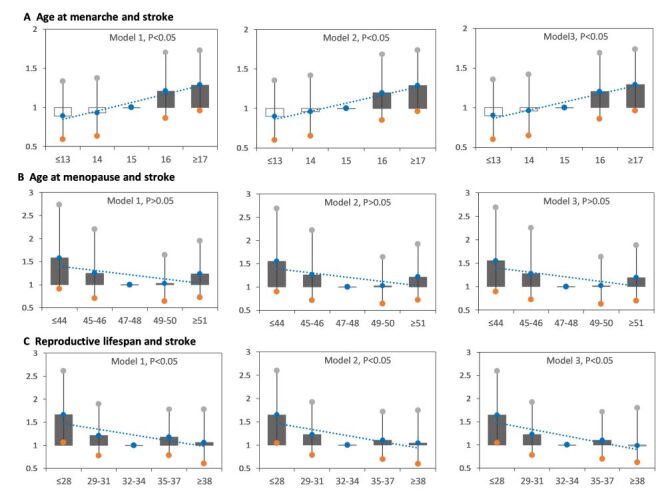
Overall, 11 256 women (5155 non-menopausal women and 6101 menopausal women) were included (mean (x̄); standard deviation (SD) age = 55.2; 12.9 years). The risk was highest in women with menarche at age ≥17 years (hazard ratio (HR) = 1.290; 95% confidence interval (CI) = 0.959-1.733) and with reproductive lifespan ≤28 years (HR = 1.643; 95% CI = 1.041-2.595). Age at menarche was positively associated with risk of stroke (HR = 1.086; 95% CI = 1.006-1.172). There was a negative association between age at menopause and stroke risk in women with two live births (HR = 0.897; 95% CI = 0.834-0.964). Reproductive lifespan was negatively associated with risk of stroke (HR = 0.963; 95% CI = 0.946-1.027). Subgroup analysis also showed that association between age at menarche, reproductive lifespan and stroke events.
Chinese women with late age at menarche and shorter reproductive lifespan have higher risk of stroke according to a large prospective study.
中国女性月经初潮年龄、绝经年龄、生殖寿命与中风风险之间的关联尚不清楚,需要进一步阐明。
采用分层多阶段随机抽样方法,在2012 - 2015年选取基线参与者。参与者的基本信息由专业调查员通过标准化问卷收集,并由经过培训的医务人员进行检查。2018 - 2020年进行随访以收集中风事件。采用Cox比例风险模型评估生殖因素与中风风险之间的风险比。
总体纳入11256名女性(5155名未绝经女性和6101名绝经女性)(均值(x̄);标准差(SD)年龄 = 55.2;12.9岁)。月经初潮年龄≥17岁的女性风险最高(风险比(HR)= 1.290;95%置信区间(CI)= 0.959 - 1.733),生殖寿命≤28年的女性风险最高(HR = 1.643;95% CI = 1.041 - 2.595)。月经初潮年龄与中风风险呈正相关(HR = 1.086;95% CI = 1.006 - 1.172)。在有两次活产的女性中,绝经年龄与中风风险呈负相关(HR = 0.897;95% CI = 0.834 - 0.964)。生殖寿命与中风风险呈负相关(HR = 0.963;95% CI = 0.946 - 1.027)。亚组分析也显示了月经初潮年龄、生殖寿命与中风事件之间的关联。
一项大型前瞻性研究表明,月经初潮年龄晚且生殖寿命短的中国女性中风风险更高。