Department of Psychiatry and Behavioral Medicine, Medical College of Wisconsin, Milwaukee, WI, United States.
Department of Medicine, Medical College of Wisconsin, Milwaukee, WI, United States.
Front Immunol. 2022 Jul 5;13:877558. doi: 10.3389/fimmu.2022.877558. eCollection 2022.
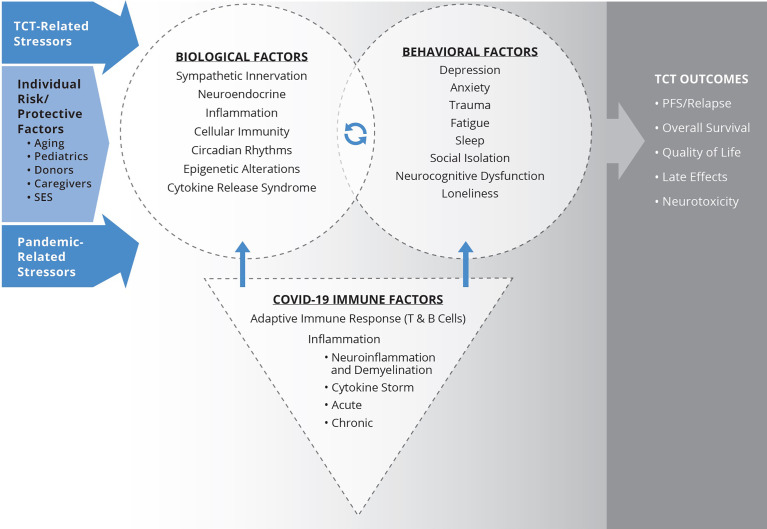
A growing body of literature has emphasized the importance of biobehavioral processes - defined as the interaction of behavior, psychology, socioenvironmental factors, and biological processes - for clinical outcomes among transplantation and cellular therapy (TCT) patients. TCT recipients are especially vulnerable to distress associated with pandemic conditions and represent a notably immunocompromised group at greater risk for SARS-CoV-2 infection with substantially worse outcomes. The summation of both the immunologic and psychologic vulnerability of TCT patients renders them particularly susceptible to adverse biobehavioral sequelae associated with the Covid-19 pandemic. Stress and adverse psychosocial factors alter neural and endocrine pathways through sympathetic nervous system and hypothalamic-pituitary-adrenal axis signaling that ultimately affect gene regulation in immune cells. Reciprocally, global inflammation and immune dysregulation related to TCT contribute to dysregulation of neuroendocrine and central nervous system function, resulting in the symptom profile of depression, fatigue, sleep disturbance, and cognitive dysfunction. In this article, we draw upon literature on immunology, psychology, neuroscience, hematology and oncology, Covid-19 pathophysiology, and TCT processes to discuss how they may intersect to influence TCT outcomes, with the goal of providing an overview of the significance of biobehavioral factors in understanding the relationship between Covid-19 and TCT, now and for the future. We discuss the roles of depression, anxiety, fatigue, sleep, social isolation and loneliness, and neurocognitive impairment, as well as specific implications for sub-populations of interest, including pediatrics, caregivers, and TCT donors. Finally, we address protective psychological processes that may optimize biobehavioral outcomes affected by Covid-19.
越来越多的文献强调了生物行为过程的重要性——定义为行为、心理、社会环境因素和生物过程的相互作用——对于移植和细胞治疗 (TCT) 患者的临床结果。TCT 受者特别容易受到与大流行相关的痛苦的影响,并且由于 SARS-CoV-2 感染的风险更高,他们是免疫功能明显受损的群体,结果明显更差。TCT 患者的免疫和心理脆弱性的总和使他们特别容易受到与 Covid-19 大流行相关的不良生物行为后果的影响。压力和不良的社会心理因素通过交感神经系统和下丘脑-垂体-肾上腺轴信号改变神经和内分泌途径,最终影响免疫细胞中的基因调节。反过来,与 TCT 相关的全身炎症和免疫失调导致神经内分泌和中枢神经系统功能失调,导致抑郁、疲劳、睡眠障碍和认知功能障碍的症状谱。在本文中,我们借鉴了免疫学、心理学、神经科学、血液学和肿瘤学、Covid-19 病理生理学以及 TCT 过程的文献,讨论它们如何相互作用以影响 TCT 结果,目的是概述生物行为因素在理解 Covid-19 与 TCT 之间关系的重要性,现在和未来都是如此。我们讨论了抑郁、焦虑、疲劳、睡眠、社会隔离和孤独以及神经认知障碍的作用,以及儿科、护理人员和 TCT 供体等特定感兴趣人群的具体影响。最后,我们探讨了可能优化受 Covid-19 影响的生物行为结果的保护心理过程。