Trueba Gabriel, Jeyaseelan Vishali, Lopez Lazaro, Mainou Bernardo A, Zhang Yiting, Whittembury Alvaro, Valarezo Alfredo Jose Olmedo, Baquero Gonzalo, de Aguinaga Rosa Romero, Salinas Lucia Jeannete Zurita, Mancheno Maria Gabriela Santacruz, Chacho Diana Elizabeth Medina, Quentin Emmanuelle, Chevez Ana Elena, Rey-Benito Gloria, Mach Ondrej
University of San Francisco, Quito, Ecuador.
Polio Eradication Department, World Health Organization, Avenue Appia 20, CH-1211 Genève 27, Geneva, Switzerland.
Lancet Reg Health Am. 2022 Jul;11:None. doi: 10.1016/j.lana.2022.100235.
In January 2018, Ecuador changed its routine immunization schedule by replacing one full dose of inactivated poliovirus vaccine (IPV) administered intramuscularly at 2 months of age with two doses of fractional IPV (1/5th of full dose, fIPV) administered intradermally at 2 and 4 months of age; and bivalent oral poliovirus vaccine (serotypes 1 and 3, bOPV) continues to be used. We compared seroprevalence and titres of polio antibodies achieved by the past and the current immunization schedules.
This was a cross-sectional serological survey in children in Ecuador who received bOPV and either one IPV dose in 2017 or two fIPV doses in 2018. One blood sample was collected between October 2020 and March 2021 and analysed for presence of poliovirus neutralizing antibodies at CDC, Atlanta by microneutralization assay.
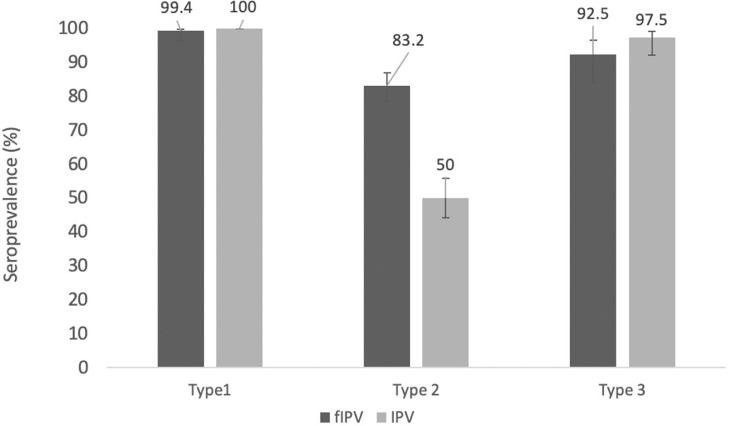
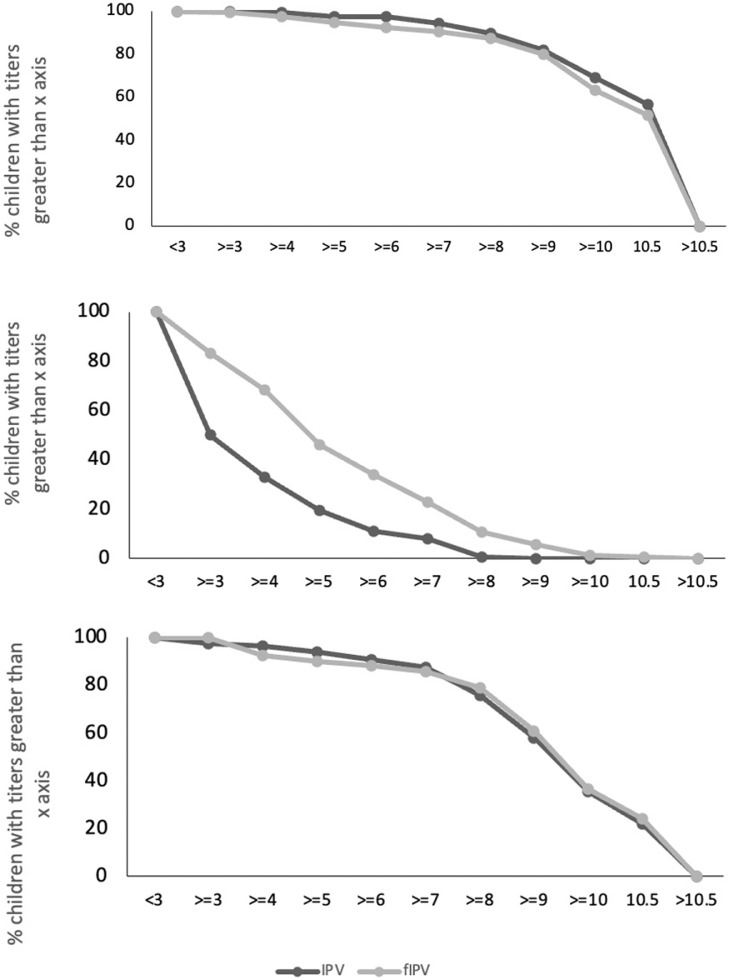
We obtained 321 analysable samples from 329 (97·6%) enrolled children (160 received IPV and 161 fIPV). For serotype 2, seroprevalence was 50·0% (CI95%= 44·2-55·8%) for IPV and 83·2% (CI95%=78·5-87·1%) for fIPV recipients (p<0·001). Median antibody titers for serotype 2 were significantly lower for IPV than for fIPV recipients (3·0, CI95%= 3 - 3·5 vs. 4·8, CI95%= 4·5 - 5·2, p<0·001). Seroprevalence for serotypes 1 and 3 was above 90% and was not significantly different between IPV and fIPV recipients.
Ecuador achieved significantly better poliovirus serotype 2 immunogenicity with two fIPV doses than with one IPV dose, while preserving vaccine supply and reducing costs. Our data provide further evidence that fIPV is a beneficial and potentially a cost-effective option in polio immunization.
WHO obtained funds for the study from Rotary International.
2018年1月,厄瓜多尔改变了其常规免疫计划,将2月龄时肌肉注射的一剂全剂量灭活脊髓灰质炎病毒疫苗(IPV)替换为2月龄和4月龄时皮内注射的两剂部分剂量IPV(全剂量的1/5,fIPV);同时继续使用二价口服脊髓灰质炎病毒疫苗(1型和3型,bOPV)。我们比较了过去和当前免疫计划所产生的脊髓灰质炎抗体血清阳性率和滴度。
这是一项针对厄瓜多尔儿童的横断面血清学调查,这些儿童在2017年接受了bOPV和一剂IPV,或在2018年接受了两剂fIPV。在2020年10月至2021年3月期间采集一份血样,并通过微量中和试验在亚特兰大的疾病控制与预防中心分析是否存在脊髓灰质炎病毒中和抗体。
我们从329名登记儿童(97.6%)中获得了321份可分析样本(160名接受IPV,161名接受fIPV)。对于2型脊髓灰质炎病毒,接受IPV儿童的血清阳性率为50.0%(95%CI=44.2-55.8%),接受fIPV儿童的血清阳性率为83.2%(95%CI=78.5-87.1%)(p<0.001)。接受IPV儿童的2型脊髓灰质炎病毒抗体滴度中位数显著低于接受fIPV儿童(3.0,95%CI=3-3.5对4.8,95%CI=4.5-5.2,p<0.001)。1型和3型脊髓灰质炎病毒的血清阳性率均高于90%,接受IPV和接受fIPV儿童之间无显著差异。
与一剂IPV相比,厄瓜多尔通过两剂fIPV在脊髓灰质炎病毒2型免疫原性方面取得了显著更好的效果,同时保持了疫苗供应并降低了成本。我们的数据进一步证明,fIPV在脊髓灰质炎免疫中是一种有益且可能具有成本效益的选择。
世界卫生组织从国际扶轮社获得了该研究的资金。