Hubacher David, Schreiber Courtney A, Turok David K, Jensen Jeffrey T, Creinin Mitchell D, Nanda Kavita, White Katharine O'Connell, Dayananda Ila, Teal Stephanie B, Chen Pai-Lien, Chen Beatrice A, Goldberg Alisa B, Kerns Jennifer L, Dart Clint, Nelson Anita L, Thomas Michael A, Archer David F, Brown Jill E, Castaño Paula M, Burke Anne E, Kaneshiro Bliss, Blithe Diana L
FHI 360, Durham, NC, USA.
Department of Obstetrics and Gynecology, University of Pennsylvania, Philadelphia, PA, USA.
EClinicalMedicine. 2022 Jul 16;51:101554. doi: 10.1016/j.eclinm.2022.101554. eCollection 2022 Sep.
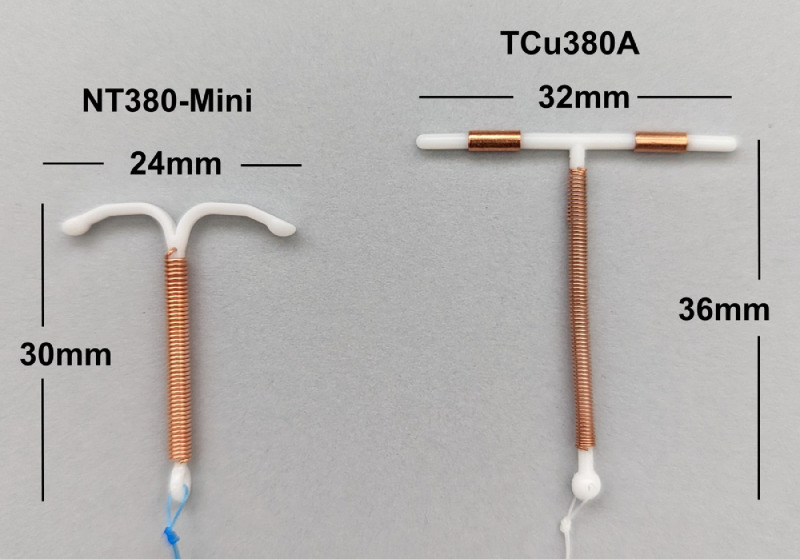
The most widely used copper intrauterine device (IUD) in the world (the TCu380A), and the only product available in many countries, causes side effects and early removals for many users. These problems are exacerbated in nulliparous women, who have smaller uterine cavities compared to parous women. We compared first-year continuation rates and reasons/probabilities for early removal of the TCu380A versus a smaller Belgian copper IUD among nulliparous users.
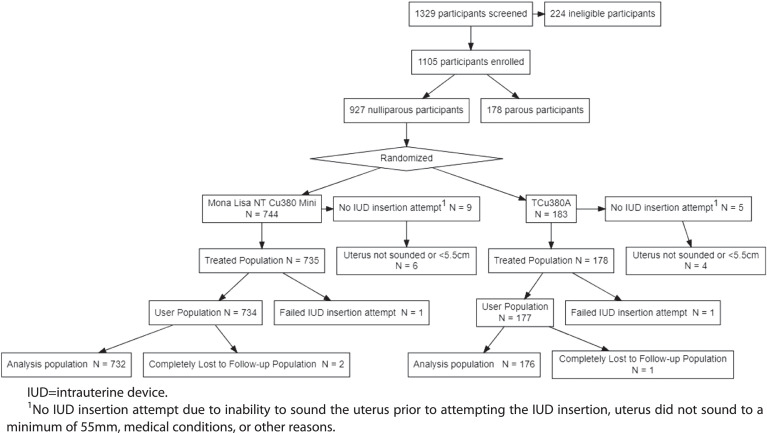
This 12-month interim report is derived from a pre-planned interim analysis of a sub population and focused on key secondary comparative endpoints. In this participant-blinded trial at 16 centres in the USA, we randomised participants aged 17-40 in a 4:1 ratio to the NT380-Mini or the TCu380A. In the first year, participants had follow-up visits at 6-weeks and 3, 6, and 12-months, and a phone contact at 9 months; we documented continued use, expulsions, and reasons for removal. Among participants with successful IUD placement, we compared probabilities of IUD continuation and specific reasons for discontinuation using log-rank tests. This trial is registered with ClinicalTrials.gov number NCT03124160 and is closed to recruitment.
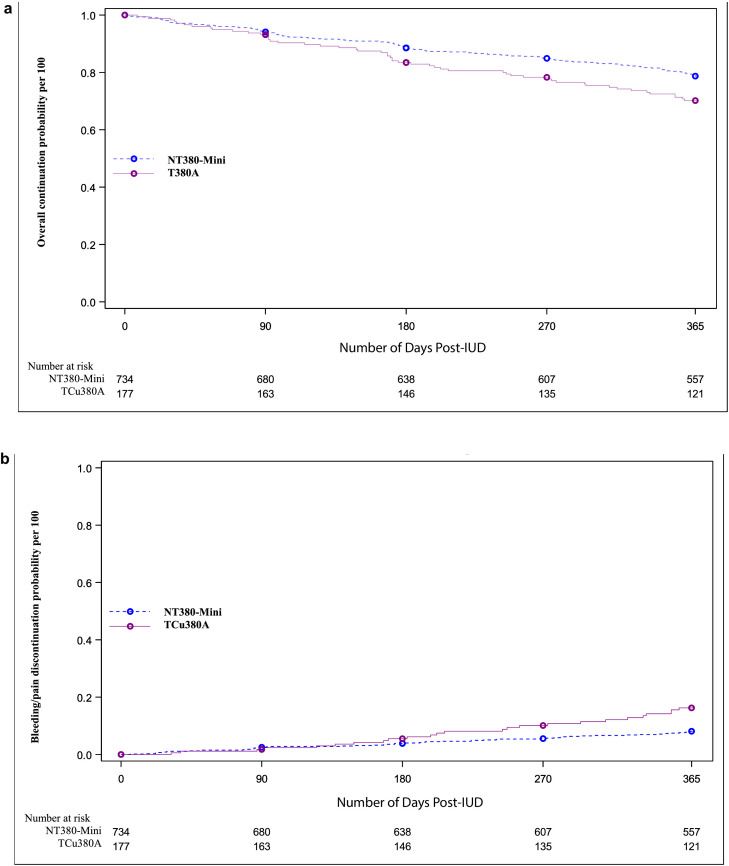
Between June 1, 2017, and February 25, 2019, we assigned 927 nulliparous women to either the NT380-Mini ( = 744) or the TCu380A ( = 183); the analysis population was 732 (NT380-Mini) and 176 (TCu380A). Participants using the NT380-Mini, compared to the TCu380A, had higher 12-month continuation rates (78·7% [95% CI: 72·9-84·5%] vs. 70·2% [95% CI: 59·7-80·7], = 0·014), lower rates of removal for bleeding and/or pain (8·1% vs. 16·2%, = 0·003) and lower IUD expulsion rates (4·8% vs. 8·9%, = 0·023), respectively.
The NT380-Mini offers important benefits for a nulliparous population compared to the TCu380A in the first twelve months, when pivotal experiences typically occur. Higher continuation rates with the NT380-Mini may avert disruptions in contraceptive use and help users avoid unintended pregnancy.
Bill & Melinda Gates Foundation, National Institute of Child Health and Human Development, and Mona Lisa, N.V. (Belgium).
全球使用最广泛的铜宫内节育器(IUD)(TCu380A),也是许多国家唯一可用的产品,导致许多使用者出现副作用并提前取出。这些问题在未生育女性中更为严重,她们的子宫腔比经产妇小。我们比较了未生育使用者中TCu380A与较小的比利时铜IUD的第一年续用率以及提前取出的原因/概率。
这份为期12个月的中期报告源自对一个亚人群的预先计划的中期分析,重点关注关键的次要比较终点。在美国16个中心进行的这项参与者设盲试验中,我们将17 - 40岁的参与者按4:1的比例随机分配至NT380 - Mini或TCu380A组。在第一年,参与者在6周、3个月、6个月和12个月时进行随访,并在9个月时进行电话联系;我们记录了持续使用情况、排出情况及取出原因。在IUD放置成功的参与者中,我们使用对数秩检验比较了IUD继续使用的概率和停用的具体原因。该试验已在ClinicalTrials.gov注册,注册号为NCT03124160,现已停止招募。
在2017年6月1日至2019年2月25日期间,我们将927名未生育女性分配至NT380 - Mini组(n = 744)或TCu380A组(n = 183);分析人群为732名(NT380 - Mini组)和176名(TCu380A组)。与TCu380A组相比,使用NT380 - Mini的参与者12个月续用率更高(78.7% [95%CI:72.9 - 84.5%] 对70.2% [95%CI:59.7 - 80.7%],P = 0.014),因出血和/或疼痛取出的比例更低(8.1%对16.2%,P = 0.003),IUD排出率也更低(4.8%对8.9%,P = 0.023)。
在最初十二个月这一关键体验期,与TCu380A相比,NT380 - Mini为未生育人群带来了重要益处。NT380 - Mini更高的续用率可能避免避孕使用中断,并帮助使用者避免意外怀孕。
比尔及梅琳达·盖茨基金会、美国国立儿童健康与人类发展研究所和比利时莫娜丽莎公司。