Fekri Nazanin, Parsaeian Mahboubeh, Pourreza Abolghasem, Swallow Ben, Amini Aminreza, Foroushani Abbas Rahimi
Department of Epidemiology and Biostatistics, School of Public Health, Tehran University of Medical Sciences, Tehran, Iran.
Department of Health Management and Economics, School of Public Health, Tehran University of Medical Sciences, Tehran, Iran.
Iran J Public Health. 2022 Feb;51(2):438-449. doi: 10.18502/ijph.v51i2.8697.
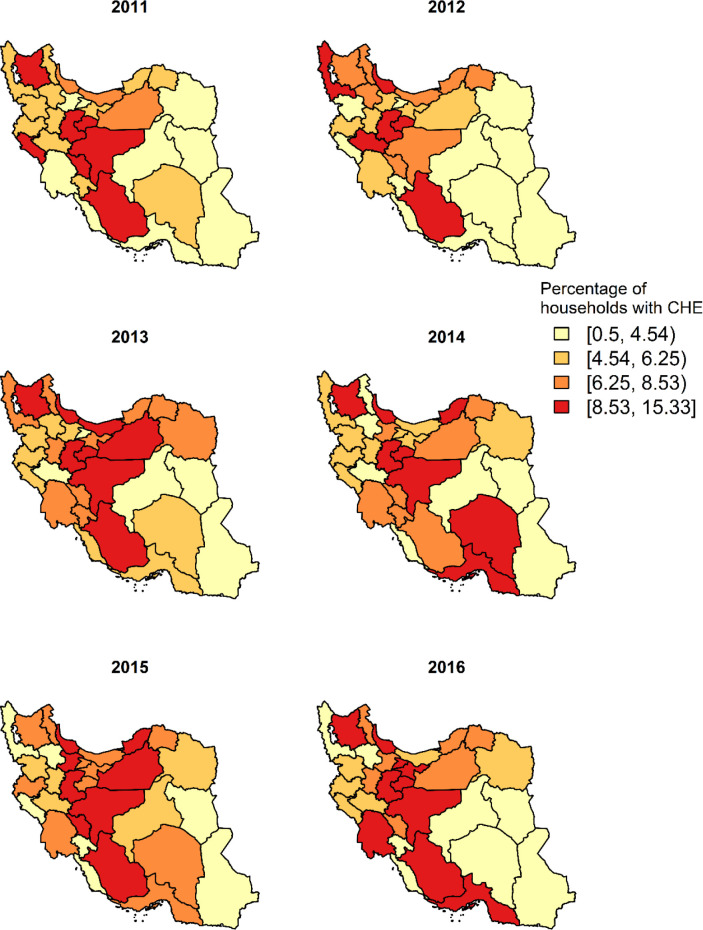
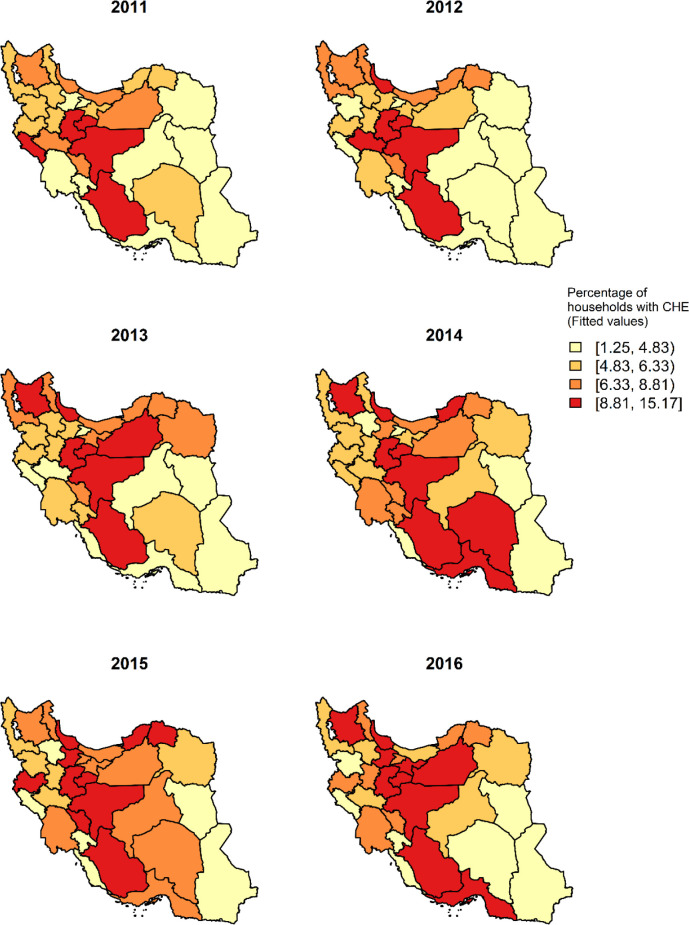
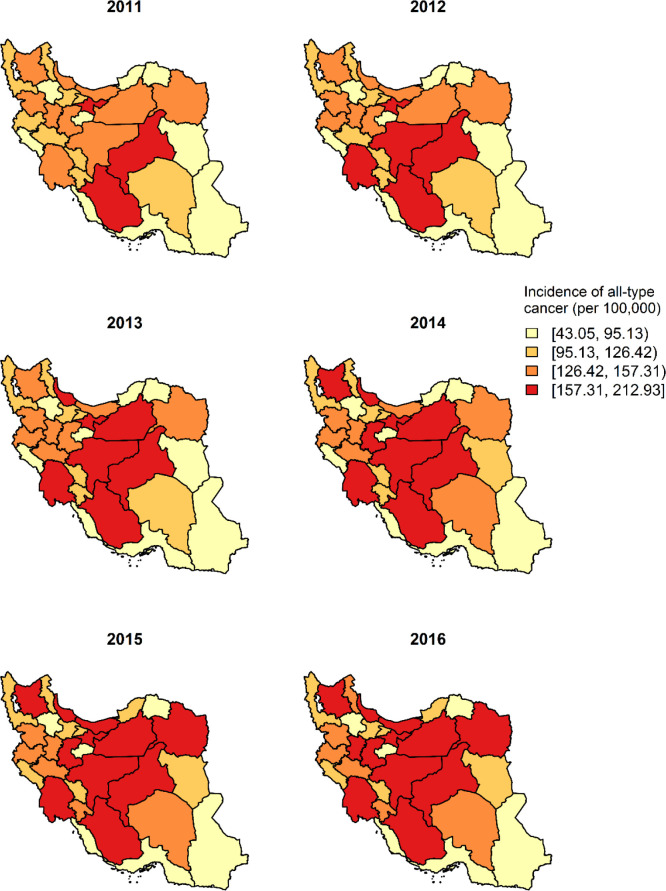
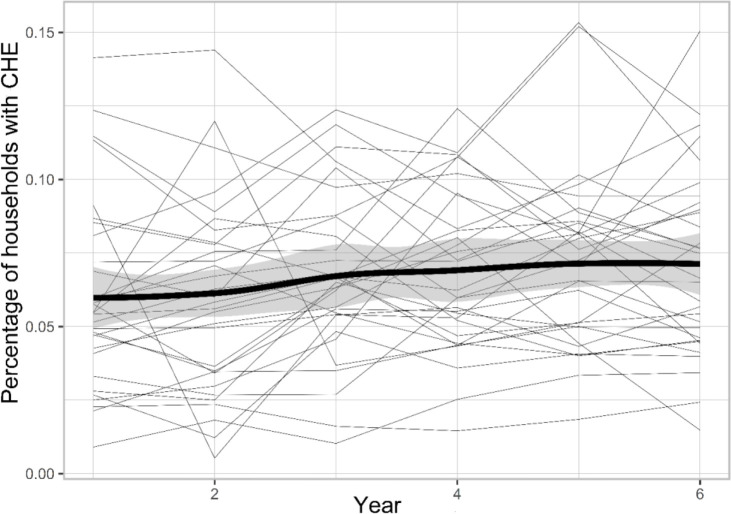
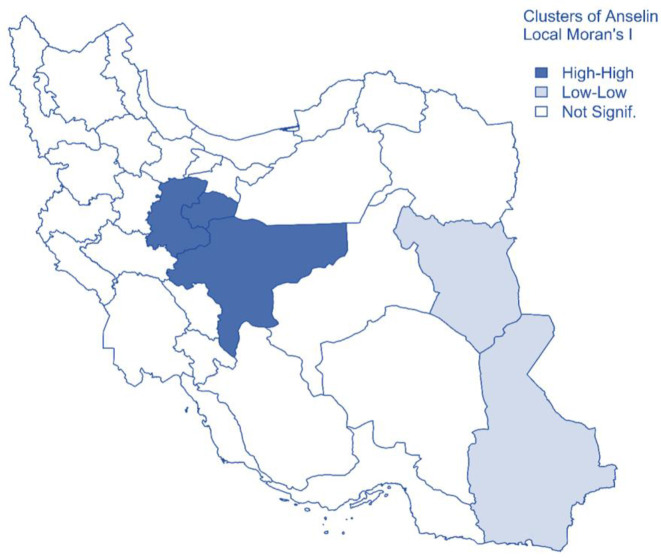
We investigated the impact of cancer incidence on CHE in Iran by considering spatial variation across provinces as well as temporal trends.
Data from Household Income-Expenditure Survey were merged with cancer incidence rates during 2011-2016. We developed a Bayesian hierarchical model to explore the spatial and temporal patterns of CHE and its associated factors at provincial level. We used a Besag-York-Mollie2 prior and a random walk prior for spatial and temporal random effects respectively. All statistical analysis was carried out in R software.
All-type cancer incidence (OR per SD (95% CrI) = 1.16 (1.02, 1.32)), unemployment rate (1.08 (1.01, 1.15)) and income equity (0.88 (0.81, 0.97)) have important association with CHE. Percentage of urbanization and percentage of poverty were not statistically significant.
The results suggest the development of new policies to protect cancer patients against financial hardship, narrow the gap in income inequality and solve the problem of high unemployment rate to reduce the level of CHE at provincial level.
我们通过考虑各省之间的空间差异以及时间趋势,研究了伊朗癌症发病率对灾难性医疗支出(CHE)的影响。
将家庭收入支出调查数据与2011 - 2016年期间的癌症发病率数据合并。我们开发了一个贝叶斯分层模型,以探索省级层面CHE的时空模式及其相关因素。我们分别对空间和时间随机效应使用了Besag - York - Mollie2先验和随机游走先验。所有统计分析均在R软件中进行。
所有类型癌症发病率(每标准差的比值比(95%可信区间)= 1.16(1.02,1.32))、失业率(1.08(1.01,1.15))和收入公平性(0.88(0.81,0.97))与CHE有重要关联。城市化百分比和贫困百分比无统计学意义。
结果表明应制定新政策,以保护癌症患者免受经济困难,缩小收入不平等差距并解决高失业率问题,从而降低省级层面的CHE水平。