Epidemiology and Health Services Research Unit CMN Siglo XXI, Mexican Institute of Social Security, Mexico City, Mexico.
Department of Global Health and Population, Harvard TH Chan School of Public Health, Boston, USA.
J Glob Health. 2022 Jul 23;12:05033. doi: 10.7189/jogh.12.05033.
Recovery of health services disrupted by the COVID-19 pandemic represents a significant challenge in low- and middle-income countries. In April 2021, the Mexican Institute of Social Security (IMSS), which provides health care to 68.5 million people, launched the National Strategy for Health Services Recovery (Recovery policy). The study objective was to evaluate whether the Recovery policy addressed COVID-related declines in maternal, child health, and non-communicable diseases (NCDs) services.
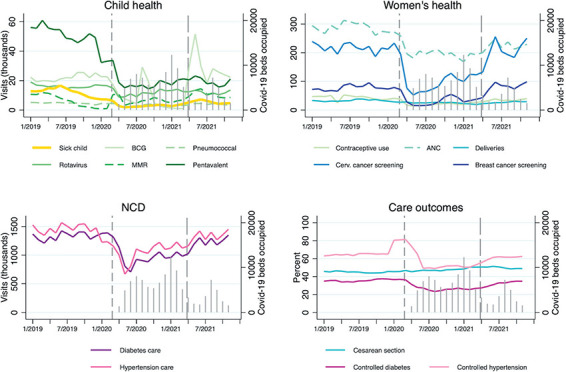
We analysed the data of 35 IMSS delegations from January 2019 to November 2021 on contraceptive visits, antenatal care consultations, deliveries, caesarean sections, sick children's consultations, child vaccination, breast and cervical cancer screening, diabetes and hypertension consultations, and control. We focused on the period before (April 2020 - March 2021) and during (April 2021 - November 2021) the Recovery policy and used an interrupted time series design and Poisson Generalized Estimating Equation models to estimate the association of this policy with service use and outcomes and change in their trends.
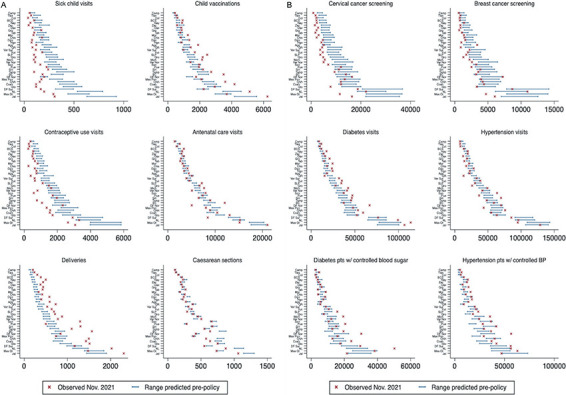
Despite the third wave of the pandemic in 2021, service utilization increased in the Recovery period, reaching (at minimum) 49% of pre-pandemic levels for sick children's consultations and (at maximum) 106% of pre-pandemic levels for breast cancer screenings. Evidence for the Recovery policy role was mixed: the policy was associated with increased facility deliveries (IRR = 1.15, 95%CI = 1.11-1.19) with a growing trend over time (IRR = 1.04, 95%CI = 1.03-1.05); antenatal care and child health services saw strong level effects but decrease over time. Additionally, the Recovery policy was associated with diabetes and hypertension control. Services recovery varied across delegations.
Health service utilization and NCDs control demonstrated important gains in 2021, but evidence suggests the policy had inconsistent effects across services and decreasing impact over time. Further efforts to strengthen essential health services and ensure consistent recovery across delegations are warranted.
新冠疫情大流行导致卫生服务的恢复面临重大挑战,这在中低收入国家尤为明显。2021 年 4 月,为 6850 万人提供医疗服务的墨西哥社会保险研究所(IMSS)推出了国家卫生服务恢复战略(恢复政策)。本研究旨在评估该政策是否解决了与新冠疫情相关的母婴健康和非传染性疾病(NCD)服务下降的问题。
我们分析了 2019 年 1 月至 2021 年 11 月 35 个 IMSS 代表团的数据,包括避孕咨询、产前保健咨询、分娩、剖腹产、儿童就诊、儿童疫苗接种、乳腺癌和宫颈癌筛查、糖尿病和高血压咨询以及控制。我们重点关注恢复政策实施前后(2020 年 4 月至 2021 年 3 月和 2021 年 4 月至 2021 年 11 月),并使用中断时间序列设计和泊松广义估计方程模型来评估该政策与服务使用和结果之间的关联,以及其趋势的变化。
尽管 2021 年出现了第三波疫情,但在恢复期间服务利用率增加,达到(最低)儿童就诊咨询的 49%和(最高)乳腺癌筛查的 106%,达到了疫情前的水平。该政策作用的证据喜忧参半:该政策与医疗机构分娩的增加相关(IRR=1.15,95%CI=1.11-1.19),并且随着时间的推移呈现出增长趋势(IRR=1.04,95%CI=1.03-1.05);产前保健和儿童健康服务的利用率有所提高,但随着时间的推移呈下降趋势。此外,该政策与糖尿病和高血压的控制有关。各代表团之间的服务恢复情况存在差异。
2021 年,卫生服务利用率和 NCD 控制取得了重要进展,但证据表明该政策对不同服务的影响不一致,并且随着时间的推移影响逐渐减弱。需要进一步努力加强基本卫生服务,并确保各代表团的恢复一致。