Usher Institute, University of Edinburgh, Edinburgh, UK.
Usher Institute, University of Edinburgh, Edinburgh, UK.
Lancet Infect Dis. 2021 Feb;21(2):193-202. doi: 10.1016/S1473-3099(20)30785-4. Epub 2020 Oct 22.
Non-pharmaceutical interventions (NPIs) were implemented by many countries to reduce the transmission of severe acute respiratory syndrome coronavirus 2 (SARS-CoV-2), the causal agent of COVID-19. A resurgence in COVID-19 cases has been reported in some countries that lifted some of these NPIs. We aimed to understand the association of introducing and lifting NPIs with the level of transmission of SARS-CoV-2, as measured by the time-varying reproduction number (R), from a broad perspective across 131 countries.
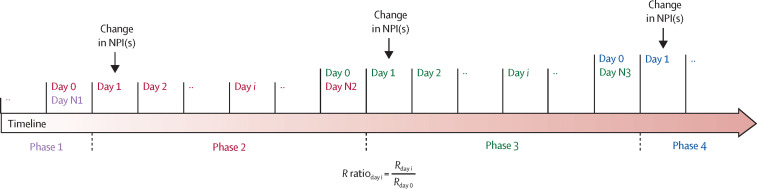
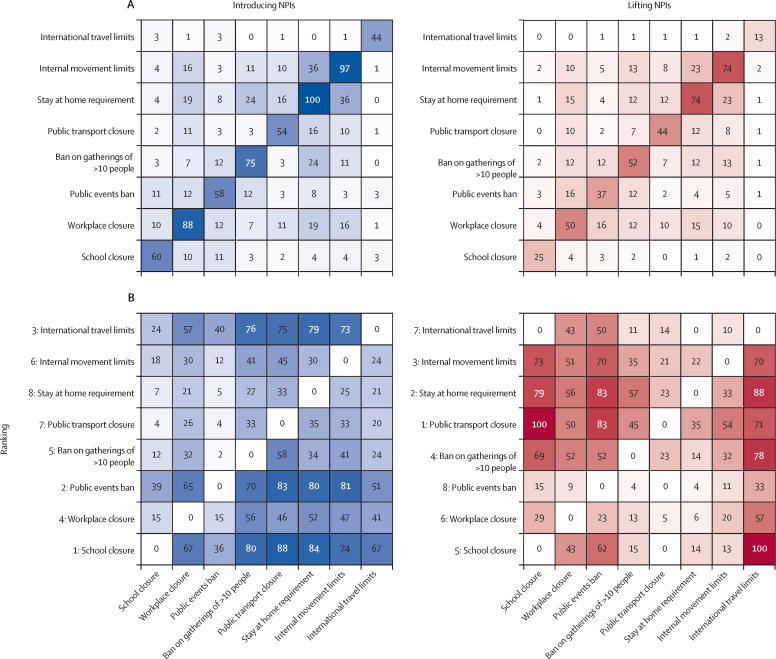
In this modelling study, we linked data on daily country-level estimates of R from the London School of Hygiene & Tropical Medicine (London, UK) with data on country-specific policies on NPIs from the Oxford COVID-19 Government Response Tracker, available between Jan 1 and July 20, 2020. We defined a phase as a time period when all NPIs remained the same, and we divided the timeline of each country into individual phases based on the status of NPIs. We calculated the R ratio as the ratio between the daily R of each phase and the R from the last day of the previous phase (ie, before the NPI status changed) as a measure of the association between NPI status and transmission of SARS-CoV-2. We then modelled the R ratio using a log-linear regression with introduction and relaxation of each NPI as independent variables for each day of the first 28 days after the change in the corresponding NPI. In an ad-hoc analysis, we estimated the effect of reintroducing multiple NPIs with the greatest effects, and in the observed sequence, to tackle the possible resurgence of SARS-CoV-2.
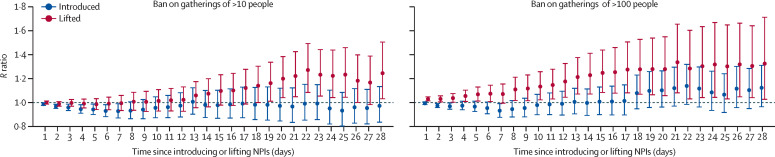
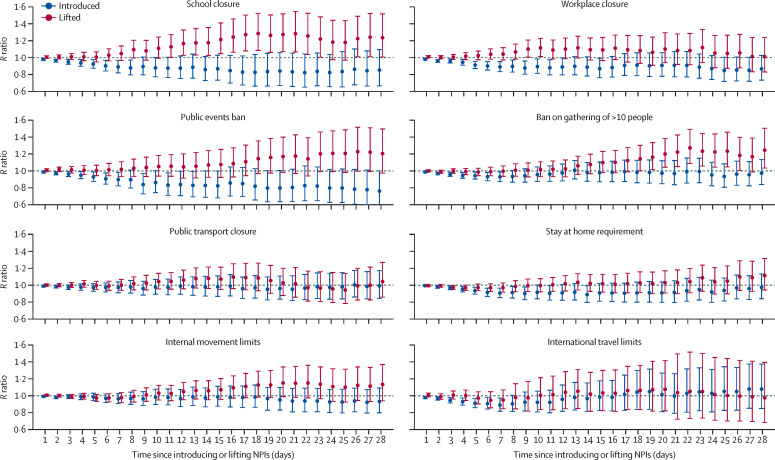
790 phases from 131 countries were included in the analysis. A decreasing trend over time in the R ratio was found following the introduction of school closure, workplace closure, public events ban, requirements to stay at home, and internal movement limits; the reduction in R ranged from 3% to 24% on day 28 following the introduction compared with the last day before introduction, although the reduction was significant only for public events ban (R ratio 0·76, 95% CI 0·58-1·00); for all other NPIs, the upper bound of the 95% CI was above 1. An increasing trend over time in the R ratio was found following the relaxation of school closure, bans on public events, bans on public gatherings of more than ten people, requirements to stay at home, and internal movement limits; the increase in R ranged from 11% to 25% on day 28 following the relaxation compared with the last day before relaxation, although the increase was significant only for school reopening (R ratio 1·24, 95% CI 1·00-1·52) and lifting bans on public gatherings of more than ten people (1·25, 1·03-1·51); for all other NPIs, the lower bound of the 95% CI was below 1. It took a median of 8 days (IQR 6-9) following the introduction of an NPI to observe 60% of the maximum reduction in R and even longer (17 days [14-20]) following relaxation to observe 60% of the maximum increase in R. In response to a possible resurgence of COVID-19, a control strategy of banning public events and public gatherings of more than ten people was estimated to reduce R, with an R ratio of 0·71 (95% CI 0·55-0·93) on day 28, decreasing to 0·62 (0·47-0·82) on day 28 if measures to close workplaces were added, 0·58 (0·41-0·81) if measures to close workplaces and internal movement restrictions were added, and 0·48 (0·32-0·71) if measures to close workplaces, internal movement restrictions, and requirements to stay at home were added.
Individual NPIs, including school closure, workplace closure, public events ban, ban on gatherings of more than ten people, requirements to stay at home, and internal movement limits, are associated with reduced transmission of SARS-CoV-2, but the effect of introducing and lifting these NPIs is delayed by 1-3 weeks, with this delay being longer when lifting NPIs. These findings provide additional evidence that can inform policy-maker decisions on the timing of introducing and lifting different NPIs, although R should be interpreted in the context of its known limitations.
Wellcome Trust Institutional Strategic Support Fund and Data-Driven Innovation initiative.
许多国家实施了非药物干预措施(NPIs),以降低严重急性呼吸综合征冠状病毒 2(SARS-CoV-2)的传播,SARS-CoV-2 是 COVID-19 的病原体。一些国家报告 COVID-19 病例出现反弹,这些国家已经取消了部分 NPI。我们旨在从更广泛的角度了解引入和取消 NPI 与 SARS-CoV-2 传播水平之间的关联,该传播水平通过时变繁殖数(R)来衡量。
在这项建模研究中,我们将伦敦卫生与热带医学院(英国伦敦)提供的每日国家层面 R 估计数据与牛津 COVID-19 政府应对追踪器(英国牛津)提供的国家特定 NPI 政策数据联系起来,数据时间为 2020 年 1 月 1 日至 7 月 20 日。我们将一个阶段定义为所有 NPI 保持不变的时间段,我们根据 NPI 的状况将每个国家的时间线划分为单独的阶段。我们将 R 比值定义为每个阶段的每日 R 与前一阶段(即在 NPI 状态发生变化之前的最后一天)的 R 之比,作为 NPI 状态与 SARS-CoV-2 传播之间关联的衡量标准。然后,我们使用对数线性回归模型,将引入和放松每种 NPI 作为第 1 天至第 28 天内对应 NPI 变化后的每一天的独立变量,来对 R 比值进行建模。在一个特别分析中,我们根据观察到的序列,估计引入最大影响的多种 NPI 的效果,以应对 SARS-CoV-2 的可能反弹。
131 个国家的 790 个阶段被纳入分析。引入学校关闭、工作场所关闭、公共活动禁令、居家要求和内部流动限制后,R 比值呈下降趋势;与引入前的最后一天相比,引入后的第 28 天 R 比值下降了 3%至 24%,尽管只有公共活动禁令的下降具有显著意义(R 比值 0.76,95%CI 0.58-1.00);对于所有其他 NPI,95%CI 的上限均高于 1。放松学校关闭、公共活动禁令、禁止超过 10 人的公共集会、居家要求和内部流动限制后,R 比值呈上升趋势;与放松前的最后一天相比,放松后的第 28 天 R 比值增加了 11%至 25%,尽管只有学校重新开放(R 比值 1.24,95%CI 1.00-1.52)和取消超过 10 人的公共集会禁令(1.25,95%CI 1.03-1.51)具有显著意义;对于所有其他 NPI,95%CI 的下限均低于 1。引入 NPI 后,平均需要 8 天(IQR 6-9)才能观察到 R 最大降低的 60%,而放松后需要更长时间(17 天[14-20])才能观察到 R 最大增加的 60%。为应对 COVID-19 的可能反弹,如果实施公共活动和超过 10 人的公共集会禁令,估计控制策略可降低 R,第 28 天的 R 比值为 0.71(95%CI 0.55-0.93),如果再加上工作场所关闭措施,则降至 0.62(0.47-0.82),如果再加上工作场所和内部流动限制措施,则降至 0.58(0.41-0.81),如果再加上工作场所关闭、内部流动限制和居家要求措施,则降至 0.48(0.32-0.71)。
包括学校关闭、工作场所关闭、公共活动禁令、禁止超过 10 人的公共集会、居家要求和内部流动限制在内的个别 NPI 与 SARS-CoV-2 的传播减少有关,但引入和取消这些 NPI 的效果会延迟 1-3 周,取消 NPI 的延迟时间更长。这些发现提供了更多的证据,可以为决策者决定引入和取消不同 NPI 的时间提供参考,尽管应在了解其已知局限性的情况下解释 R。
惠康信托基金机构战略支持基金和数据驱动创新计划。