Department of Anesthesiology, University of Colorado School of Medicine, University of Colorado Denver Anschutz Medical Campus, 12705 E Montview Blvd, Bioscience 2, Suite 200, Aurora, CO, 80045-7109, USA.
Division of Renal Diseases and Hypertension, University of Colorado School of Medicine, University of Colorado Anschutz Medical Campus, Aurora, CO, USA.
J Nephrol. 2023 Jan;36(1):83-91. doi: 10.1007/s40620-022-01361-6. Epub 2022 Jul 22.
Autosomal dominant polycystic kidney disease (ADPKD) is a common hereditary disorder, characterized by kidney cyst formation. A major pathological feature of ADPKD is the development of interstitial inflammation. Due to its role in inflammation and oxidative stress, tryptophan metabolism and related kynurenines may have relevance in ADPKD.
Data were collected from a well-characterized longitudinal cohort of pediatric and adult patients with ADPKD and compared to age-matched healthy subjects. To evaluate the role of kynurenines in ADPKD severity and progression, we investigated their association with height-corrected total kidney volume (HtTKV) and kidney function (estimated glomerular filtration rate (eGFR)). Key tryptophan metabolites were measured in plasma using a validated liquid chromatography-mass spectrometry assay.
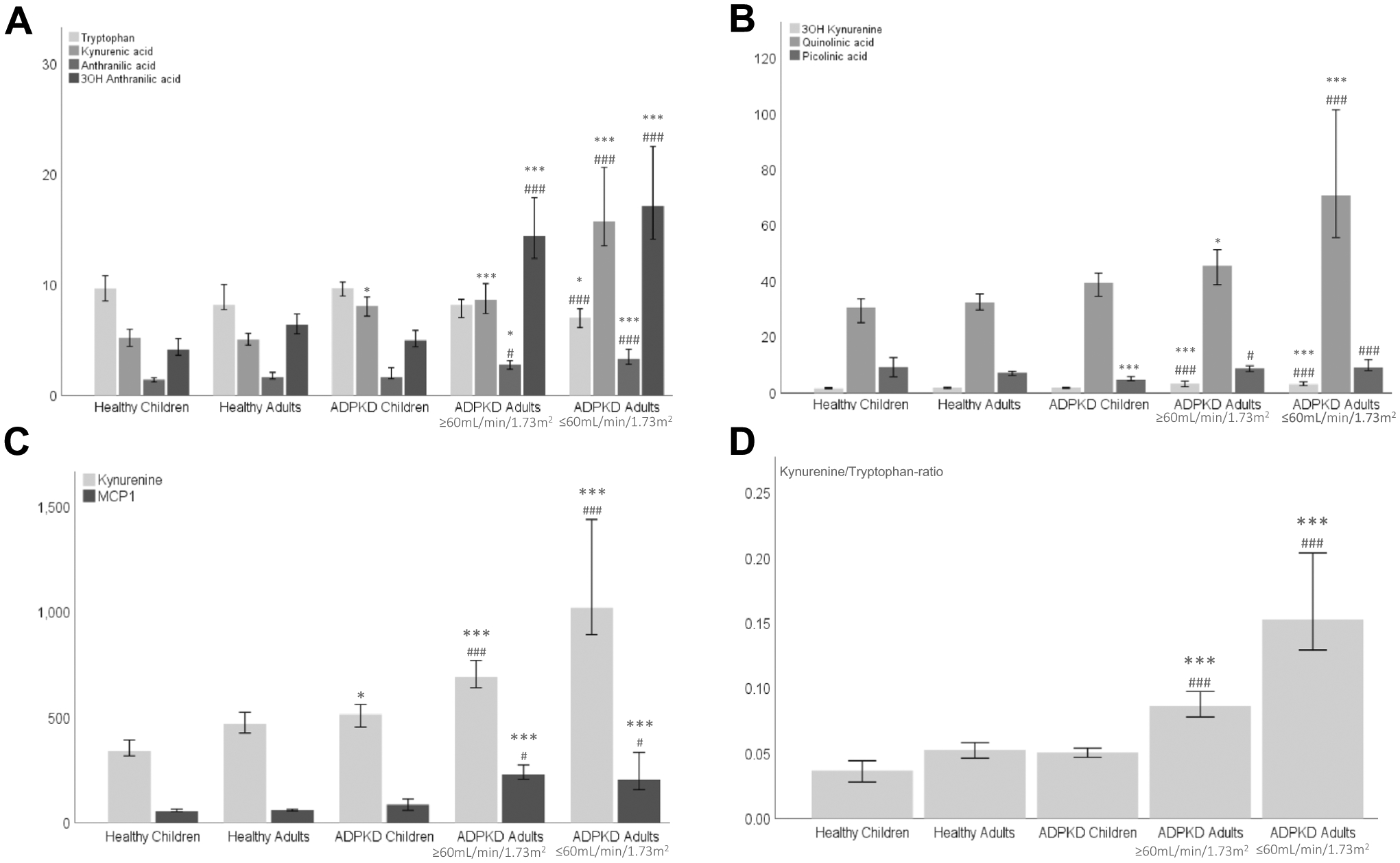
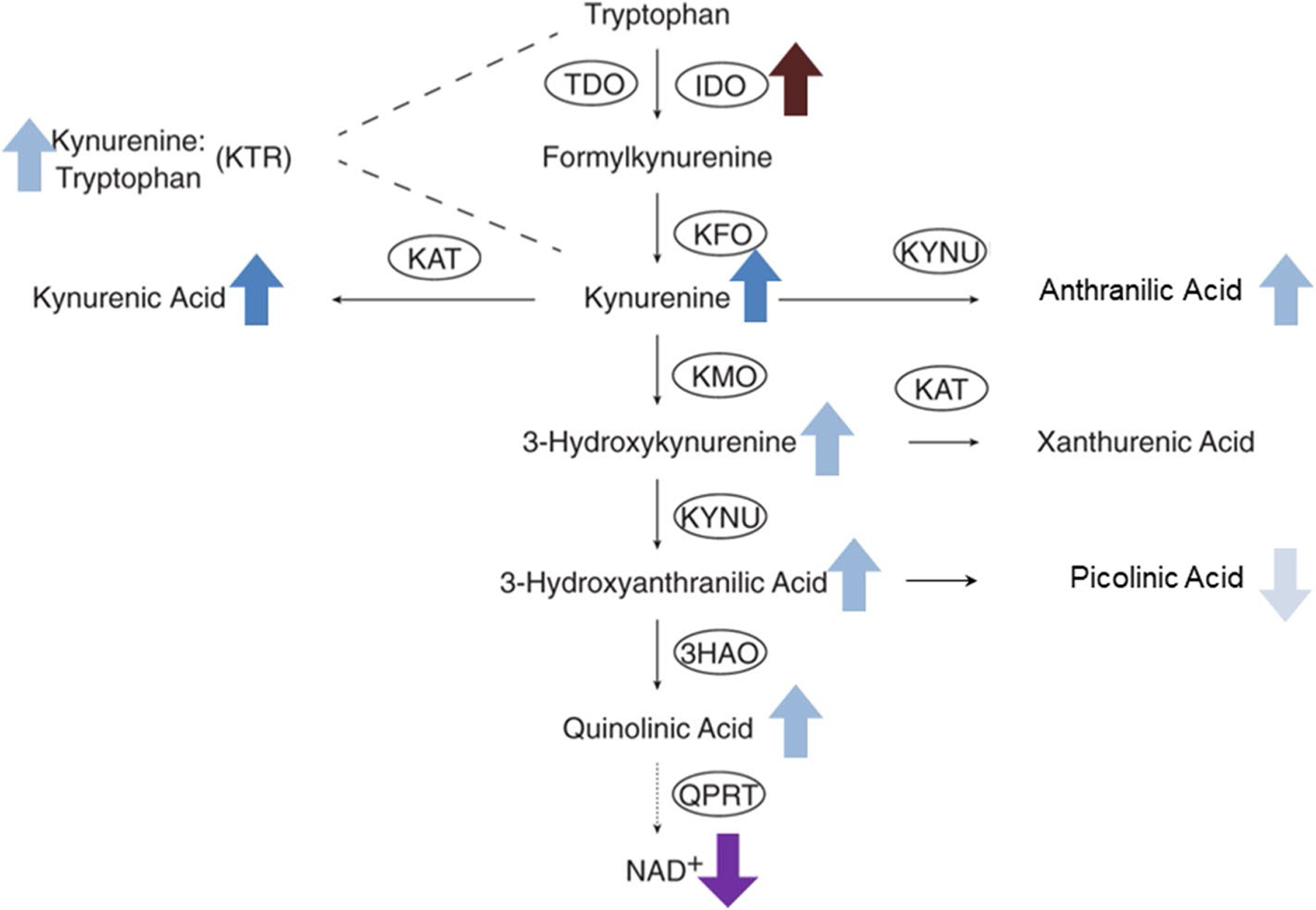
There was a significant accumulation of kynurenine and kynurenic acid (KYNA) in children and adults with ADPKD as compared to healthy subjects. Downstream kynurenines continued to accumulate in adults with ADPKD concurrent with the increase of inflammatory markers IL-6 and MCP-1. Both markers remained unchanged in ADPKD as compared to healthy children, suggesting alternate pathways responsible for the observed rise in kynurenine and KYNA. KYNA and kynurenine/tryptophan positively associated with disease severity (HtTKV or eGFR) in patients with ADPKD. After Bonferroni adjustment, baseline kynurenines did not associate with disease progression (yearly %change in HtTKV or yearly change in eGFR) in this limited number of patients with ADPKD.
Kynurenine metabolism seems dysregulated in ADPKD as compared to healthy subjects. Inhibition of kynurenine production by inhibition of main pathway enzymes could present a novel way to reduce the progression of ADPKD.
常染色体显性多囊肾病(ADPKD)是一种常见的遗传性疾病,其特征是肾脏囊肿的形成。ADPKD 的一个主要病理特征是间质炎症的发展。由于色氨酸代谢物及其相关的犬尿氨酸在炎症和氧化应激中的作用,它们在 ADPKD 中可能具有相关性。
从一个经过充分特征描述的儿科和成人 ADPKD 纵向队列中收集数据,并与年龄匹配的健康受试者进行比较。为了评估犬尿氨酸在 ADPKD 严重程度和进展中的作用,我们研究了它们与身高校正的总肾体积(HtTKV)和肾功能(估计肾小球滤过率(eGFR))的关系。使用经过验证的液相色谱-质谱联用法测定血浆中关键色氨酸代谢物。
与健康受试者相比,ADPKD 儿童和成人的犬尿氨酸和犬尿氨酸酸(KYNA)明显蓄积。下游犬尿氨酸在并发炎症标志物 IL-6 和 MCP-1 增加的情况下在 ADPKD 成人中继续蓄积。与健康儿童相比,ADPKD 中的这些标志物没有变化,这表明导致观察到的犬尿氨酸和 KYNA 升高的替代途径。KYNA 和犬尿氨酸/色氨酸与 ADPKD 患者的疾病严重程度(HtTKV 或 eGFR)呈正相关。在对 Bonferroni 进行调整后,在这个有限数量的 ADPKD 患者中,基线犬尿氨酸与疾病进展(HtTKV 的年变化率或 eGFR 的年变化率)无关。
与健康受试者相比,ADPKD 中的犬尿氨酸代谢似乎失调。通过抑制主要途径的酶来抑制犬尿氨酸的产生可能是减少 ADPKD 进展的一种新方法。