Department of Paediatrics and Adolescent Medicine, Lillebaelt Hospital, University Hospital of Southern Denmark, Kolding, Denmark.
Population Health Research Institute, St George's, University of London, London, United Kingdom.
PLoS One. 2022 Jul 22;17(7):e0269874. doi: 10.1371/journal.pone.0269874. eCollection 2022.
Congenital anomalies are a leading cause of childhood morbidity, but little is known about the long-term outcomes.
To quantify the burden of disease in childhood for children with congenital anomalies by assessing the risk of hospitalisation, the number of days spent in hospital and proportion of children with extended stays (≥10 days).
European population-based record-linkage study in 11 regions in eight countries including children with congenital anomalies (EUROCAT children) and without congenital anomalies (reference children) living in the same regions. The children were born between 1995 and 2014 and were followed to their tenth birthday or 31/12/2015. European meta-analyses of the outcome measures were performed by two age groups, <1 year and 1-4 years.
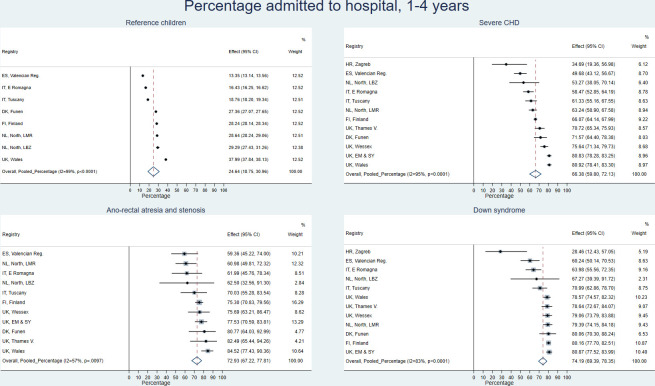
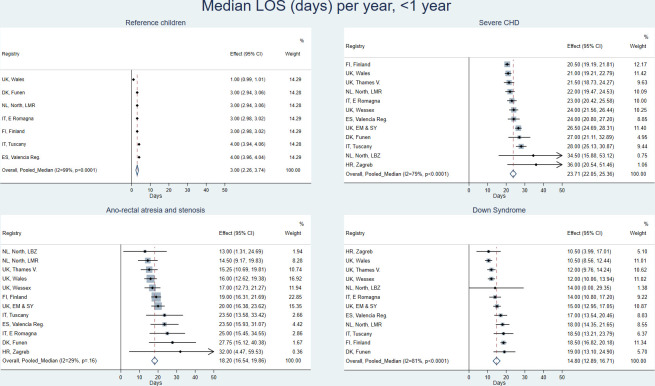
99,416 EUROCAT children and 2,021,772 reference children were linked to hospital databases. Among EUROCAT children, 85% (95%-CI: 79-90%) were hospitalised in the first year and 56% (95%-CI: 51-61%) at ages 1-4 years, compared to 31% (95%-CI: 26-37%) and 25% (95%-CI: 19-31%) of the reference children. Median length of stay was 2-3 times longer for EUROCAT children in both age groups. The percentages of children with extended stays (≥10 days) in the first year were 24% (95%-CI: 20-29%) for EUROCAT children and 1% (95%-CI: 1-2%) for reference children. The median length of stay varied greatly between congenital anomaly subgroups, with children with gastrointestinal anomalies and congenital heart defects having the longest stays.
Children with congenital anomalies were more frequently hospitalised and median length of stay was longer. The outlook improves after the first year. Parents of children with congenital anomalies should be informed about the increased hospitalisations required for their child's care and the impact on family life and siblings, and they should be adequately supported.
先天性畸形是导致儿童发病的主要原因,但人们对其长期后果知之甚少。
通过评估住院风险、住院天数以及住院时间延长(≥10 天)儿童的比例,量化先天性畸形儿童的疾病负担。
在 8 个国家的 11 个地区开展了一项基于人群的欧洲病历链接研究,纳入了患有先天性畸形的儿童(EUROCAT 儿童)和无先天性畸形的儿童(参照儿童),这些儿童都在同一地区出生,出生时间在 1995 年至 2014 年之间,随访至 10 岁生日或 2015 年 12 月 31 日。通过两个年龄组(<1 岁和 1-4 岁)对欧洲关于结局指标的荟萃分析进行了评估。
将 99416 名 EUROCAT 儿童和 2021772 名参照儿童与医院数据库进行了链接。在 EUROCAT 儿童中,85%(95%CI:79-90%)在 1 岁以内住院,56%(95%CI:51-61%)在 1-4 岁时住院,而参照儿童中分别为 31%(95%CI:26-37%)和 25%(95%CI:19-31%)。两组 EUROCAT 儿童的住院中位时间均延长了 2-3 倍。在 1 岁以内,EUROCAT 儿童中住院时间延长(≥10 天)的比例为 24%(95%CI:20-29%),而参照儿童中这一比例为 1%(95%CI:1-2%)。先天性异常亚组之间的住院中位时间差异很大,胃肠道异常和先天性心脏病患儿的住院时间最长。
患有先天性畸形的儿童更频繁地住院,住院中位时间也更长。在 1 岁以后,情况有所改善。应告知患儿家长其子女需要频繁住院治疗,以及这对家庭生活和兄弟姐妹的影响,并为其提供充分支持。