Medical Research Council Clinical Trials Unit, University College London, London, UK.
Department of Pharmacy, Radboud Institute for Health Sciences, Radboud University Medical Center, Nijmegen, Netherlands.
Lancet HIV. 2022 Sep;9(9):e627-e637. doi: 10.1016/S2352-3018(22)00160-6. Epub 2022 Jul 19.
Children with HIV-associated tuberculosis (TB) have few antiretroviral therapy (ART) options. We aimed to evaluate the safety and pharmacokinetics of dolutegravir twice-daily dosing in children receiving rifampicin for HIV-associated TB.
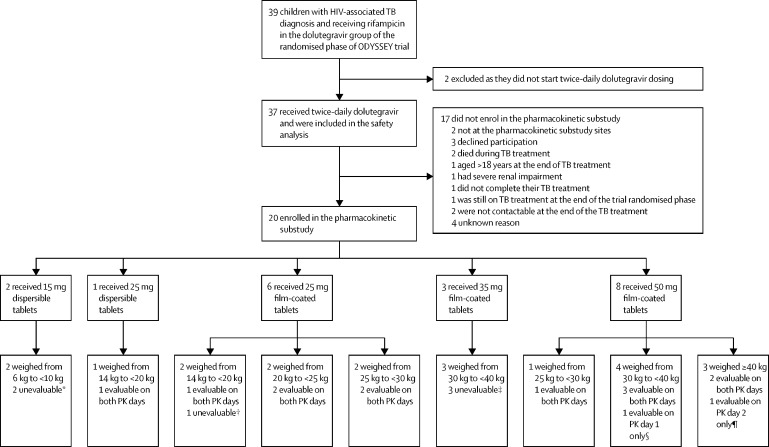
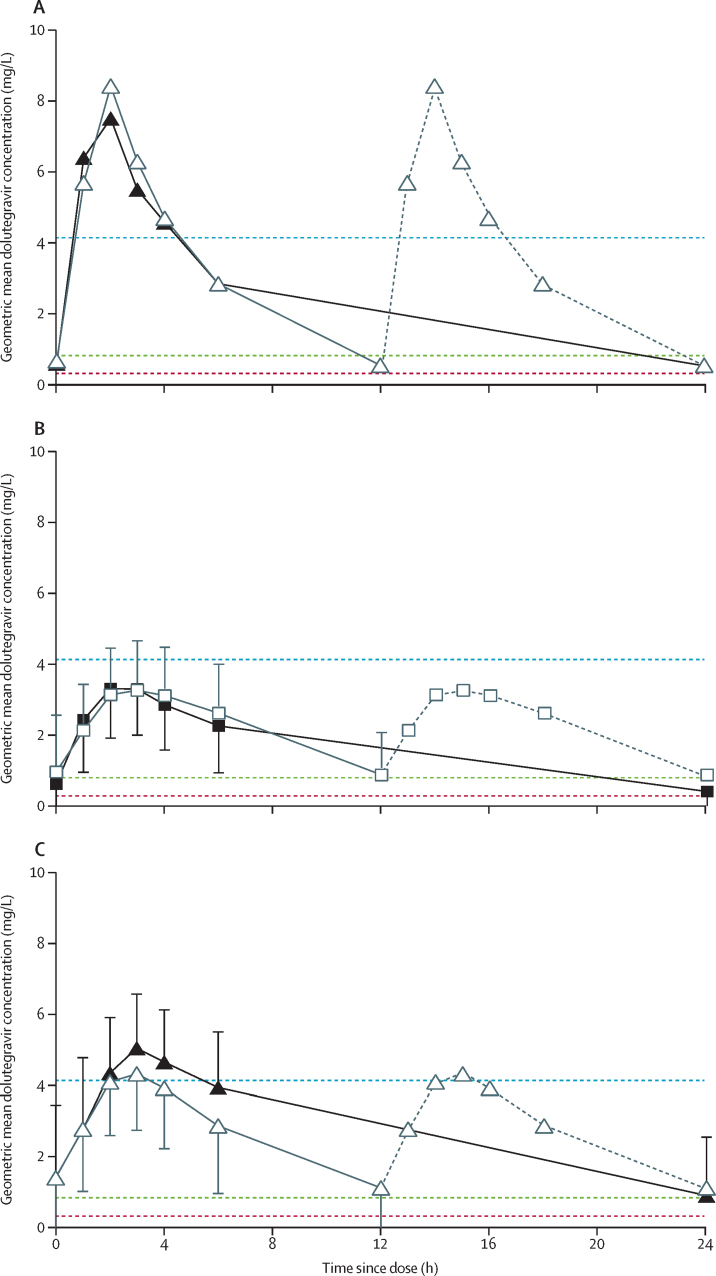
We nested a two-period, fixed-order pharmacokinetic substudy within the open-label, multicentre, randomised, controlled, non-inferiority ODYSSEY trial at research centres in South Africa, Uganda, and Zimbabwe. Children (aged 4 weeks to <18 years) with HIV-associated TB who were receiving rifampicin and twice-daily dolutegravir were eligible for inclusion. We did a 12-h pharmacokinetic profile on rifampicin and twice-daily dolutegravir and a 24-h profile on once-daily dolutegravir. Geometric mean ratios for trough plasma concentration (C), area under the plasma concentration time curve from 0 h to 24 h after dosing (AUC), and maximum plasma concentration (C) were used to compare dolutegravir concentrations between substudy days. We assessed rifampicin C on the first substudy day. All children within ODYSSEY with HIV-associated TB who received rifampicin and twice-daily dolutegravir were included in the safety analysis. We described adverse events reported from starting twice-daily dolutegravir to 30 days after returning to once-daily dolutegravir. This trial is registered with ClinicalTrials.gov (NCT02259127), EudraCT (2014-002632-14), and the ISRCTN registry (ISRCTN91737921).
Between Sept 20, 2016, and June 28, 2021, 37 children with HIV-associated TB (median age 11·9 years [range 0·4-17·6], 19 [51%] were female and 18 [49%] were male, 36 [97%] in Africa and one [3%] in Thailand) received rifampicin with twice-daily dolutegravir and were included in the safety analysis. 20 (54%) of 37 children enrolled in the pharmacokinetic substudy, 14 of whom contributed at least one evaluable pharmacokinetic curve for dolutegravir, including 12 who had within-participant comparisons. Geometric mean ratios for rifampicin and twice-daily dolutegravir versus once-daily dolutegravir were 1·51 (90% CI 1·08-2·11) for C, 1·23 (0·99-1·53) for AUC, and 0·94 (0·76-1·16) for C. Individual dolutegravir C concentrations were higher than the 90% effective concentration (ie, 0·32 mg/L) in all children receiving rifampicin and twice-daily dolutegravir. Of 18 children with evaluable rifampicin concentrations, 15 (83%) had a C of less than the optimal target concentration of 8 mg/L. Rifampicin geometric mean C was 5·1 mg/L (coefficient of variation 71%). During a median follow-up of 31 weeks (IQR 30-40), 15 grade 3 or higher adverse events occurred among 11 (30%) of 37 children, ten serious adverse events occurred among eight (22%) children, including two deaths (one tuberculosis-related death, one death due to traumatic injury); no adverse events, including deaths, were considered related to dolutegravir.
Twice-daily dolutegravir was shown to be safe and sufficient to overcome the rifampicin enzyme-inducing effect in children, and could provide a practical ART option for children with HIV-associated TB.
Penta Foundation, ViiV Healthcare, UK Medical Research Council.
患有 HIV 相关结核病(TB)的儿童可供选择的抗逆转录病毒治疗(ART)方案有限。我们旨在评估在接受利福平治疗 HIV 相关 TB 的儿童中,每日两次给予度鲁特韦的安全性和药代动力学。
我们在南非、乌干达和津巴布韦的研究中心进行的开放性、多中心、随机、对照、非劣效性 ODYSSEY 试验中,嵌套了一个为期两期、固定顺序的药代动力学亚研究。有 HIV 相关 TB 的儿童(年龄 4 周至<18 岁),正在接受利福平和每日两次度鲁特韦治疗,符合纳入条件。我们对利福平和每日两次度鲁特韦进行了 12 小时药代动力学分析,并对每日一次度鲁特韦进行了 24 小时分析。谷血浆浓度(C)、给药后 0 至 24 小时的血浆浓度时间曲线下面积(AUC)和最大血浆浓度(C)的几何均数比值用于比较亚研究日之间的度鲁特韦浓度。我们在第一次亚研究日评估了利福平的 C 值。所有在 ODYSSEY 试验中接受利福平和每日两次度鲁特韦治疗的 HIV 相关 TB 儿童均被纳入安全性分析。我们描述了从开始每日两次度鲁特韦治疗到恢复每日一次度鲁特韦治疗后 30 天报告的不良事件。这项试验在 ClinicalTrials.gov(NCT02259127)、EudraCT(2014-002632-14)和 ISRCTN 注册处(ISRCTN91737921)注册。
在 2016 年 9 月 20 日至 2021 年 6 月 28 日期间,有 37 名患有 HIV 相关 TB 的儿童(中位年龄 11.9 岁[范围 0.4-17.6],19[51%]为女性,18[49%]为男性,36[97%]在非洲,1[3%]在泰国)接受了利福平联合每日两次度鲁特韦治疗,并纳入安全性分析。37 名儿童中有 20 名(54%)参加了药代动力学亚研究,其中 14 名至少提供了一条可评估的度鲁特韦药代动力学曲线,包括 12 名有自身对照。利福平与每日两次度鲁特韦相比,每日一次度鲁特韦的谷血浆浓度(C)、AUC 和 C 的几何均数比值分别为 1.51(90%CI 1.08-2.11)、1.23(0.99-1.53)和 0.94(0.76-1.16)。所有接受利福平联合每日两次度鲁特韦治疗的儿童的个体度鲁特韦 C 浓度均高于接受利福平联合每日一次度鲁特韦治疗的儿童的 90%有效浓度(即 0.32mg/L)。在 18 名可评估利福平浓度的儿童中,15 名(83%)的 C 浓度低于 8mg/L 的最佳目标浓度。利福平的 C 几何均数为 5.1mg/L(变异系数为 71%)。在中位随访 31 周(IQR 30-40)期间,37 名儿童中有 15 名(30%)发生了 15 例 3 级或以上不良事件,8 名(22%)儿童发生了 10 例严重不良事件,包括 2 例死亡(1 例结核病相关死亡,1 例创伤性损伤相关死亡);没有不良事件,包括死亡,被认为与度鲁特韦有关。
每日两次度鲁特韦在儿童中表现出安全性和足够的效果,能够克服利福平酶诱导作用,可为 HIV 相关结核病的儿童提供一种实用的 ART 选择。
Penta 基金会、ViiV 医疗保健公司、英国医学研究理事会。