Department of Veterinary Parasitology, Lala Lajpat Rai University of Veterinary and Animal Sciences, Hisar, Haryana, 125004, India.
Parasitology Lab, ICAR-National Research Centre on Equines, Hisar, Haryana, 125001, India.
Trop Anim Health Prod. 2022 Jul 22;54(4):240. doi: 10.1007/s11250-022-03228-1.
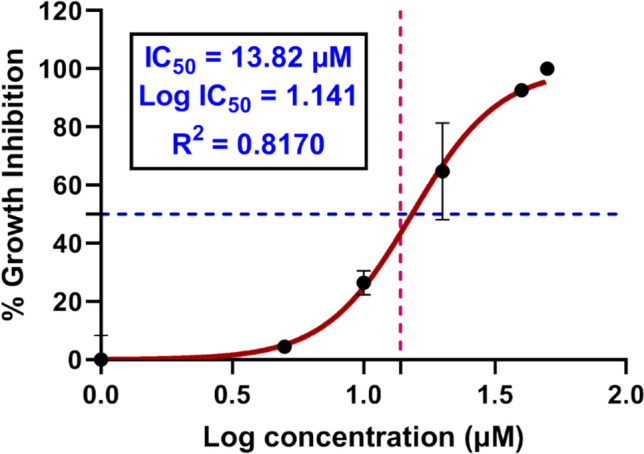
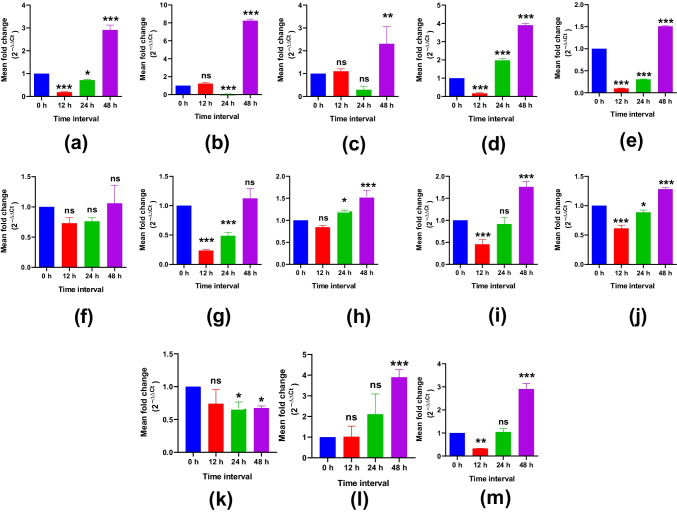
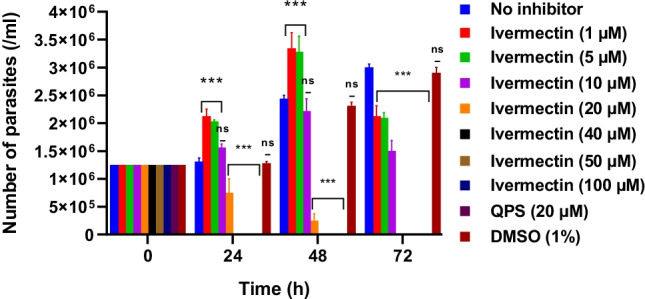
High cytotoxicity and increasing resistance reports of existing chemotherapeutic agents against T. evansi have raised the demand for novel, potent, and high therapeutic index molecules for the treatment of surra in animals. In this regard, repurposing approach of drug discovery has provided an opportunity to explore the therapeutic potential of existing drugs against new organism. With this objective, the macrocyclic lactone representative, ivermectin, has been investigated for the efficacy against T. evansi in the axenic culture medium. To elucidate the potential target of ivermectin in T. evansi, mRNA expression profile of 13 important drug target genes has been studied at 12, 24, and 48 h interval. In the in vitro growth inhibition assay, ivermectin inhibited T. evansi growth and multiplication significantly (p < 0.001) with IC values of 13.82 μM, indicating potent trypanocidal activity. Cytotoxicity assays on equine peripheral blood mononuclear cells (PBMCs) and Vero cell line showed that ivermectin affected the viability of cells with a half-maximal cytotoxic concentration (CC) at 17.48 and 22.05 μM, respectively. Data generated showed there was significant down-regulation of hexokinase (p < 0.001), ESAG8 (p < 0.001), aurora kinase (p < 0.001), casein kinase 1 (p < 0.001), topoisomerase II (p < 0.001), calcium ATPase 1 (p < 0.001), ribonucleotide reductase I (p < 0.05), and ornithine decarboxylase (p < 0.01). The mRNA expression of oligopeptidase B remains refractory to the exposure of the ivermectin. The arginine kinase 1 and ribonucleotide reductase II showed up-regulation on treatment with ivermectin. The ivermectin was found to affect glycolytic pathways, ATP-dependent calcium ATPase, cellular kinases, and other pathway involved in proliferation and maintenance of internal homeostasis of T. evansi. These data imply that intervention with alternate strategies like nano-formulation, nano-carriers, and nano-delivery or identification of ivermectin homologs with low cytotoxicity and high bioavailability can be explored in the future as an alternate treatment for surra in animals.
高细胞毒性和现有化疗药物对 T. evansi 耐药性的报道增加了对新型、有效和高治疗指数分子的需求,以治疗动物中的苏拉病。在这方面,药物发现的再利用方法为探索现有药物对新生物体的治疗潜力提供了机会。有鉴于此,已研究了大环内酯类代表伊维菌素对无细胞培养物中的 T. evansi 的功效。为了阐明伊维菌素在 T. evansi 中的潜在靶标,研究了 13 个重要药物靶基因的 mRNA 表达谱在 12、24 和 48 小时间隔。在体外生长抑制试验中,伊维菌素显著抑制 T. evansi 的生长和增殖(p < 0.001),IC 值为 13.82 μM,表明具有很强的杀锥虫活性。伊维菌素对马外周血单核细胞(PBMCs)和 Vero 细胞系的细胞毒性试验表明,伊维菌素以半最大细胞毒性浓度(CC)分别为 17.48 和 22.05 μM 影响细胞活力。生成的数据表明,己糖激酶(p < 0.001)、ESAG8(p < 0.001)、极光激酶(p < 0.001)、酪蛋白激酶 1(p < 0.001)、拓扑异构酶 II(p < 0.001)、钙 ATP 酶 1(p < 0.001)、核糖核苷酸还原酶 I(p < 0.05)和鸟氨酸脱羧酶(p < 0.01)的表达显著下调。寡肽 B 的 mRNA 表达对伊维菌素的暴露仍具有抗性。精氨酸激酶 1 和核糖核苷酸还原酶 II 在伊维菌素处理时上调。伊维菌素被发现可影响糖酵解途径、ATP 依赖性钙 ATP 酶、细胞激酶和其他参与 T. evansi 增殖和内部动态平衡维持的途径。这些数据表明,可以探索使用纳米制剂、纳米载体和纳米递药等替代策略,或寻找具有低细胞毒性和高生物利用度的伊维菌素同源物进行干预,作为动物苏拉病的替代治疗方法。