Institute for Genetics, University of Cologne, 50931, Cologne, Germany.
Centre for Molecular Medicine Cologne (CMMC), University of Cologne, 50931, Cologne, Germany.
Sci Rep. 2022 Jul 22;12(1):12538. doi: 10.1038/s41598-022-16737-8.
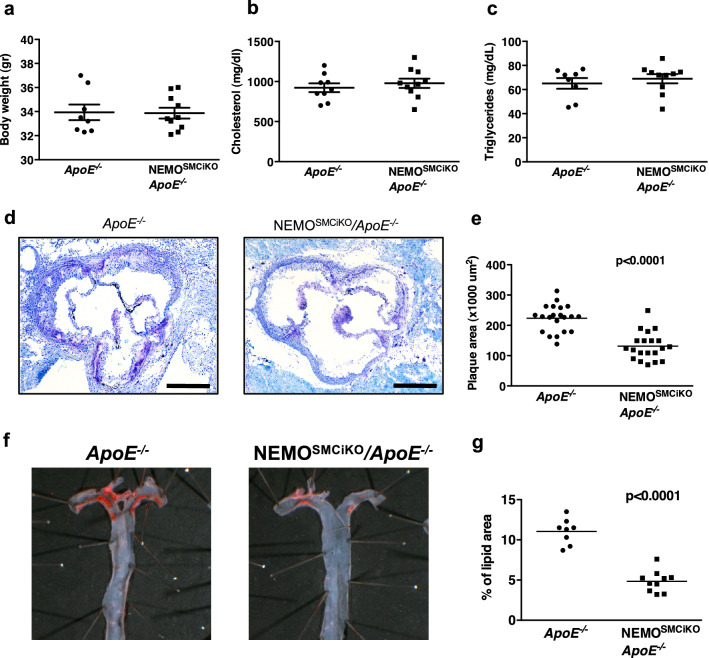
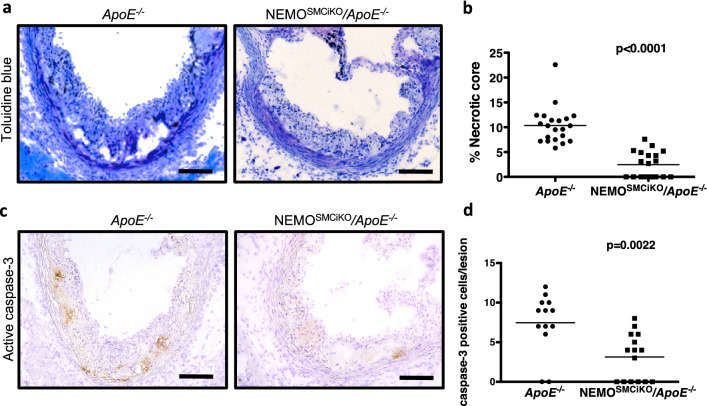
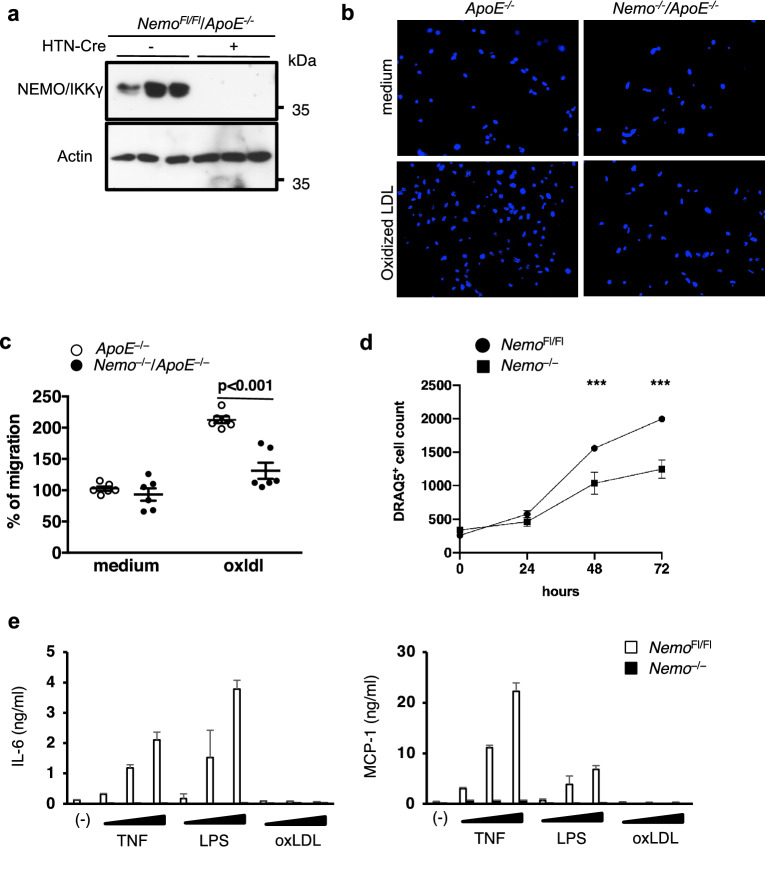
The development of atherosclerotic plaques is the result of a chronic inflammatory response coordinated by stromal and immune cellular components of the vascular wall. While endothelial cells and leukocytes are well-recognised mediators of inflammation in atherosclerosis, the role of smooth muscle cells (SMCs) remains incompletely understood. Here we aimed to address the role of canonical NF-κB signalling in SMCs in the development of atherosclerosis. We investigated the role of NF-κB signalling in SMCs in atherosclerosis by employing SMC-specific ablation of NEMO, an IKK complex subunit that is essential for canonical NF-κB activation, in ApoE mice. We show that SMC-specific ablation of NEMO (NEMO) inhibited high fat diet induced atherosclerosis in ApoE mice. NEMO/ApoE mice developed less and smaller atherosclerotic plaques, which contained fewer macrophages, decreased numbers of apoptotic cells and smaller necrotic areas and showed reduced inflammation compared to the plaques of ApoE mice. In addition, the plaques of NEMO/ApoE mice showed higher expression of α-SMA and lower expression of the transcriptional factor KLF4 compared to those of ApoE mice. Consistently, in vitro, NEMO-deficient SMCs exhibited reduced proliferation and migration, as well as decreased KLF4 expression and lower production of IL-6 and MCP-1 upon inflammatory stimulus (TNF or LPS) compared to NEMO-expressing SMCs. In conclusion, NEMO-dependent activation of NF-κB signalling in SMCs critically contributes to the pathogenesis of atherosclerosis by regulating SMC proliferation, migration and phenotype switching in response to inflammatory stimuli.
动脉粥样硬化斑块的形成是血管壁基质和免疫细胞成分协调的慢性炎症反应的结果。虽然内皮细胞和白细胞是动脉粥样硬化中炎症的公认介质,但平滑肌细胞(SMC)的作用仍不完全清楚。在这里,我们旨在研究经典 NF-κB 信号在动脉粥样硬化中 SMC 中的作用。我们通过在 ApoE 小鼠中特异性敲除 IKK 复合物亚基 NEMO 来研究 SMC 中 NF-κB 信号在动脉粥样硬化中的作用,NEMO 对于经典 NF-κB 的激活是必需的。我们发现,SMC 特异性敲除 NEMO(NEMO)抑制了 ApoE 小鼠高脂饮食诱导的动脉粥样硬化。与 ApoE 小鼠的斑块相比,NEMO/ApoE 小鼠的斑块更少、更小,巨噬细胞更少,凋亡细胞数量减少,坏死面积更小,炎症反应减轻。此外,与 ApoE 小鼠的斑块相比,NEMO/ApoE 小鼠的斑块中α-SMA 的表达更高,转录因子 KLF4 的表达更低。一致地,体外研究表明,与 NEMO 表达的 SMC 相比,NEMO 缺陷的 SMC 在炎症刺激(TNF 或 LPS)下表现出增殖和迁移减少,KLF4 表达降低,IL-6 和 MCP-1 的产生减少。总之,SMC 中 NEMO 依赖性 NF-κB 信号的激活通过调节 SMC 对炎症刺激的增殖、迁移和表型转换,对动脉粥样硬化的发病机制具有重要作用。