Division of Nephrology and Hypertension, Department of Internal Medicine, Universitas Indonesia/Dr. Cipto Mangunkusumo National Hospital, Jakarta, Indonesia.
Department of Internal Medicine, Universitas Indonesia/Dr. Cipto Mangunkusumo National Hospital, Jl. Pangeran Diponegoro No.71, Jakarta, 10430, Indonesia.
BMC Nephrol. 2022 Jul 22;23(1):259. doi: 10.1186/s12882-022-02890-9.
Gut microbiota dysbiosis in patients with chronic kidney disease on haemodialysis (CKD-HD) creates an increase in proteolytic bacteria activity, leading to an increase in the production of uraemic toxins, such as indoxyl sulphate, worsening of constipation symptoms and reducing patients' quality of life. Improving gut microbiota dysbiosis is expected to improve this condition. This study aimed to evaluate the effect of synbiotics on indoxyl sulphate levels, constipation symptoms, and constipation-related quality of life in haemodialysis patients.
This was a double-blinded randomized controlled clinical trial with a parallel design involving haemodialysis patients. We included chronic haemodialysis patients with gastrointestinal complaints, difficulty defecating, faeces with hard consistency, or a bowel movement frequency of fewer than three times per week. Patients were randomly divided into two groups (synbiotics (Lactobacillus acidophilus and Bifidobacterium longum 5x10 CFU) and placebo) for 60 days of oral intervention. All participants, caregivers, and outcome assessors were blinded to group assignment. The primary outcome was a decrease in indoxyl sulphate toxin levels. Meanwhile, improvement in constipation symptoms (measured using the Patient Assessment of Constipation: Symptoms (PAC-SYM) questionnaire) and improvement in constipation-related quality of life (measured using the Patient Assessment of Constipation Quality of Life (PAC-QOL) questionnaire) were assessed as secondary outcomes.
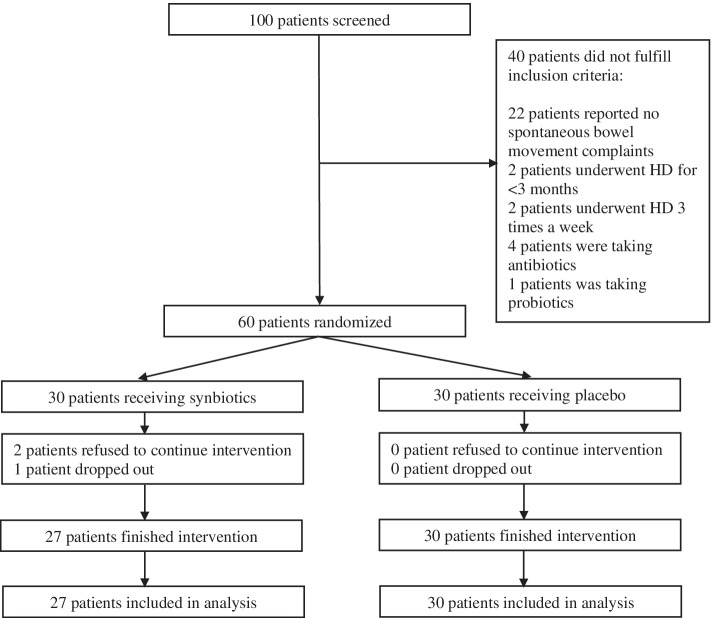
We included 60 patients (30 intervention; median age of 51.23 (13.57) years, 33.3% male; 30 control; median age of 52.33 (11.29) years, 36.7% male). There was no significant difference in terms of pre- and postintervention indoxyl sulphate toxin levels in the synbiotics group compared to the placebo group (p=0.438). This study found an improvement in constipation symptoms (p = 0.006) and constipation-related quality of life (p=0.001) after synbiotic administration.
Two months of synbiotic supplementation did not lower indoxyl sulphate toxin levels. Nevertheless, it had a major effect in improving constipation and quality of life affected by constipation in patients undergoing chronic haemodialysis.
NCT04527640 (date of first registration: 26/08/2020).
接受血液透析(HD)治疗的慢性肾脏病(CKD)患者肠道微生物群失调会导致蛋白水解细菌活性增加,从而导致尿毒素(如吲哚硫酸酯)的产生增加,加重便秘症状,并降低患者的生活质量。改善肠道微生物群失调有望改善这种情况。本研究旨在评估合生剂对血液透析患者吲哚硫酸酯水平、便秘症状和与便秘相关的生活质量的影响。
这是一项双盲随机对照临床试验,采用平行设计,纳入有胃肠道不适、排便困难、粪便质地坚硬或每周排便少于 3 次的慢性血液透析患者。将患者随机分为两组(合生剂(嗜酸乳杆菌和长双歧杆菌 5x10 CFU)和安慰剂)进行 60 天的口服干预。所有参与者、护理人员和结果评估人员均对分组情况不知情。主要结局是吲哚硫酸酯毒素水平降低。同时,评估便秘症状(使用患者便秘评估:症状(PAC-SYM)问卷)和与便秘相关的生活质量(使用患者便秘评估生活质量(PAC-QOL)问卷)的改善情况作为次要结局。
我们纳入了 60 名患者(30 名干预组;中位年龄 51.23(13.57)岁,33.3%为男性;30 名对照组;中位年龄 52.33(11.29)岁,36.7%为男性)。与安慰剂组相比,合生剂组治疗前后吲哚硫酸酯毒素水平无显著差异(p=0.438)。本研究发现,给予合生剂后,便秘症状(p=0.006)和与便秘相关的生活质量(p=0.001)均有改善。
两个月的合生剂补充剂并没有降低吲哚硫酸酯毒素水平。然而,它对改善慢性血液透析患者的便秘症状和受便秘影响的生活质量有显著作用。
NCT04527640(首次注册日期:2020 年 8 月 26 日)。