Systemic Autoimmune Diseases Unit, Vall d'Hebron General Hospital, Medicine Department, Universitat Autónoma de Barcelona, Barcelona, Spain.
Department of Clinical Immunology and Rheumatology, Sanjay Gandhi Postgraduate Institute of Medical Sciences, Lucknow, India.
Muscle Nerve. 2022 Oct;66(4):426-437. doi: 10.1002/mus.27681. Epub 2022 Aug 8.
INTRODUCTION/AIMS: In this study we investigated COVID-19 vaccination-related adverse events (ADEs) 7 days postvaccination in patients with idiopathic inflammatory myopathies (IIMs) and other systemic autoimmune and inflammatory disorders (SAIDs).
Seven-day vaccine ADEs were collected in an international patient self-reported e-survey. Descriptive statistics were obtained and multivariable regression was performed.
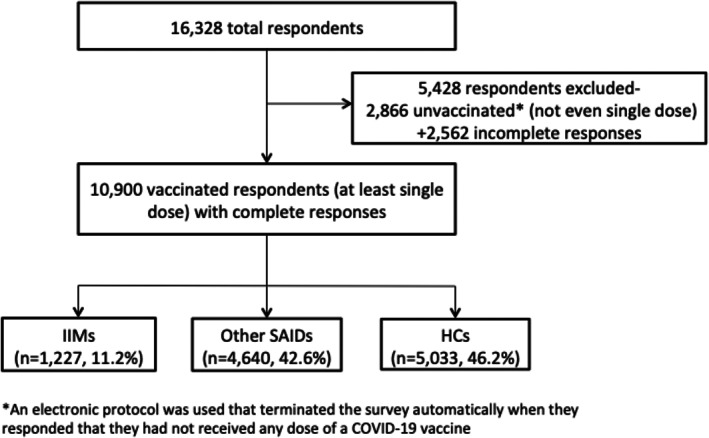
Ten thousand nine hundred respondents were analyzed (1227 IIM cases, 4640 SAID cases, and 5033 healthy controls [HCs]; median age, 42 [interquartile range, 30-455] years; 74% female; 45% Caucasian; 69% completely vaccinated). Major ADEs were reported by 76.3% of the IIM patients and 4.6% reported major ADEs. Patients with active IIMs reported more frequent major (odds ratio [OR], 2.7; interquartile range [IQR], 1.04-7.3) and minor (OR, 1.5; IQR, 1.1-2.2) ADEs than patients with inactive IIMs. Rashes were more frequent in IIMs (OR, 2.3; IQR, 1.2-4.2) than HCs. ADEs were not impacted by steroid dose, although hydroxychloroquine and intravenous/subcutaneous immunoglobulins were associated with a higher risk of minor ADEs (OR, 1.9; IQR, 1.1-3.3; and OR, 2.2; IQR, 1.1-4.3, respectively). Overall, ADEs were less frequent in inclusion-body myositis (IBM) and BNT162b2 (Pfizer) vaccine recipients.
Seven-day postvaccination ADEs were comparable in patients with IIMs, SAIDs, and HCs, except for a higher risk of rash in IIMs. Patients with dermatomyositis with active disease may be at higher risk, and IBM patients may be at lower risk of specific ADEs. Overall, the benefit of preventing severe COVID-19 through vaccination likely outweighs the risk of vaccine-related ADEs. Our results may inform future guidelines regarding COVID-19 vaccination in patients with SAIDs, specifically in those with IIMs. Studies to evaluate long-term outcomes and disease flares are needed to shed more light on developing future COVID-19 vaccination guidelines.
介绍/目的:本研究旨在调查接种 COVID-19 疫苗后 7 天内特发性炎性肌病(IIM)和其他系统性自身免疫和炎症性疾病(SAID)患者的疫苗相关不良事件(ADE)。
通过国际患者自我报告的电子调查收集 7 天疫苗 ADE。获得描述性统计数据并进行多变量回归。
分析了 10900 名受访者(1227 例 IIM 病例、4640 例 SAID 病例和 5033 例健康对照[HC];中位年龄 42 [四分位距 30-455] 岁;74%为女性;45%为白种人;69%完全接种疫苗)。76.3%的 IIM 患者报告了主要 ADE,4.6%报告了主要 ADE。活动性 IIM 患者比非活动性 IIM 患者更频繁地报告主要(优势比[OR],2.7;四分位距[IQR],1.04-7.3)和次要(OR,1.5;IQR,1.1-2.2)ADE。与 HC 相比,IMN 患者皮疹更常见(OR,2.3;IQR,1.2-4.2)。ADE 不受类固醇剂量的影响,但羟氯喹和静脉/皮下免疫球蛋白与较小 ADE 的风险增加相关(OR,1.9;IQR,1.1-3.3;和 OR,2.2;IQR,1.1-4.3)。总体而言,包涵体肌炎(IBM)和 BNT162b2(辉瑞)疫苗接种者的 ADE 发生频率较低。
除了 IIM 中皮疹风险较高外,IMN、SAID 和 HC 患者接种疫苗后 7 天的 ADE 相当。活动性皮肌炎患者的风险可能更高,而 IBM 患者特定 ADE 的风险可能更低。总体而言,通过接种疫苗预防严重 COVID-19 的益处可能超过疫苗相关 ADE 的风险。我们的研究结果可能为未来针对 SAID 患者,特别是 IIM 患者的 COVID-19 疫苗接种指南提供信息。需要研究来评估长期结果和疾病发作,以进一步阐明制定未来 COVID-19 疫苗接种指南。