Mary McKillop Institute for Health Research, Australian Catholic University, Melbourne, Australia.
Canadian Sport Institute Pacific, Victoria, Canada.
J Bone Miner Res. 2022 Oct;37(10):1915-1925. doi: 10.1002/jbmr.4658. Epub 2022 Aug 10.
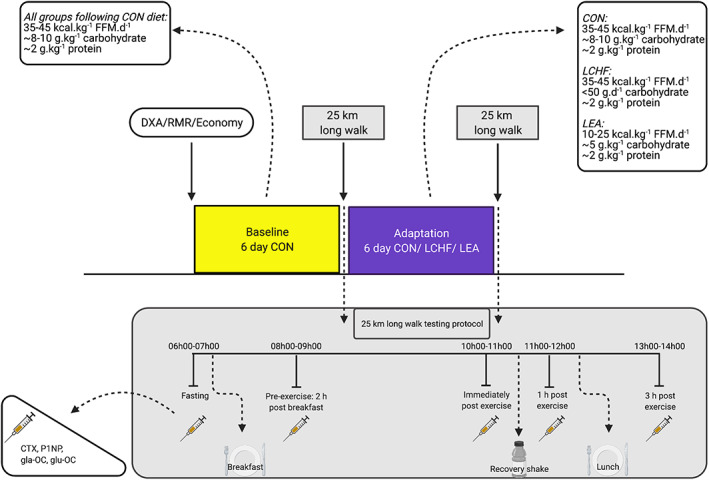
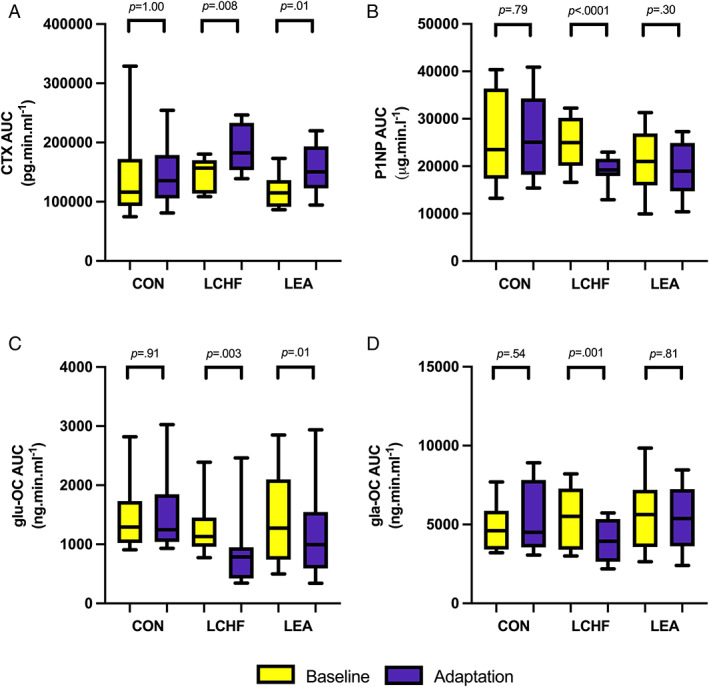
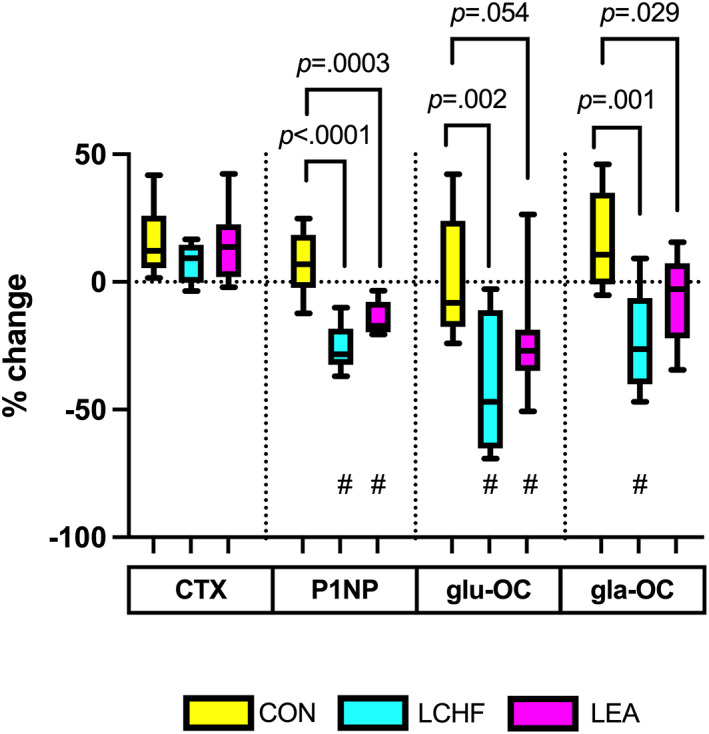
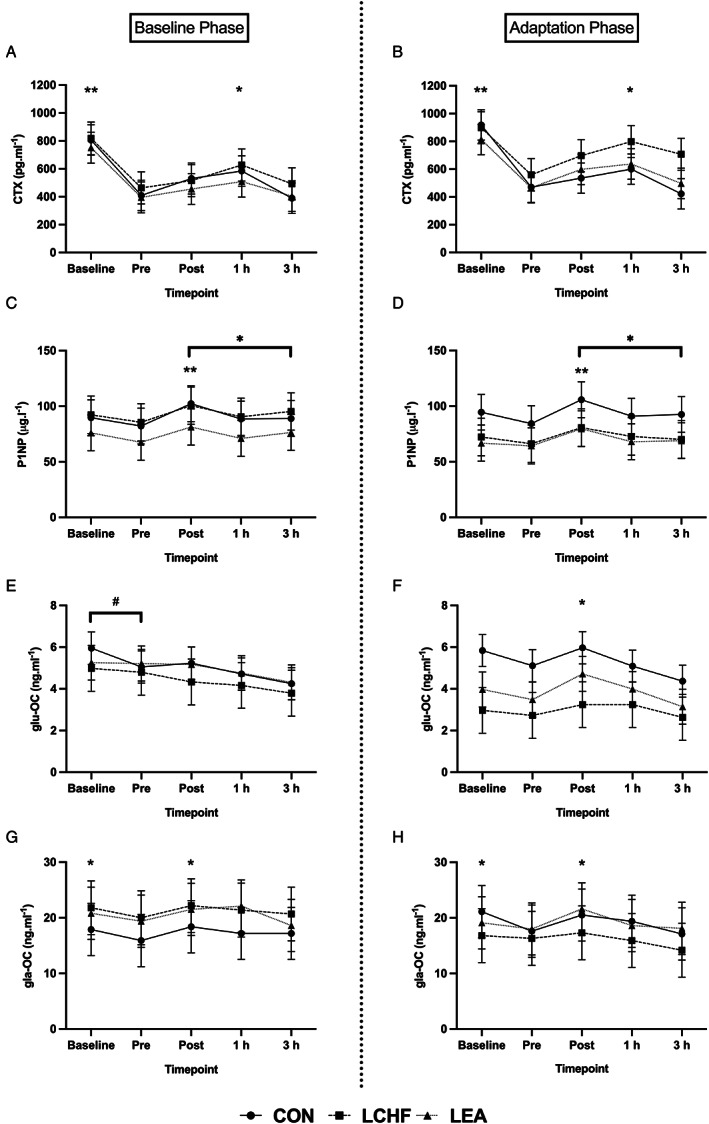
Bone stress injuries are common in athletes, resulting in time lost from training and competition. Diets that are low in energy availability have been associated with increased circulating bone resorption and reduced bone formation markers, particularly in response to prolonged exercise. However, studies have not separated the effects of low energy availability per se from the associated reduction in carbohydrate availability. The current study aimed to compare the effects of these two restricted states directly. In a parallel group design, 28 elite racewalkers completed two 6-day phases. In the Baseline phase, all athletes adhered to a high carbohydrate/high energy availability diet (CON). During the Adaptation phase, athletes were allocated to one of three dietary groups: CON, low carbohydrate/high fat with high energy availability (LCHF), or low energy availability (LEA). At the end of each phase, a 25-km racewalk was completed, with venous blood taken fasted, pre-exercise, and 0, 1, 3 hours postexercise to measure carboxyterminal telopeptide (CTX), procollagen-1 N-terminal peptide (P1NP), and osteocalcin (carboxylated, gla-OC; undercarboxylated, glu-OC). Following Adaptation, LCHF showed decreased fasted P1NP (26%; p < 0.0001, d = 3.6), gla-OC (22%; p = 0.01, d = 1.8), and glu-OC (41%; p = 0.004, d = 2.1), which were all significantly different from CON (p < 0.01), whereas LEA demonstrated significant, but smaller, reductions in fasted P1NP (14%; p = 0.02, d = 1.7) and glu-OC (~24%; p = 0.049, d = 1.4). Both LCHF (p = 0.008, d = 1.9) and LEA (p = 0.01, d = 1.7) had significantly higher CTX pre-exercise to 3 hours post-exercise but only LCHF showed lower P1NP concentrations (p < 0.0001, d = 3.2). All markers remained unchanged from Baseline in CON. Short-term carbohydrate restriction appears to result in reduced bone formation markers at rest and during exercise with further exercise-related increases in a marker of bone resorption. Bone formation markers during exercise seem to be maintained with LEA although resorption increased. In contrast, nutritional support with adequate energy and carbohydrate appears to reduce unfavorable bone turnover responses to exercise in elite endurance athletes. © 2022 The Authors. Journal of Bone and Mineral Research published by Wiley Periodicals LLC on behalf of American Society for Bone and Mineral Research (ASBMR).
骨应激损伤在运动员中很常见,导致他们训练和比赛的时间损失。能量摄入不足的饮食与循环骨吸收增加和骨形成标志物减少有关,尤其是在长时间运动后。然而,研究尚未将能量摄入不足的影响与相关的碳水化合物摄入减少分开。本研究旨在直接比较这两种限制状态的影响。在一项平行组设计中,28 名精英竞走运动员完成了两个 6 天的阶段。在基线阶段,所有运动员都遵循高碳水化合物/高能量摄入饮食(CON)。在适应阶段,运动员被分配到三个饮食组之一:CON、低碳水化合物/高脂肪高能量摄入(LCHF)或低能量摄入(LEA)。在每个阶段结束时,完成 25 公里竞走,在空腹、运动前和运动后 0、1、3 小时取静脉血,以测量羧基末端肽(CTX)、前胶原 1 N-端肽(P1NP)和骨钙素(羧基化, gla-OC;未羧基化, glu-OC)。适应后,LCHF 显示空腹 P1NP 降低约 26%(p<0.0001,d=3.6),gla-OC 降低约 22%(p=0.01,d=1.8),glu-OC 降低约 41%(p=0.004,d=2.1),均与 CON 显著不同(p<0.01),而 LEA 则显示空腹 P1NP 降低约 14%(p=0.02,d=1.7)和 glu-OC 降低约 24%(p=0.049,d=1.4)。LCHF(p=0.008,d=1.9)和 LEA(p=0.01,d=1.7)的 CTX 水平在运动前至运动后 3 小时均显著升高,但只有 LCHF 显示 P1NP 浓度降低(p<0.0001,d=3.2)。CON 组所有标志物在基线时均无变化。短期碳水化合物限制似乎会导致休息和运动时骨形成标志物降低,进一步增加与运动相关的骨吸收标志物。尽管吸收增加,但 LEA 似乎能维持运动时的骨形成标志物。相比之下,在精英耐力运动员中,充足的能量和碳水化合物的营养支持似乎可以减少运动对骨代谢的不利影响。