School of Health and Rehabilitation Sciences, Division of Occupational Therapy, The Ohio State University, Columbus, USA.
College of Social Work, The Ohio State University, Columbus, USA.
Implement Sci. 2022 Jul 23;17(1):49. doi: 10.1186/s13012-022-01216-5.
Academic institutions building capacity for implementation scholarship are also well positioned to build capacity in real world health and human service settings. How practitioners and policy makers are included and trained in implementation capacity-building initiatives, and their impact on building implementation practice capacity is unclear. This scoping review identified and examined features of interventions that build implementation practice capacity across researchers and practitioners or practitioners-in-training.
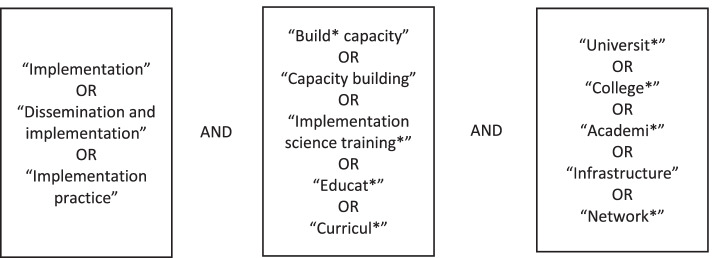
Five bibliographic databases were searched. Eligible studies (a) described an implementation capacity building intervention with a connection to an academic institution, (b) targeted researchers and practitioners (including practitioners-in-training, students, or educators), and (c) reported intervention or participant outcomes. Articles that only described capacity building interventions without reporting outcomes were excluded. Consistent with Arksey and O'Malley's framework, key study characteristics were extracted (target participants, core components, and outcomes) and analyzed using open coding and numerical analysis.
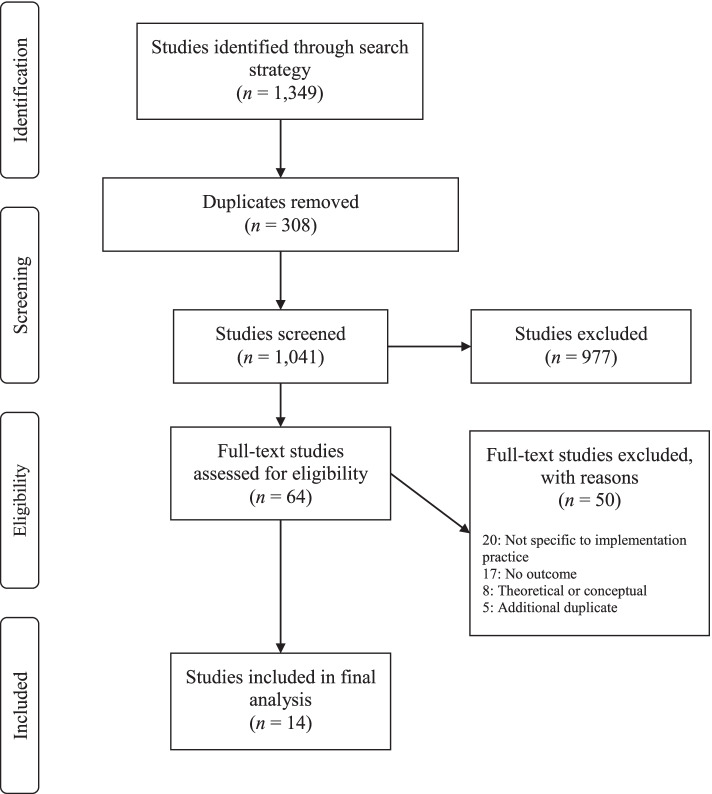
Of 1349 studies identified, 64 met eligibility for full-text review, and 14 were included in the final analysis. Half of the studies described implementation capacity building interventions that targeted health or behavioral health researchers, practitioners, and practitioners-in-training together, and half targeted practitioners or practitioners-in-training only. The most common components included structured didactic activities offered in person or online, mentorship and expert consultation to support implementation, and practical application activities (e.g., field placements, case studies). Knowledge sharing activities and technical assistance were less common. All studies reported favorable outcomes related to knowledge attainment, increased ability to implement evidence, productivity, and satisfaction.
Building implementation capacity among practitioners is critical for integrating insights from implementation science into the field and preventing the "secondary" implementation research-to-practice gap. This scoping review identified several promising implementation practice capacity building interventions that tend to build practitioner capacity via expert led activities which may be relevant for academic institutions seeking to build implementation practice capacity. To avoid widening the implementation research-to-practice gap, implementation capacity building interventions are needed that target policy makers, expand beyond multiple practice settings, and leverage university/community partnerships or on-site academic medical centers. Future studies will also be needed to test the impact on service quality and public health outcomes.
致力于实施学术研究的学术机构也非常适合在现实世界的健康和人类服务环境中建立能力。在实施能力建设计划中,从业者和政策制定者是如何被纳入并接受培训的,以及他们对建设实施实践能力的影响尚不清楚。本范围综述确定并检查了针对研究人员和从业者(包括从业者培训师、学生或教育工作者)的实施实践能力建设干预措施的特征。
搜索了五个文献数据库。符合条件的研究(a)描述了与学术机构有联系的实施能力建设干预措施,(b)针对研究人员和从业者(包括从业者培训师、学生或教育工作者),(c)报告了干预或参与者的结果。仅描述能力建设干预措施而未报告结果的文章被排除在外。根据 Arksey 和 O'Malley 的框架,提取了关键研究特征(目标参与者、核心组成部分和结果),并使用开放式编码和数值分析进行分析。
在 1349 项研究中,有 64 项符合全文审查标准,有 14 项被纳入最终分析。一半的研究描述了针对健康或行为健康研究人员、从业者和从业者培训师的实施能力建设干预措施,另一半仅针对从业者或从业者培训师。最常见的组成部分包括面对面或在线提供的结构化教学活动、支持实施的指导和专家咨询以及实际应用活动(例如,实地考察、案例研究)。知识共享活动和技术援助则较少。所有研究都报告了与知识获取、实施证据能力提高、生产力和满意度相关的有利结果。
在从业者中建立实施能力对于将实施科学的见解纳入该领域并防止“二次”实施研究与实践之间的差距至关重要。本范围综述确定了一些有前途的实施实践能力建设干预措施,这些措施倾向于通过专家主导的活动来建立从业者的能力,这可能与寻求建立实施实践能力的学术机构相关。为了避免扩大实施研究与实践之间的差距,需要针对政策制定者的实施能力建设干预措施,扩大到多个实践环境,并利用大学/社区伙伴关系或现场学术医疗中心。未来的研究也将需要测试对服务质量和公共卫生结果的影响。