Basic Science Department, AUC School of Medicine, Philipsburg, Sint Maarten.
Surg Radiol Anat. 2022 Aug;44(8):1147-1156. doi: 10.1007/s00276-022-02988-7. Epub 2022 Jul 24.
We hypothesized that the cranial phenotype influences the shape of the posterior cranial fossa and the relative position of the sigmoid sinus.
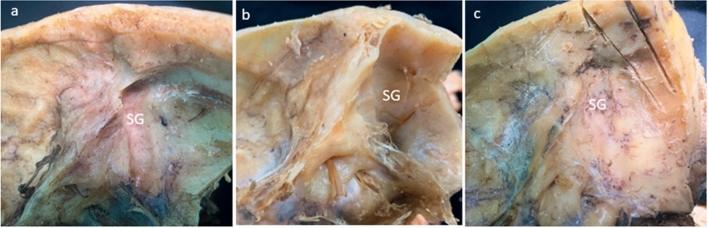
The topography of the sigmoid sinus was studied on 26 magnetic resonance venograms and 35 embalmed cadavers by morphometric analysis, dissection, and photo modeling techniques.
The data show that the transverse diameter of the posterior cranial fossa correlates positively with the laterolateral diameter of the skull. The majority of cases with the low-anterior position of the sigmoid sinus were recorded in the brachycephalic group (82%), while the high-posterior localization of the sigmoid sinus was typical for the dolichocephalic patients (63%). The results of the ANOVA test confirm the significance of differences.
The shape of the skull reflects the morphology of the posterior cranial fossa and influences the topographic characteristics of the sigmoid sinus that must be considered in the selection of surgical approach to the inner ear and pontocerebellar angle.
我们假设颅面表型会影响颅后窝的形状和乙状窦的相对位置。
通过形态测量分析、解剖和照片建模技术,在 26 例磁共振静脉造影和 35 例防腐尸体上研究了乙状窦的形态。
数据显示,颅后窝的横径与颅骨的内外径呈正相关。大多数乙状窦位置靠前的病例出现在短头型(82%)中,而乙状窦位置靠后的病例则主要出现在长头型(63%)中。方差分析的结果证实了差异的显著性。
颅骨的形状反映了颅后窝的形态,并影响乙状窦的解剖特征,在选择内耳和桥脑小脑角的手术入路时必须考虑到这一点。