Prosty Connor, Gabrielli Sofianne, Ben-Shoshan Moshe, Le Michelle, Giménez-Arnau Ana M, Litvinov Ivan V, Lefrançois Philippe, Netchiporouk Elena
Faculty of Medicine, McGill University, Montreal, QC, Canada.
Division of Allergy, Immunology and Dermatology, Montreal Children's Hospital, Montreal, QC, Canada.
Front Med (Lausanne). 2022 Jul 7;9:926753. doi: 10.3389/fmed.2022.926753. eCollection 2022.
The immunopathogenesis of chronic spontaneous urticaria (CSU) is poorly understood, but recent research suggests that patients can be divided into autoallergic and autoimmune subtypes. Given that not all patients can be controlled with current treatment regimens, including anti-IgE monoclonal antibodies, a better understanding of the immune pathways involved in CSU may enable the repurposing of monoclonal antibodies used for other dermatologic diseases (e.g., Th2 and Th17 inhibitors). Therefore, we investigated the implicated immune cells and pathways by reanalyzing publicly available transcriptomic data.
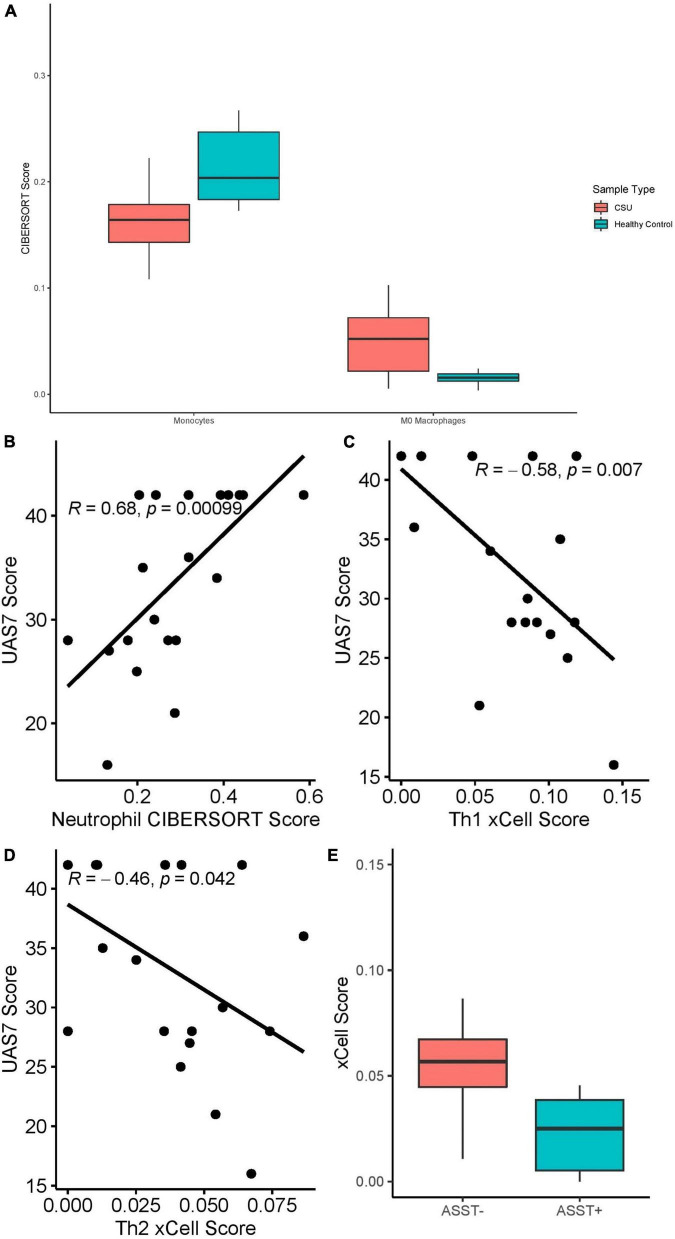
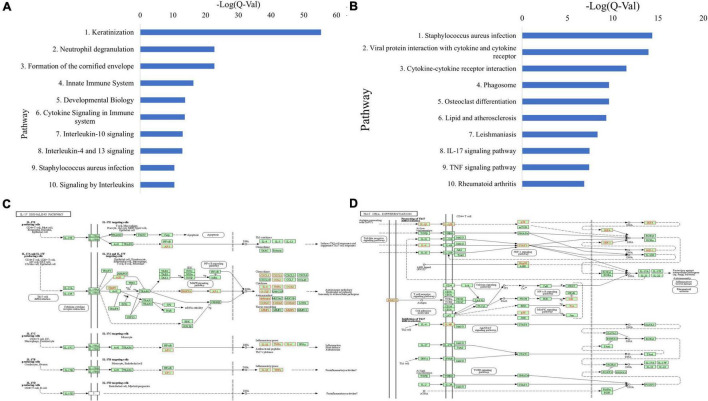
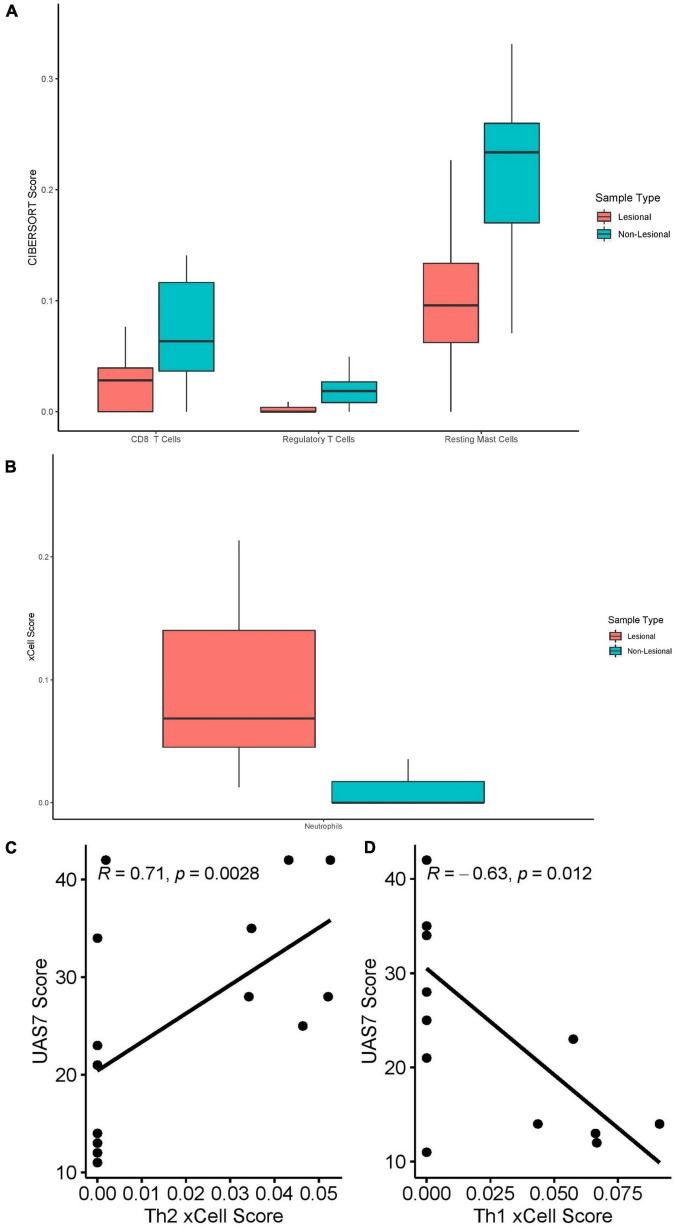
Microarray data of CSU and healthy control (HC) skin and blood were obtained from the Gene Expression Omnibus (GSE72542, GSE57178). Differentially expressed genes were defined as a false discovery rate <0.05 and a |log fold change| ≥1. Pathway analyses were conducted using ToppGene and KEGG. Cell-type enrichment was determined by CIBERSORT and xCell and was correlated with clinical characteristics.
Th2 (IL-4/13 signaling) and Th17-related (IL-17/23 signaling) pathways were upregulated in lesional compared to non-lesional and HC samples. In non-lesional versus lesional samples, CIBERSORT analysis revealed increased regulatory T-cells (Treg) and resting mast cells. xCell analysis established that Th1 and Th2 scores were not significantly different between lesional and HC samples. However, Th2 scores in both lesional and non-lesional samples correlated positively with disease severity. Few differentially expressed genes and pathways were identified between CSU and HC blood samples.
Our results support the involvement of Th2 and Th17-related genes and pathways in CSU. Th2 scores associate with disease severity, which indicates the clinical relevance of these findings. Increased resting mast cell and Treg scores in non-lesional samples may suggest local suppression of wheal formation. Moreover, disease activity seemed to be restricted to the skin as there were limited findings from blood. Larger studies using next-generation sequencing will be helpful to confirm these results.
慢性自发性荨麻疹(CSU)的免疫发病机制尚不清楚,但最近的研究表明,患者可分为自身过敏性和自身免疫性亚型。鉴于并非所有患者都能通过包括抗IgE单克隆抗体在内的现有治疗方案得到控制,更好地了解CSU中涉及的免疫途径可能有助于重新利用用于其他皮肤病(如Th2和Th17抑制剂)的单克隆抗体。因此,我们通过重新分析公开可用的转录组数据来研究相关的免疫细胞和途径。
从基因表达综合数据库(GSE72542、GSE57178)获取CSU和健康对照(HC)皮肤及血液的微阵列数据。差异表达基因定义为错误发现率<0.05且|对数倍变化|≥1。使用ToppGene和KEGG进行通路分析。通过CIBERSORT和xCell确定细胞类型富集情况,并将其与临床特征相关联。
与非皮损和HC样本相比,皮损样本中Th2(IL-4/13信号通路)和Th17相关(IL-17/23信号通路)通路上调。在非皮损与皮损样本中,CIBERSORT分析显示调节性T细胞(Treg)和静息肥大细胞增加。xCell分析表明,皮损样本与HC样本之间的Th1和Th2评分无显著差异。然而,皮损和非皮损样本中的Th2评分均与疾病严重程度呈正相关。在CSU和HC血液样本之间鉴定出的差异表达基因和通路较少。
我们的结果支持Th2和Th17相关基因及通路参与CSU。Th2评分与疾病严重程度相关,这表明这些发现具有临床相关性。非皮损样本中静息肥大细胞和Treg评分增加可能提示对风团形成的局部抑制。此外,由于血液中的发现有限,疾病活动似乎仅限于皮肤。使用下一代测序的更大规模研究将有助于证实这些结果。